
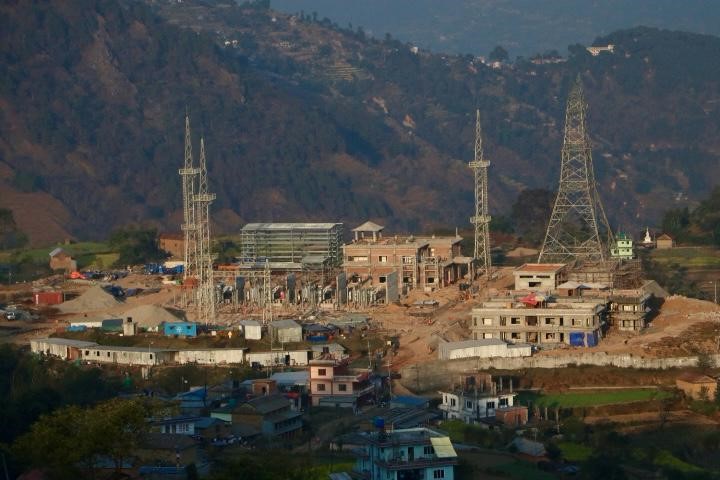
In Bojheni, a village in the northeastern part of the Kathmandu Valley, the Nepal Electricity Authority (NEA), with financial investment from the Asian Development Bank (ADB), is constructing a hydropower substation and five hydropower towers of the Upper Tamakoshi Hydropower Project for the distribution of three different high voltage transmission lines of electricity 400 KV, 220 KV, and 132 KV for a number of hydropower projects. The NEA had acquired approximately 70 ropani (3.5 hectares) of land from local families in 2015 to build the infrastructure. Strategically significant for energy distribution, Bojheni is also the ancestral land of the Indigenous Tamang communities.
For the Tamang communities of Bojheni, this land is not merely a resource or property but a legacy of inherited livelihoods and cultural memory integral to their identity and heritage. For many households, the land remains their primary means of subsistence, passed down from ancestors and carrying with it a rich history, culture, and knowledge system. For Tara, a Tamang woman, the patch of land now covered by a large building and a substation was once her family’s means of subsistence, passed down from her husband’s ancestors. For 25 years, she grew corn, rice, wheat, and vegetables that sustained her household throughout the year. She recalls, ‘I tilled the land for 25 years. Now, I can’t even tell where it once was, it has been buried by a building in just two years.’
Bojheni has been Tara’s home since she married into the village as a teenager 25 years ago. When the hydropower project acquired Tara’s and her neighbours’ land and began constructing a substation and transmission towers on the fields she once cultivated, Tara herself was drawn into resisting the project. Her resistance to the state-led hydropower project in defence of her land and livelihood has become a continuous emotional, legal, and social form of labour. Her experience offers a glimpse into how Indigenous people are governed through the production of prolonged uncertainty in their everyday lives.
From legal resistance to everyday confrontation
The Tamang communities in Bojheni have opposed the construction of the substation and transmission line, demanding its relocation since 2015. They resisted the project quietly and persistently through administrative applications, political negotiations, and community delegations sent to the NEA ward and municipal offices to relocate the project. Tara did not initially take part in these processes and efforts.
On 1 January 2023, she stepped into the protests for the first time, holding a placard as NEA officials arrived with engineers and security forces in Bojheni to conduct a land survey and mark the beginning of construction.

When I first met Tara by chance on a road in Bojheni during my initial research visit in the spring of 2023, she returned to that particular day repeatedly. She recalled that the locals began a peaceful protest demanding the relocation of the substation and its associated infrastructure from their land. However, the protest was abruptly disrupted by police intervention. Officers pushed protesters back, threatened them at gunpoint, and manhandled those who refused to disperse. By the end of the confrontation, twelve protestors and two Nepal Police personnel were injured. Seven people from the village, including women and a minor, were arrested. For Tara, this moment marked the beginning of what she described as her ‘active protest’.
After that day, resistance in Bojheni took on a different rhythm. Protest no longer remained confined to meetings, petitions, and delegations. It entered everyday life through peaceful protests along construction sites and roadsides, repeated confrontations, and the intensified presence of police in the village. This was not a departure from the long-standing legal and political struggle. Rather, the protest escalated as a consequence of years of neglect by the state apparatus toward the concerns and demands of the local community. The Upper Tamakoshi Hydropower Project, along with its associated infrastructure, highlights how state-led development practices aimed at advancing the production of green energy conflict with the rights and livelihoods of Indigenous communities. While hydropower is promoted as a path to prosperity in Nepal, it has displaced Indigenous communities and accelerated cultural erosion and the loss of ancestral lands.
Uncertainty as everyday governance
Despite continued resistance from locals, the NEA pushed forward with construction behind barbed wire and under police protection. Armed police personnel are stationed at the substation and tower construction sites. When the NEA began constructing hydropower towers in January 2025 on land belonging to families who had neither agreed to the project nor accepted compensation, protests once again escalated into violent confrontation. Eighteen locals were arrested. Six of them, including Tara, continue to face charges of public property damage at the Kathmandu District Court.
Recalling the incident, she explained, ‘We tried to chase away the excavator to stop it from tilling the land to build the tower. That was when we threw stones at the excavator.’ Her attempt to stop the excavator became the reason for her arrest, detention in police custody for three days, and an ongoing legal battle.
‘My life has been stuck around this case, counting the days and waiting for the next three months.’ For Tara, her legal battle against the state has become a prolonged condition of waiting rather than a pathway to justice.
Tara now appears in court every three months, with each hearing extending the case without resolution. ‘Even now, there is no certainty about whether we will receive a clean acquittal,’ she shared. ‘I no longer trust the police, the court, or their intentions.’

The prolonged repetition of these court appearances, combined with uncertainty surrounding both the outcome and the timing of verdicts, reinforces for her the sense that resistance to state-initiated projects is punishable and leads to an uncertain future. Sociologist Javier Auyero suggests that such waiting is not administrative delay but a technique of rule. In Bojheni, the state governs protesters through prolonged legal charges with uncertain timelines and outcomes, where people like Tara become examples of how state governs Indigenous people when they voice opposition to state-led development projects.
This uncertainty extends beyond Tara to her family. Although her husband was not involved in any physical confrontation, his role in organising protests, and negotiating with officials led to the issuance of an arrest warrant. Tara explained, ‘The police are just waiting for an incident to arrest him.’
Her husband is one of six people in the village currently living under the threat of arrest. To avoid it, her husband tries to limit encounters with the police, though this is not always possible as the police station is located close to their home. Whenever her husband participates in community meetings or neighbourhood discussions, Tara and her family remain alert, watching the police, fearing the possibility of his arrest. Her family now lives under constant threat, monitoring police presence, and reorganising daily life to avoid encounters. Tara’s family situation reflects what anthropologist Veena Das frames as latent violence, where the state exercises power through unpredictability and suspended decision-making rather than direct coercion. Procedural uncertainty has reshaped Tara’s daily life, care for family members, and social relationships, producing chronic anxiety and constrained agency.
Infrastructure, uncertain future, and anxiety
During my return to Bojheni in September 2025, Tara asked if I still had the photographs we had taken in 2023 on the land acquired by the NEA for the substation. When I showed them to her, she fell silent for a moment and said, ‘This beautiful land has turned into concrete towers. It aches my heart more than the legal charges I am facing.’
She gestured toward the substation and the towers standing in the middle of the village and said, ‘We have been living with the very hydro infrastructures we have been resisting for ten years.’ Tara was unsettled not only by what had already been built in her land and village, but by what remained uncertain.
She further said, ‘When I think about what will happen if the project is completed...’, and her questions followed one after another, ‘How would we live beneath high-voltage transmission lines stretching over our homes and fields? Would it be possible to farm under the wires? Could daily life continue with a substation with high voltage electricity standing in our courtyard? Is survival guaranteed under the constant presence of electricity?’

I had no answers for Tara, and I believe her questions were not seeking immediate answers either. In between the conversation, Tara repeatedly asks: ‘Ke hunchha hola hai (Wonder what will happen next?).’ Her questions reveal deep anxiety about the future, produced by the perceived dangers of high-voltage hydropower infrastructure. The lives of Tara and other residents of Bojheni reflect the condition of living with the unfinished state-led development project, where hydropower infrastructure has already transformed the landscape of Bojheni, yet the consequences for health, livelihood, life, and community remain uncertain.
In Bojheni, resistance to the construction of substations and transmission towers for the Upper Tamakoshi Project is articulated not only through experiences of loss of land, culture, history, memory, and sovereignty, but also through anxiety produced by infrastructural risk, as high-voltage hydropower infrastructure makes the future of everyday life and livelihoods uncertain. This anxiety resonates with anthropologist Arjun Appadurai’s argument that the future is the cultural and political field shaped by unequal access to security and aspiration. For Tara and her community in Bojheni, state-led hydropower infrastructure produces a future that is precarious and unpredictable, generating anticipatory anxiety and chronic waiting. In this way, uncertainty itself becomes a form of governance, structuring how they live, plan, resist, and imagine their futures.
Resistance as continuous labour
Nepal’s energy transition from eighteen hours of daily loadshedding a decade ago to current claims of energy sufficiency and ambitions to become a green energy exporter is celebrated through metrics such as megawatts produced, projects in the pipeline, and projected economic growth from hydropower production. But for the Tamang communities in Bojheni, the costs are evident not only in the loss of land, sovereignty, and livelihoods, but also in uncertain futures, emotional fatigue, and the normalisation of anxiety as a condition of citizenship. The state has compelled Tamang communities to live alongside hydropower infrastructure they have opposed for over a decade, without resolution. Despite deliberate efforts to repress resistance, people in Bojheni continue to oppose the project at multiple scales. Drawing on development scholars Ian Scoones and Andy Stirling, such uncertainty can be understood as constructed through knowledge, materiality, embodied experience, and everyday practice. The struggle in Bojheni thus reflects not only resistance to material dispossession but also opposition to the state’s ongoing production of uncertainty.

As studies of infrastructure have highlighted, development projects are political technologies shaping power through space, time, and everyday life, producing consequences long after construction begins. In Bojheni, hydropower infrastructure has become a tool for dispossessing the Indigenous community of their land and a permanent condition of uncertainty rather than a completed project. The near-completion of the substation and towers does not mark success; instead, it exposes a deeper contradiction in Nepal’s development practices, where infrastructure is built without local acceptance and legitimacy remains unsettled.
Resistance in Bojheni shows that marginalisation is not only material or cultural. It also occurs through prolonged uncertainty, turning opposition into continuous emotional, legal, and social labour. For Tara, this labour unfolds in everyday life: counting months between court hearings, monitoring police presence near her home, and wondering how her family will live beneath the transmission lines. Her repeated question, Ke hunchha hola hai? (Wonder what will happen next?) reflects how hydropower projects have unsettled the future.
The state has weaponised uncertainty to push the project forward despite local resistance. Indigenous resistance in Bojheni is therefore not only a political struggle to defend land and livelihood but also a form of labour, produced by the state’s slow governance, emotional fatigue, and the prolonged anxiety of ordinary people like Tara.
