
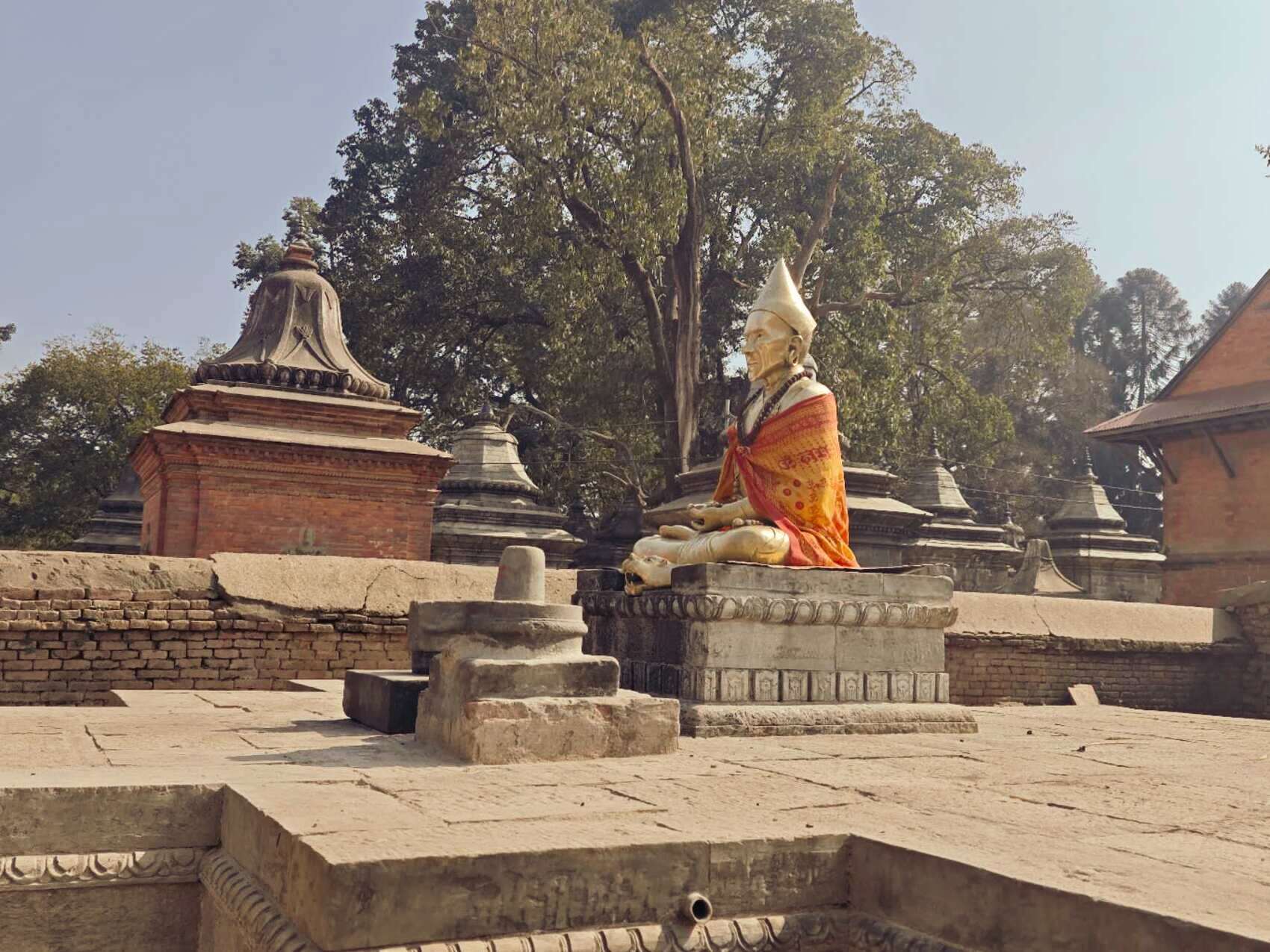
To trace the intellectual history of the Hindu nationalist ideology in Nepal requires an understanding of the role played by one person—Yogi Naraharinath. It was he who took the initiative to institutionalise the idea of Hindu nationalism that existed erstwhile only in scattered form in the country. His contribution to the governing philosophy of Nepal as a Hindu nation remained strong until Nepal was declared a secular state in 2006.
As a political ideology, Hindu nationalism began taking shape in India during the anti-colonial freedom struggle. In Nepal, although the advent of the Hindu polity can be traced as far back as the Malla period when King Jayasthiti Malla (r. 1382–1395) codified the varna system, the state structure had not been interpreted under the framework of Hindu nationalist ideology until the modern era. The Panchayat constitution of 1962 officially declared Nepal a Hindu state. However, it was Yogi Naraharinath, a polymath with contributions in archaeology, history, philosophy, politics, Ayurveda and literature, who provided ideological depth to Hindu nationalism in Nepal.
During his frequent travels throughout Nepal and India, Yogi Naraharinath collected many manuscripts and documents, particularly related to Nepali history and Hindu culture. Recognising his contributions to shaping Hindu nationalism in the Nepali context, he is celebrated as Rastriya Guru (National Teacher) by Hindu nationalist organisations in Nepal such as Hindu Swayamsevak Sangh (HSS).
Birth of an ideologue
Yogi Naraharinath was born Balbir Singh Riksen Thapa on 28 February 1915 in Lalugaun in what is now Naraharinath Rural Municipality in Kalikot district of Karnali province. According to his travelogue, he had gone on pilgrimages to several Hindu deities, including in Manasarovar, when he was only eight years old. He received his basic education from Jumla, where he underwent renunciation and received the name ‘Naraharinath’.
He sought further education in Banaras, Lahore, Ludhiana and Haridwar of undivided India where he studied the Vedas, classical Sanskrit texts, and Hindu philosophy, making him a staunch activist of the Hindu nationalist movement. In India, Yogi Naraharinath actively participated in the movement against cow slaughter—a movement deeply intertwined with the rise of Hindu nationalism.
Historian Janak Lal Sharma remembered Yogi Naraharinath as a learned man with a wide knowledge of Sanskrit classic literature and Hindu theology. His mastery of the Sanskrit language enabled him to gain a deeper understanding of Hindu classical texts.

After Yogi Naraharinath returned to Nepal in 1947, then Rana prime minister Juddha Shumsher provided him with four ropani land at Mrigasthali on the hill near Pashupatinath temple to establish the Gorakhnath Peeth. That was where he continued his activities for the rest of his life until his demise at the age of 88. He has been entombed near the Peeth.
During the Panchayat system, Yogi Naraharinath served as an intellectual pillar aligned with the Hindu monarchical foundation of the prevailing political system. He did have reservations regarding certain Panchayat policies such as the New Education Policy that, he argued, westernised the Nepali society, overshadowing Hindu traditions and culture. However, he remained an ideological leader of the Panchayat system.
Yogi Naraharinath amalgamated Nepali nationalism with Hindu nationalism and defined ‘patriotism’ in Nepal as following the Hindu religion, culture, lifestyle, and morality. He equated being a Nepali citizen with one who follows Hindu-ness and this interpretation worked as the cultural roots of Panchayat nationalism.
In March 1966, the Brihat Adhyatmik Parishad was established under the leadership of Yogi Naraharinath at a conference held in Dang district where King Mahendra shared his worries about the degrading spirituality among Nepalis. The prime objective of the Parishad was to promote spirituality. Yogi Naraharinath soon organised spiritual conferences in major urban centres of Nepal, which were essentially politico-cultural mass mobilisations with ministers, political figures, and members of the royal family and the elite class participating. The Parishad used to publish Vishwatma Darshan,a monthly magazine containing articles on the Vedas, Hindu morality, Ayurveda, the Sanskrit language, the Hindu nation and nationality. Such activities worked as the cultural scaffolds of the Panchayat system, consolidating and spreading the image of Nepal as a true and vibrant Hindu nation.
Likewise, in 1974, a state-subsidised Sanskrit school, the Nepal Ved Vidhyashram, was established under the instruction of King Mahendra, and similar schools in different parts of Nepal served as ‘ideal vehicles to promote Hindu Nationalism’. The Mahendra Sanskrit University was established in 1986 in Dang district to strengthen Hindu nationhood by popularising Hindu morality of which the Sanskrit language served as the backbone. Yogi Naraharinath himself took an active initiative to establish and run the Vidhyashram and the University, though in later years, he was not satisfied with the way the University was being run.
In April 1980, Yogi Naraharinath became the chief of the Vishwa Hindu Sangh amid the global meeting of Sanatan Dharma Omkar followers at Birgunj and, through the organisation, he initiated a series of the grand Hindu fire ritual, the kotihom, in Nepal and India. It was a part of an initiation led by the Sanatan Dharma Sewa Samiti under the leadership of the then Queen with the objective to ‘revive, redefine, sustain and expand Hindu spiritualism’. Yogi Naraharinath used the kotihoms as a tool to expand Hindu-ness and to consolidate Nepal as a Hindu nation. Between 1980 and 2002, a total of 114 kotihoms were organised in Nepal and certain places in India.
Defining the Hindu and the Hindu Nation
In his articles, Yogi Naraharinath has defined ‘Hindu’ as those who follow the Omkar mantra(that is, those who follow the Sanatanadharma, Buddhism, Jainism and other religions that celebrate ‘Om’ as the starting point of the universe), worship the cow as a mother, celebrate the Sanskrit language, and respect the Vedas as the origin of knowledge.
In the booklet written in Hindi, Vedic Siddhanta, Yogi Naraharinath has glorified the Hindu religion as a human religion (manav dharma) and described Hindus as enlightened beings following an Aryan civilisation, wherein he interpreted ‘Arya’ as progressives. It is characteristic of Hindu nationalists to rank the Arya civilisation and the Hindu religion very high as is glorification of the Vedas. All Hindu nationalists believe the Vedas to be the superior achievement of human civilisation and assert that all human knowledge originated from the Vedas. In his essay from the early 1960s, ‘Hami Hindu Houn’ (We are Hindus), Yogi Naraharinath describes the Vedas as the most supreme level of knowledge: ‘All other religions are branches and sub-branches of it. All other religions are fruitful because of Vedic nourishment.’

While glorifying the Vedas, Naraharinath linked the scriptures with Nepali nationalism, connecting them with the Himalaya of Nepal. Similarly, the Indian Hindu nationalist ideologues, Vinayak Damodar Savarkar and K.B. Hedgewar, identified geography as an essential factor of the Hindu nation. They had drawn boundaries of what they said was Hindu or Arya land. Although Yogi Naraharinath was not clear and consistent about the boundary of the Arya land, for him, the land roughly from the Himalaya to Jambudeep (i.e., the Indian subcontinent) is a Hindu nation. He called it the Land of the Gods, the Land of Sages, the Land of the Arya, and the origin land of Hindus; hence, Hindustan.
As a staunch advocate of the Hindu nation, Yogi Naraharinath believed India should also be declared a Hindu nation. He even wrote a letter to the then Indian Prime Minister, Atal Behari Vajpayee, in 1996 in the Sanskrit language, demanding the declaration of India as a Hindu state. Making India a Hindu nation has been a long-awaited mission of Hindu nationalist forces in India, including Vajpayee’s own Bharatiya Janata Party (BJP).
Yogi Naraharinath articulated his views on the Hindu nation and Hindu nationalism in an appeal during the All-Nepal Hindu Dharma Conference in 1974:
A Hindu nation is the cultural unity centre of all Hindus throughout the world. Hindu nation is own home of all Hindus. There is no guest and no servant in home…Hindu nation is not a foreign land for any Hindu. Moreover, for Hindu nation Bharat (India) the Himali Hindu nation (Nepal) cannot be a foreign land and for Hindu nation Hindustan cannot be a foreign land. …Nepal and India can never be foreign land mutually. Political borders are temporary—it keeps on extending and contracting. But dharma is unbounded, eternal, unending and unbroken.
Nepali Nationalism as part of Hindu Nationalism
Yogi Naraharinath had widely explored Nepali history and culture to strengthen the image of Nepal as a Hindu nation. His travelogue, Hamro Desh-Darshan, describes the significance of temples, shrines, mountains, and religious places all over Nepal, highlighting their historical and cultural importance. His descriptions of such religious places are intended to elaborate Nepal’s image as a Hindu nation, connecting meanings of the varied geography and culture in Nepal with the Hindu religion and civilisation.
Among the widespread contributions of Yogi Naraharinath to different sectors of knowledge creation, his enrichment of Nepali history is of prime importance. The decade of 1950s–1960s was his most active period devoted to historical exploration of Nepal. He used to reach many places on foot, observe places first-hand, and collect relevant historical documents as primary sources for his writings. He started the Itihas Prakash Mahamandal in 1945 intending to research, collect and write on Nepali history. A total of seven volumes of historical collections under the title Sandhipatra were published under his name and it is said there are 75 other volumes of a similar kind that are yet to be published.
Among the listed 534 works that Yogi Naraharinath authored, 247 are the genealogies (vanshawali) of different communities in Nepal. He used the vanshawali as a way of linking communities, castes, and ethnicities within the Hindu framework in order to strengthen the Hindu nationalist outlook.
The publication of Prithvi Narayan Shah’s Divya Upadesh helped Yogi Naraharinath on his mission to strengthen Nepal as a cradle of Hindu religion and so the ideal Hindu nation. Prithvi Narayan Shah’s description of Nepal as the ‘True Hindustan’ (Asli Hindustan), not having been contaminated by any foreign aggression, provided the historical grounds to interpret Nepali nationalism as equalling Hindu nationalism.

Among the historians in Nepal, it was Yogi Naraharinath at the forefront of presenting Hindu-ness as the mainstream of Nepali history. The interpretation of Nepali history as the history of Hindu nationalism took to heights during the Panchayat period. Yogi Naraharinath’s historical explorations provided cultural and ideological approval to the Panchayat monarchical system and strengthened the discourse of the Nepali king as the king of all Hindus and Nepal as a Hindu nation.
During my field visit to the Gorakhnath Peeth in July 2025, a disciple of Yogi Naraharinath drew my attention to a heap of moth-eaten and decayed documents, haphazard piles of books—most of them written by Naraharinath—inside the CGI-roofed building which had served as his residence before his demise. After his demise, the building was kept locked for many years by the Guthi Sansthan, the government office responsible for the conservation of historical and cultural property. In the absence of preservation, these records have literally been destroyed, the disciple said.
Yogi Naraharinath was accused of engaging in politics in the guise of a yogi. As a supporter of the Panchayat system, he enjoyed privileges from the government of the time. But with the end of the Panchayat system in 1990, he was sidelined by the new political elites. He could also not afford to be as active because of his advanced age.
Against proselytisation
Like other Hindu nationalist ideologues, Yogi Naraharinath staunchly opposed Christianity and Islam in Nepali society. In his booklet, Vedic Siddhanta, he presented Muslims as a threat to Hindus and called on Hindus to awaken to protect the purity of Hinduism. He wrote, ‘Your house is on fire! Mother Cow is being slaughtered. Hindu girls have been kidnapped. Mosques are being built on the temples. But silence prevails in your holy land. And you are still snoring! Why are you all wasting time? Awake, Oh, Hindu! Awake!’
He differentiated Christianity and Islamism from Hinduism and other religions that had originated in ‘Hindustan’. In an interview from 1999, he said that there is no difference between Hinduism and Buddhism but refuted Christianity and Islamism, which, according to Naraharinath, consider Hindus dharmaheen, karmaheen, and nitiheen (lacking religion, duty, and principles).
Yogi Naraharinath’s staunch dislike for ‘alien religions’ manifested in his strong opposition to the New Education Policy introduced in 1971. That was one of the main disagreements he had with the Panchayat regime. He argued that the policy widened Western influences in Nepal, threatening the country’s identity as a Hindu nation. In a 1999 interview, he opposed the adoption of western-style education as an ‘imitation of foreigners’ that had dismantled the Hindu educational norms and values of a Hindu Nepal. In Vedic Samyavad (Vedic Communism), Yogi Naraharinath discusses the model of the Vedic education system which emphasises spiritual development as opposed to Western education’s focus on material aspects.
Conclusion
Yogi Naraharinath represented a period when Nepal was consolidating its image as a Hindu nation. The Panchayat period was the heyday of the Yogi Naraharinath-led Hindu nationalist activism that helped the system build an image of an ideal Hindu state. His research supported the political mission of the regime to establish Nepal as a Hindu nation even as he engaged in propagating Hindu nationalist ideas in the country.
