

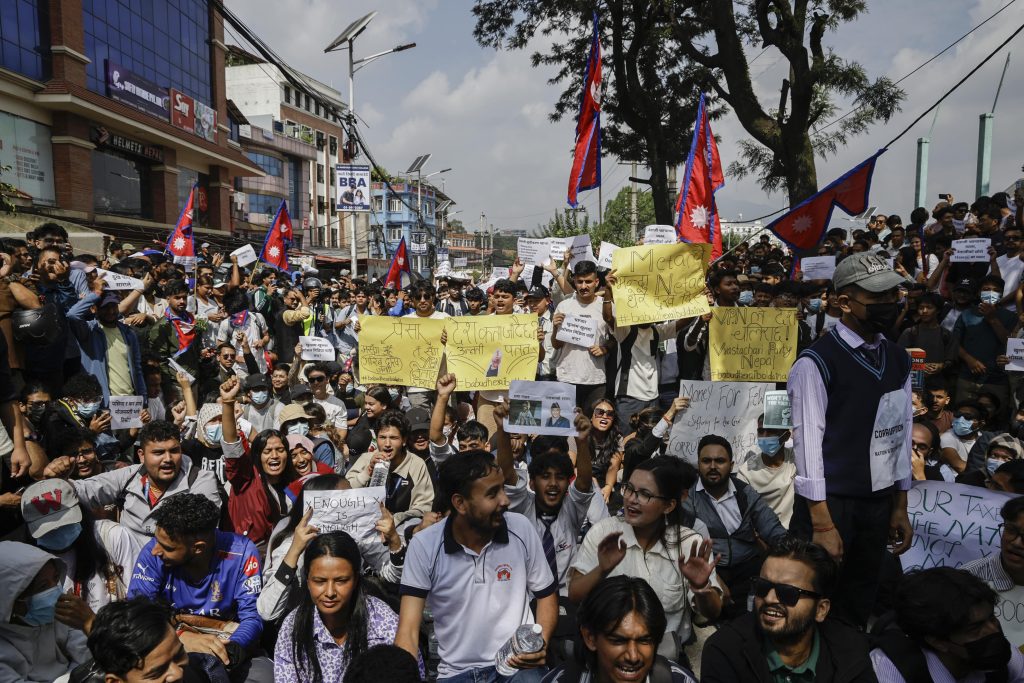
Many questions remain unanswered about last month’s events in Kathmandu, including responsibility for the 21 fatalities among demonstrators on the first day, whether the subsequent anarchy on the streets was deliberately orchestrated, and what precisely transpired between the then Prime Minister, the President and the Nepal Army before the interim government was installed. Some answers may be provided by the commission of enquiry that has now been set up, though it is also possible that no generally agreed narrative emerges and people will continue to adopt different interpretations, as remains the case with the Royal Massacre of 2001. Nevertheless, the basic dynamics behind the protest are clear enough to make comparisons both with Nepal’s own past and with similar upheavals in other countries.
Nepal has a long history of transfers of power mediated by violence but before the 20th century these primarily involved struggles within the governing elite, including Bhimsen Thapa’s rise to predominance at the beginning of the 19th century, the Kot Massacre of 1846 which inaugurated the Rana regime and the 1885 coup which transferred power to the Shamsher branch of the Rana family. Jang Bahadur himself, as recorded by a British official during his 1850 visit to London, summarised the situation: ‘[A]lthough revolutions often occurred [in Nepal], yet the country as a whole did not suffer more from such disturbances than England would from a change of Ministry; neither the army nor the peasantry taking any part in the disputes, and submitting without a murmur to the dictates of whichever party might emerge the victors.’
Rana rule did, however, come under threat from below with the slow introduction of western ideas and particularly the influence of the Indian National Movement after World War I. With no freedom of assembly or political organisation in Nepal, opposition could be freely expressed only within the growing Nepali diaspora in India, whilst within the country, it at first took the form of secret conspiracy, as with the Praja Parishad and Raktapat Mandal in the 1930s and 1940s. The campaign which culminated in the ending of the Rana regime in 1950/51 relied for its success mainly on an insurgency launched from India and on limited support from the Indian government, but there were elements of ethnic revolt amongst the Limbus and also a peasant uprising organised by K.I. Singh further west.
Street demonstrations in Kathmandu had occurred towards the end of the Rana regime, but the now-familiar pattern of lethal confrontation between police and urban protestors was first seen on 11 November 1951, under the Congress-Rana coalition government. Angry that groups based in the Kathmandu Valley had been excluded from the recently established advisory assembly, students surrounded the police headquarters. A demonstrator allegedly tried to snatch one policeman’s weapon and the police opened fire, killing one of the crowd. B.P. Koirala, as Home Minister, was in charge of the police and when the Prime Minister, Mohan Shamsher, implicitly criticised their action in a radio address, the Congress ministers resigned, after which King Tribhuvan appointed B.P.’s brother, M.P. Koirala, to lead a Congress-only government.
After King Mahendra’s termination of the parliamentary experiment in 1960 and the establishment of the Panchayat system, the main opposition took the form of attempted insurgency, including the Jhapeli rebellion in which former prime minister K.P. Oli was initially involved and the 1973 aircraft hijacking in which current prime minister Sushila Karki’s husband, Durga Subedi, took part. Street demonstrations only again played a key role in 1979, when police heavy-handedness against student protestors led to escalating disturbances in Kathmandu and some Tarai towns. Eleven people were killed and the army had to be brought onto the streets. The government made concessions to the students on their demands for the education sector, but radicals continued the protests and King Birendra finally announced a referendum to choose between a reformed Panchayat system or a return to multi-party democracy.
Although the Panchayat side won the vote, there was now de facto freedom for political parties to organise within Nepal and also for the beginnings of ethnic activism. In this partially liberalised atmosphere, the example of the collapse of authoritarian regimes in Eastern Europe and elsewhere and also the effects of the partial blockade imposed by India in March 1989, led in spring 1990 to Janandolan-I, co-ordinated jointly by Congress and the communist groups in the United Left front. Though there were protests in other parts of the country, the movement was predominantly in the Kathmandu Valley, with ethnic solidarity within the still-mainly Newar cities of Bhaktapur and Patan a major factor. The climax came on 6 April 1990, when, after tear gas had failed to halt demonstrators marching towards the royal palace, security forces opened fire. The total fatalities were certainly less than the 21 on 8 September this year, but initial reports that 50 had died led Birendra, probably against the advice of palace insiders, to concede to the opposition’s demands.
After the re-establishment of multi-party democracy, street demonstration and deaths in police firing continued intermittently but the number was dwarfed by the 15,000 or so who died as a result of the Maoist insurgency and the state’s response to it. The rebels were only ever able to hold district centres for a few hours and they were disappointed in their hope for an urban uprising after the Royal Massacre in 2001. They were, of course, a more effective presence than the government in much of the countryside but only managed to secure a significant share of power at the centre after Gyanendra’s missteps united the political parties, the Maoists and India against him.
It was finally the Janandolan-II street protests called for by the Seven Party Alliance and the Maoists that ousted Gyanendra. Demonstrations took place all over the country, involving far more people than Janandolan-I but costing only 21 deaths in 19 days. However, as in 1990, events climaxed in Kathmandu: as crowds surged towards the palace, the monarch was again confronted with a choice between authorising lethal force on a large-scale or giving way. Whether Gyanendra’s choice for the latter was his own or urged upon him by the army remains unclear.
Demonstration effect
Last month’s events have arguably more in common with recent movements in other countries than those in Nepal itself. The ‘Nepo baby’ label, which originated in the USA in the 2010s has been taken up in many Asian countries, and Bangladesh in particular is a close parallel because there, as in Nepal, protests led to the appointment of an interim prime minister outside the usual constitutional channels. Even though the ultimate outcome was very different, the 2019-20 Hong Kong protests were also clearly an influence: Hami Nepal leader Sudan Gurung, the highest profile organizer of the Gen Z protests, revealed in a recent interview that the use of the Discord platform was adopted following the Hong Kong example.
Since the reversion of the territory to China in 1997, the Hong Kong population has been divided very roughly into two camps. The ‘establishment’ or ‘pro-Beijing’ bloc, which had slightly less support among the wider electorate, including both big business and old-school Leftists, still had substantial backing from a section of working class and from the older generation. The ‘democratic camp’, of whom a minority embraced the totally unrealistic goal of independence, wanted full internal autonomy and liberal democracy on Western lines and enjoyed broad support from the middle class and the younger and more educated Hongkongers. Discontent with the Beijing-imposed ‘semi-democracy’, the second group conducted vigorous street protests until the 2020 crackdown. The 30,000-strong Nepali community, in so far as they concern themselves at all with local politics, have tended to align with the pro-Beijing camp, partly from pre-existing Leftist sympathies, partly because of the Nepali tendency to sympathise with China as a counter to India, and partly because the largest pro-Beijing political party, the Democratic Alliance for the Betterment of Hong Kong, has fostered links at the grassroots level. It was not, therefore, very surprising that on the eve of the Gen Z protest in Nepal, one Hong Kong Nepali posted an appeal on Facebook for the youth not to participate in the movement, pointing to the failure of the Hong Kong protests, which have left many youngsters in jail or exile.
Six years ago, Naresh Koirala drew a comparison between the Hong Kong movement and the mass protests in Kathmandu against the government’s attempt to take control of guthi funds. The similarities between the Hong Kong protests and this year’s Nepal’s Gen Z protests are even stronger. In both cases, there were large numbers of peaceful demonstrators on the streets and a minority who took violent action—I am thinking here of the events of the stone throwing which Sudan Gurung acknowledged took place before the police firing on the 8th, rather than of the much greater violence on the 9th which was probably the work of people not connected with the original protest movement. In both cases the catalyst was a specific government action which the government quickly agreed to reverse. In Hong Kong, a bill allowing for extradition to mainland China; in Nepal the ban on Facebook and other popular social media. Both movements also had much broader demands: in Nepal, an end to corruption and nepotism and in Hong Kong a fully democratic system. Both in Nepal and in Hong Kong there was apparent wide backing for the aims of the protestors amongst the population as a whole. Finally, conspiracy theorists are eager in both cases to blame ‘foreign hands’, even though the main impetus of the protests clearly emerged from the internal dynamics of both Hong Kong and Nepali society.
There were, however, crucial differences. In the first place, the Hong Kong police’s reaction to violence from some of the protestors was much more restrained. Far from using firearms to prevent the storming of the Legislative Assembly building, the police were thought by some observers not to have made full use of the non-lethal means at their disposal. Second, and more fundamentally, Hong Kong is not an independent state and its government was not free to make the broad concessions it would have otherwise have had to make.
After the 2019 local elections revealed continuing mass support for the democrats, and when fear of Covid made mass protests less likely, Beijing imposed a National Security Law and brought in a ‘reformed’ electoral system and vetting to ensure only ‘patriots’ could stand. Although Hong Kong is still freer than mainland China, freedom of expression and political organisation have been greatly curtailed. Hongkongers are indeed now worse off than before the protests, but this stems from the fundamental contradiction of a society that would on its own function as a democracy being controlled by an authoritarian state in which a self-selected minority of citizens, the Communist Party of China, has its predominance enshrined in law. This contradiction has to be tolerated unless liberalisation takes hold in China itself. The situation is very different in Nepal, where foreign influence, especially from India, is strong but the future will largely be determined internally.
Returning to the unanswered questions outlined at the start, as well as to the question of who ordered the police firing on 8 September, we should also ask why orders were not given at the outset not to open fire unless the lives of policemen themselves or of those they were protecting were under direct threat. If a state shoots protestors on the streets of its capital, it must then either double down on the use of force so that fear outweighs anger, or make substantial concessions. The former option was open to the Chinese government in 1989, given its firm control over most of China outside Beijing and Shanghai and its ability to withstand international disapproval. For a much weaker state like Nepal, as history demonstrates, this is not a viable strategy even under royal autocracy, let alone for a government that has to face genuine elections. If the security forces were unable to control the crowd with non-lethal means, then it would have been better to allow the parliament building to be entered and then get the protestors out in slower time, the strategy adopted by the Hong Kong authorities in 2019 and by the French authorities when protestors occupied much of central Paris in 1968.
Once mass fatalities had occurred and large-scale looting and arson began later the same day, the obvious step would have been both to get the army onto the streets, or at least to guard key installations, and also to open talks with the protestors. Why this did not happen on 8 September and the responsibility both of K.P. Oli and of the Nepal Army is another key question to be addressed.
The cycle continues
As Fraser Sugden and Feyzi Ismail have pointed out, the fundamental factor behind protests in Nepal and other places has been that young people, increasingly well-educated and aware of the world around them, have little hope of finding employment matching their education and aspirations. This was an important reason for the fall of the Panchayat system in 1990, and the problem has worsened in the internet era where the contrast between others’ success and one’s own situation becomes even more stark. Resentment is particularly strong if others’ advantages are seen as unfairly obtained, hence the particular concern with corruption.
Even though in a recent article Mitra Pariyar argues that ‘all of us are corrupt in some way’, it is unfair to argue that everybody is equally guilty. Nevertheless, Nepali society is not divided into devils who preside over political parties and angels who lead ordinary lives or become NGO activists. Familism, patronage networks and ‘source force’ and other factors behind corruption and nepotism are woven into the fabric of human society and appear particularly strong in South Asia: the 2025 Corruption Perception Index, with Denmark on 100 rated the cleanest and the world average at 48, gives India, Nepal, Sri Lanka, Pakistan and Bangladesh scores of 32.5, 27.3, 24.7, 18.2 and 13 respectively. Improvement is possible but simply changing faces at the top is unlikely to be the solution, particularly when, as Subina Shrestha has reminded us, Sher Bahadur Deuba, Khadga Prasad Oli and Pushpa Kamal Dahal all started out as ideologically committed young activists.
Finally, despite its problems, Nepal does have achievements to its credit since 2006, including probably the freest media in South Asia and elections relatively free of malpractice. Established parties were successfully challenged by independents like Balen Shah in Kathmandu and by the rise of the Rastriya Swatantra Party. Though the latter’s leader is himself now in custody on corruption charges, it is still clear that constitutional means of pushing for change are available. Yet, a government formed by a parliament elected by the whole country in 2022 has now been replaced by a prime minister selected through an internet poll involving just 8,000 individuals. The events of 8 and 9 September may have made that unavoidable and we must wish Sushila Karki and her colleagues well, but it is a matter for regret that Nepal has returned to the dismal cycle of repeatedly making rules for peaceful competition for power but then failing to abide by them.
