
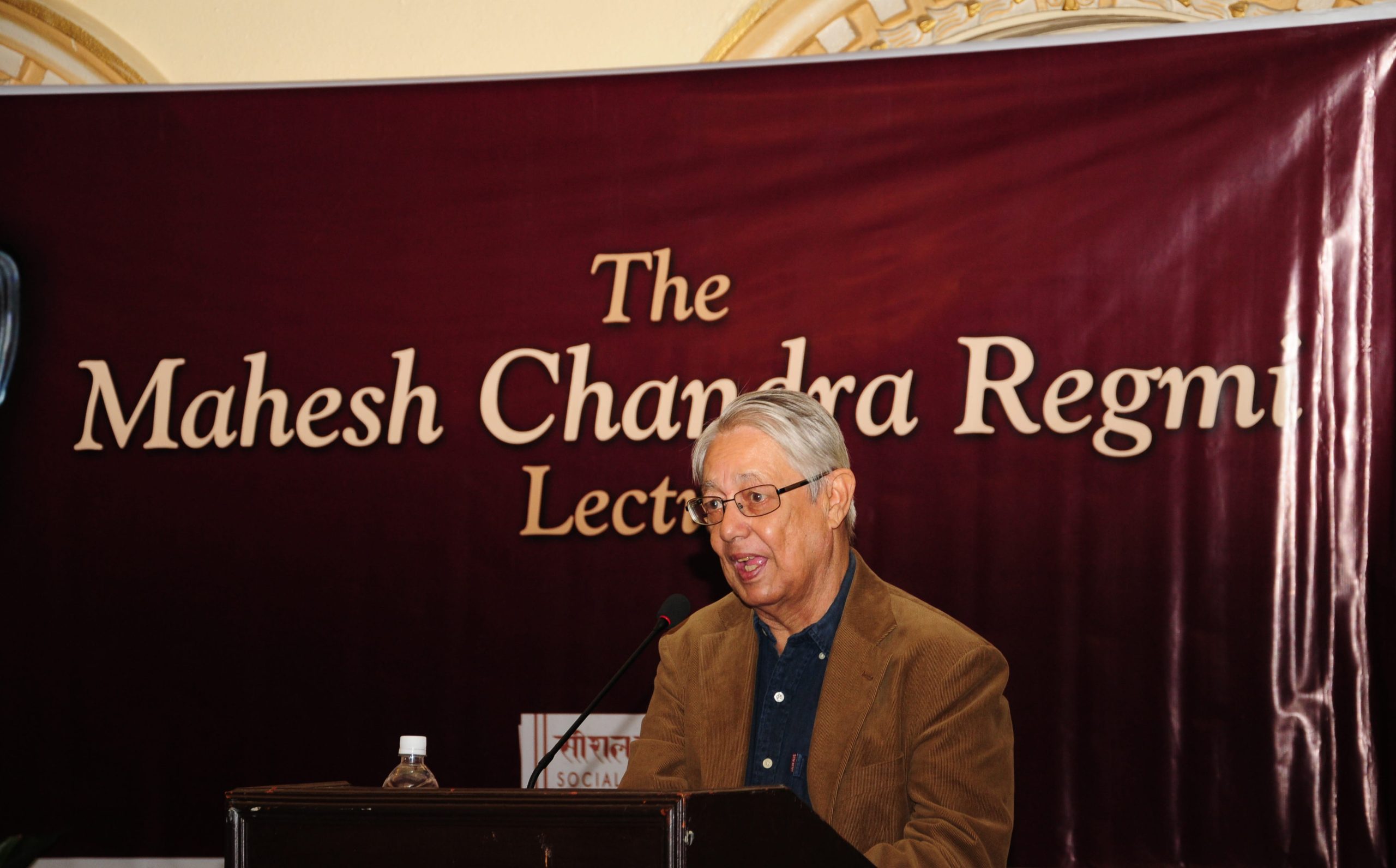
Veteran Indian sociologist André Béteille (1934–2026) breathed his last on 3 February 2026. Should this matter to Nepal now and in the future?
While it is comparatively easier for us to adopt a Western thinker as our own without much rhyme or reason, we often falter when it comes to our own part of the world and seek definite reasons to follow or unfollow someone of similar stature. Hence, the question posed above, as Béteille is perhaps one name with whom Nepali social scientists are most familiar. Reading lists of sociology and anthropology courses in different Nepali universities have featured his works continually. His concepts and ideas related to indigenous peoples, tribes, peasants, inequality, reservations, caste, power, ideology, or the university system serve as ready references in Nepali academic and public debates as well.
But is there any need to bring Béteille out of the ambit of Nepali academia and establish him in the common sphere of everyday thought processes of Nepal, something that might be expected from readers of The Commons? Moreover, since Béteille did not write particularly on Nepal in any significant manner, should an obituary on him really matter to an already enlightened section of the Nepali readership?
Before I try to navigate these doubts, I cannot but recall my days at the Delhi School of Economics, during which I had felt Béteille’s unmistakable aura. He had retired before I joined what we fondly call ‘D’School’ for doctoral studies, but the opportunities of lighter conversations with this man during his occasional visits to the Department of Sociology at Delhi University left an intense impression on my young mind then. As such, later in 2015, I took an extensive interview with him on issues ranging from the absence of Nepal in the sociological imagination of Indian scholars to why South Asian realities do not tend to become serious matters of inquiry for him. The questions, as the readers might realise, were uncomfortable, but the scholar in him brought forward interesting perspectives to these queries which have been elaborated in my book, Contours of South Asian Social Anthropology: Connecting India and Nepal (Routledge, 2022).
It was during this 2015 interview that he shared with me about his visit to Nepal upon the invitation of Social Science Baha, Kathmandu, Nepal, for the Mahesh Chandra Regmi Lecture. Among his hosts at Social Science Baha was Rajendra Pradhan, who had been a doctoral student at D’School. The lecture took place in November 2012 and is available in the public domain. It is this lecture, The Varieties of Democracy(2012), that makes it worthwhile to remember him in Nepal at this momentous juncture when another round of democratic experiment is about to begin in contemporary Nepal, a moment that coincides with his death.
While ‘Nepal’ appears only thrice in the lecture, the three most important messages implicit in its content are valuable for Nepal as well as the subcontinent at this moment.
Pluralising the discourse of democracy
In an attempt to pluralise the discourse of democracy on the one hand and debunk the ‘big brotherly’ attitude of the Indian academics on the other, Béteille argues that democracy has evolved in different ways to take different forms within different nations. It is therefore not only unrealistic but unreasonable to expect a uniform pattern of democracy all over the world or to follow the footprints of those nations where democratic institutions, rules and procedures first took shape. Béteille considered democracy to be an experiment in learning the art of politics, where this ‘learning’ is a never-ending process that must begin in response to the changing conditions of one’s own country, and not to be an act of mere imitation. So, while one must never turn one’s back on the experiences of other countries, particularly in one’s neighbourhood, it is important to develop democracy as one’s own. Without explicitly bringing in the India–Nepal context in his lecture, he left the message and his intentions quite clear for the Nepali readership.
Importance of democratic reasoning
Béteille emphasised what he called ‘democratic reasoning’ in order to understand democracy. Democratic reasoning proceeds through debate, discussion, negotiation, compromise, and mutual accommodation. It permits citizens to make mistakes while providing opportunities for correction. Democratic reasoning, in this sense, takes a pragmatic view of imperfections in the social and political order where it must accept that all political regimes—past, present and future—are imperfect, and act on that understanding, in the hope that the future can be made a little better than the present.
If there is an upsurge of anger, for example, like the Gen Z protests of the recent past, against corruption in public life in a country, where social activists and leaders of civil society movements demand that all corruption be brought to an end here and now, then the mere expression of moral outrage cannot be a substitute for democratic reasoning because when that expression acquires an intemperate form, it threatens and subverts the very process of democratic reasoning. It is important to understand that in a democracy, corruption can be reduced, but it cannot be eliminated completely. When social activists mount relentless assaults on the basic institutions of democracy, such as the legislatures or the courts, they set in motion forces that end by increasing, instead of reducing, corruption. It is a mistake to believe that only an excess of concern for order generates corruption. Disorder, too, generates its own forms of corruption which, in fact, are more virulent because their sources are more diffused and dispersed.
Worth of political parties
Béteille’s lecture zooms in on the importance vis-à-vis the dwindling glory of political parties at length. He considered the development of the party as a political institution as one of the great innovations of modern democracies and maintained that the success of the party as a political institution depends not on how many members it has or on the strength of its leaders to wield power in government machinery, but on the party’s ability to outlive its founders and most important leaders, while being able to pass on the baton of the organisation to new leaders and recruit new members to replace older ones.
The ability to maintain a presence distinct from that of its present leaders and followers makes a party different from a faction, a clique, or a coterie. The life of a party continues independent of the lives of its members. Factions emerge and dissolve as their individual members move in and out of the political arena. These fundamentals of political parties seem meaningful at that point in time when public esteem and respect towards political parties have been replaced by disdain and contempt, be it in Nepal, India, or elsewhere. The situation in Nepal is particularly vulnerable, where many political parties have enjoyed their share in the formation of the government in the past but no party escaped hostile public scrutiny during the Gen Z protests.
Although political parties have fallen in the public esteem almost everywhere, let us hope, in tune with Béteille, that these will continue to play their role as democratic institutions for the articulation of dissent and opposition while also enriching democratic reasoning. Reading Béteille’s 2012 lecture at this point in time once again in the Nepali context can be an apt way of commemorating the death of this South Asian thinker.
Swatahsiddha Sarkar is a Professor at the Centre for Himalayan Studies, University of North Bengal. ...
Swatahsiddha Sarkar is a Professor at the Centre for Himalayan Studies, University of North Bengal. In addition to three books—Gorkhaland Movement (2013), Ethnicity in India (2013), and Contours of South Asian Social Anthropology (2022)—he has more than 50 research articles published in national/ international academic journals. He occasionally contributes to public platforms such as The Hindu, The Kathmandu Post, Kantipur, and Sikkim Express, among others. He has been actively engaged in teaching and research for over two decades, consistently contributing to pedagogical renewal in Himalayan Studies and to critical rethinking of the Himalaya. He is one of the Associate Editors of Studies in Nepali History and Society (SINHAS). Sarkar has coined the idea of ‘Himalaya as Method’ (2022).