
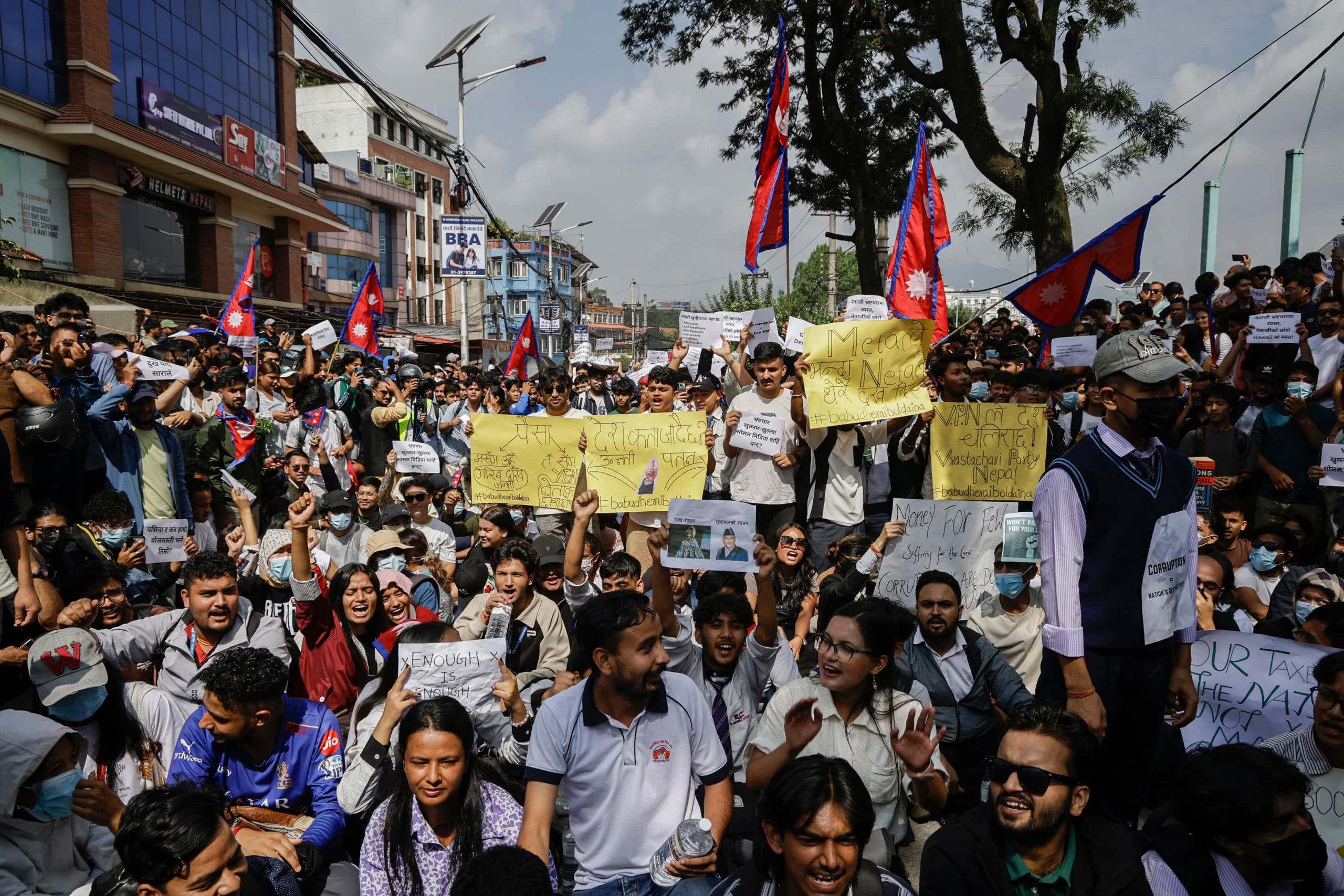
With the election of a new government, on the back of the September 2025 Gen Z movement, many inside and outside Nepal will be wondering how we might measure the success of Nepal’s rejuvenated democracy and also whether existing democracy scoring systems might have alerted us to the flaws which Gen Z saw in Nepal’s actually existing democracy.
Political science has tools at hand, in the form of several well-known democracy indices. But I am going to argue that these tools are inadequate and misleading: both too ‘precise’ in a pseudo-scientific sense (they provide the democracy–seminar industrial complex with copious quantitative data) but also out of touch with how people at the grassroots perceive democracy’s substantive successes and failures. I will give an overview of the problems with these measuring tools and suggest qualitative alternatives, useful for assessing the causes and outcomes of Nepal’s current dramatic moment.
There are four main democracy indices cited in policy and academic circles: the Polity IV scores (henceforth Polity); the Economist Intelligence Unit democracy scores (EIU); Freedom House; and the V Dem democracy scores (V Dem). These four indices are highly inconsistent between each other and measure very different things.
Polity hasn’t published a global democracy index since 2018. When it did, Nepal stood at an impressive eight out of ten, standing alongside a heterogeneous set of score-neighbours (other 8’s) including the USA, the UK, Botswana, and Nigeria.
The EIU has the least charitable view of Nepal’s democracy, with its latest score (2024) rating Nepal a ‘hybrid regime’, with score-neighbours including Tunisia, Georgia, Uganda, and Gambia.
Freedom House shares the EIU’s somewhat dyspeptic view of Nepal’s democracy, rating it (also in 2024) ‘partly free’ with score-neighbours being Mexico, the Philippines, Moldova, and Benin.
Finally, the V Dem scores are not unitary but split into five categories: deliberative, egalitarian, electoral, liberal, and participatory. Their rating system makes comparisons much more complicated, but Nepal’s scores across the various dimensions seem closer to Polity’s positive view. For example, Nepal hugely outscores India across all dimensions in the 2025 ratings and stands comfortably above average on all categories for Asia as a whole, although slightly below the global average in each of the five categories.
The EIU and Freedom House scores can fairly easily be dismissed as ratings of Nepal’s democracy per se. Both these rating systems primarily assess things other than what we usually think of as ‘democracy’. I will skip over the EIU because it uses proprietary question banks, which outsiders can’t access, but I suspect the flaws are similar to Freedom House with which it shares a broadly similar approach. Freedom House’s scores rate ‘political rights’ (40 points) and ‘civil liberties’ (60 points) with sub -indices that punish Nepal heavily for corruption, lack of transparency in government functioning, lack of due process in courts, gender inequality, and persistence of ‘traditional’ forms of economic exploitation. All these outcomes are very important, of course, and their inclusion explains why these indices rate Nepal lower than the other two which focus on specifically political institutions. But are these outcomes really measuring ‘democracy’ in Nepal? Perhaps they are measures of Weberian modernisation instead? They seem to be measuring things that one might hope (sometimes in vain) are the outcome of democratic decision making, but not democratic processes themselves.
The Polity scores focus much more narrowly on political processes. They have three broad categories of ‘executive recruitment’ (is it ‘open’ or is it restricted to certain families, ethnic groups?); ‘executive constraints’ (is the executive responsive to Parliament, courts and parties?), and ‘political competition’ (are opposition parties allowed to be competitive?). Nepal scores highly on these measures (at least it did in 2017 when the data was gathered). And, indeed, one could say that even in 2024 Nepal had ‘relatively stable and enduring secular political groups which regularly compete for political influence at the national level’, as Polity’s measure of the highest level of ‘competitive’ politics says.
Questioning the V Dem measures
Before I move on to the most sophisticated set of measures—the V Dem scores, I will set out my core issue with these measures and then turn to V Dem to see whether it addresses these issues (?). As the Polity language I quoted in the previous paragraph suggests, Nepal was able to score highly in some of these ratings because it had relatively stable parties that were not (entirely) under hereditary control, had fairly free and regular elections, moderately low levels of electoral violence, somewhat robust free speech (until just before the Gen Z protests at least), and competition at all levels for political power between organised parties. However, as anyone who lives in Nepal knows, the formal structures of democracy can be subverted in ways that are very hard to measure quantitatively.
In Nepal, people speak of the systems of bhagbanda (division of spoils) and ‘setting’ (the ‘behind the scenes’ processes whereby political parties collude with each other and with officials to manipulate contracts and direct government resources into areas where party elites would benefit). Again, as all who live in Nepal know (including presumably those scholars and intellectuals involved in providing ratings to democracy indices), these systems have been pervasive across multiple sectors: the education sector has suffered from party affiliated teacher unions and student party organisations, which often seem to have a veto over any attempts at reform; the system of contractors for basic infrastructure has been ‘particised’ with highly rated contractors (A and B contractors) often themselves being elected party officials or affiliated with them; the NGO sector is pervaded with party-affiliated organisations, which deploy their resources in coordination with their party allies; the same is true of the labour migration sector, large tourism companies, and countless other business houses and business cartels deemed large enough to provide rent-seeking opportunities for the parties that form linkages with them.
These facts are trivially known to anyone paying attention in Nepal. This system of bhagbanda is the underlying reason behind the Gen Z protests and the rise of Balen Shah (and other independent mayors), with outrage over ‘nepo babies’ being the proximate incarnation of the anger at this system.
This system is invisible to political science measures of democracy. This is because it is compatible with such democratically correct phenomena as the regular rotation of parties in office and constraints on executives by party organisations. The rotation of parties, for example, has provided ample cover for collusive rent-seeking by the major parties, with elections providing an illusion of ‘cleaning house’ and each party able to blame the others for corruption, thus distracting attention from the systemic collusion at its heart. In other words, some factors that would boost standard democracy scores (rotation of parties and active opposition parties) are structurally tied to the bhagbanda system in Nepal in ways that are invisible to the rating systems.
As Tolstoy said, ‘all happy families are alike; each unhappy family is unhappy in its own way’. Perhaps we can say the same about democracies, with the proviso that as of 2026 it might be hard to find a happy one. The serious point is that the ‘unhappiness’ of democracies is very hard to capture in numbers or in measures that are intended to compare countries globally. Do systems somewhat similar to bhagbanda exist in other countries? Undoubtedly. But no scoring system points us toward them and the particular configuration of ‘particised’ corruption is likely to look very different in the Philippines, Mexico, Nigeria, and the United States. Each conjunction will be historically path-dependent and mixed, shaped by ethnic factors, legacies of landholding elites, or imperial legacies of ethnic divide and rule. In a few of these cases it might be captured by quantitative measures; it will be invisible to them in most.
Before I suggest some alternatives, let us examine the V Dem project, which is the most sophisticated democracy scoring system. Unlike the other democracy raters, V Dem has a transparent academic approach, with indices and scoring systems intricately explained in publicly accessible venues. V Dem tries to improve the scoring system by throwing everything into the bucket. It takes every theoretical (and ideological) interpretation of democracy and makes an index out of it. So, we have electoral democracy for formal minimalists, liberal democracy for classical liberals, participatory democracy for fans of Rousseau and NGO seminars, deliberative democracy for Habermasians, and egalitarian democracy for those on the Left (broadly speaking). The first three measures are more sophisticated versions of what we have found in the other rating agencies, especially Polity IV. The last two are more original to V Dem. Each of these is measured by a labyrinth of sub-indices. For example, deliberative democracy is measured by a panel of experts who assess the range of consultation engaged in by political leaders and whether civil society is engaged in those issues.
One worrying aspect of this project, for Nepal at least, is that the five scores seem to correlate quite well, going up and down together in the useful graphs that V Dem provides free of charge at their website. If the measures were actually capturing Nepal’s particular complex of rent seeking this would not have been the case—the electoral measure would have been much higher than those for participatory and deliberative democracy for example—had those latter two measures been measuring anything about actual democratic decision making. For example, if civil society is ‘particised’ in the ways I described above, then ‘consultation’ between government and civil society might be vigorous and extensive but not serve the public good at all.
Scores vs reality
At this point this essay might seem to be an exercise in nihilism. And to some extent it is. I would echo the brilliant critique of ‘democracy’ as a concept launched recently by philosopher Herman Cappelen in a nice example of an analytical thinker cutting through some of the weeds cultivated by social science. Cappelen’s critique is at the conceptual rather than empirical level and he doesn’t include any case studies. He argues, contentiously, that these measures of democracy rarely seem to capture what ordinary language means by the adjective ‘democratic’. ‘Democratic’ would seem to involve people who are concerned with an issue being consulted on and involved in decisions pertaining to that issue. Very few measures of political democracy capture this essence of the ‘democratic’. To go back to the Nepali case—there may be elections, parties open to outsiders, constraints on executives, opposition free speech, etc, but do any of these things capture the ‘democratic’ per se?
To be more concrete, in my fieldwork in rural Nepal, respondents often referred to a sense of helplessness and exclusion when it came to offering input on the functioning of basic public services. One respondent was a retired Indian army officer who had returned to Nepal with the hope of getting involved in the management of the school which his grandchildren attended. He quickly found that party-affiliated unions controlled all essential aspects of school governance and gave up. ‘Democracy’ had trumped the ‘democratic’ in this case; if party-affiliated unions were curbed, Nepal’s democracy score might go down on some indices of ‘participation’, even as more ‘democratic’ involvement in school management might increase.
This is also the source of what is ideologically controversial in Cappelen’s argument, because countries such as China and Singapore score very poorly across all these indices, even though if one could aggregate all the ‘democratic’ decisions being made in those countries across all their institutions (an impossible task, of course), it is not clear that they would be deemed less democratic than India or the United States.
Aside from these controversial points, where does this leave us when it comes to democratic assessment in Nepal? I would refer to Sumana Shrestha’s simple but powerful TED talk, available on YouTube, titled ‘The Nepali Dream’. The ‘dream’ consists of a future where ‘you don’t need to know somebody powerful to live a dignified life’ and she applies this to numerous sectors, especially to education. To go back to our example of the retired veteran returning to his town and trying to make changes to the local school: a more ‘democratic’ future would be one where those affected by a policy or public service are able to give input into the policy or the service. But assessing these kinds of changes cannot be done through rating systems, it can only be done by qualitative research at the grassroots level.