
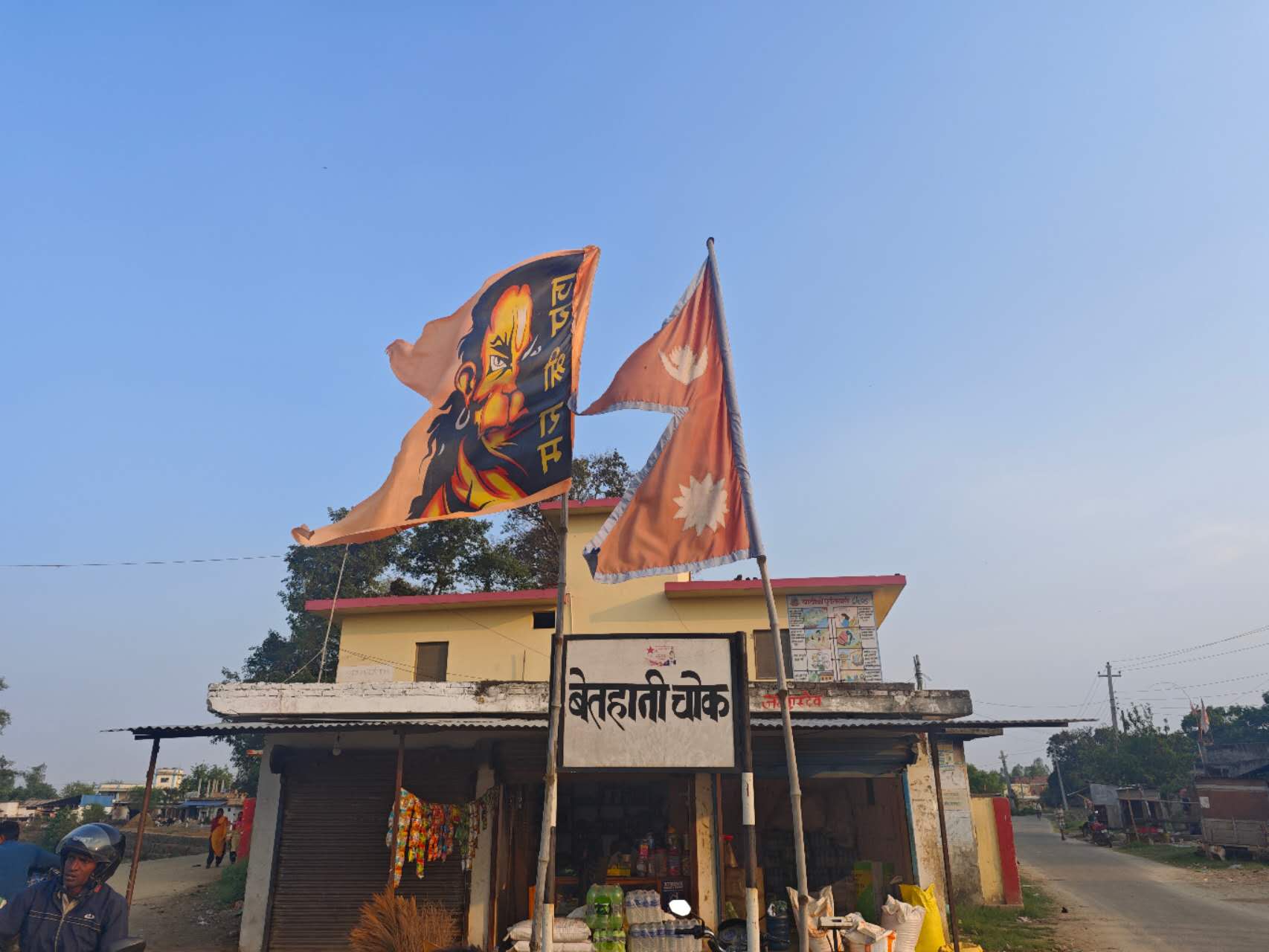
Asked about the cause of increasing Hindu–Muslim tensions, local residents from different Tarai districts frequently mention ‘DJ’. They use the neologism ‘DJ’ in such a natural manner that it sounds more like a Hindi or local word than an English abbreviation, even though no one has yet explained to me the correct full form of DJ—disc jockey.
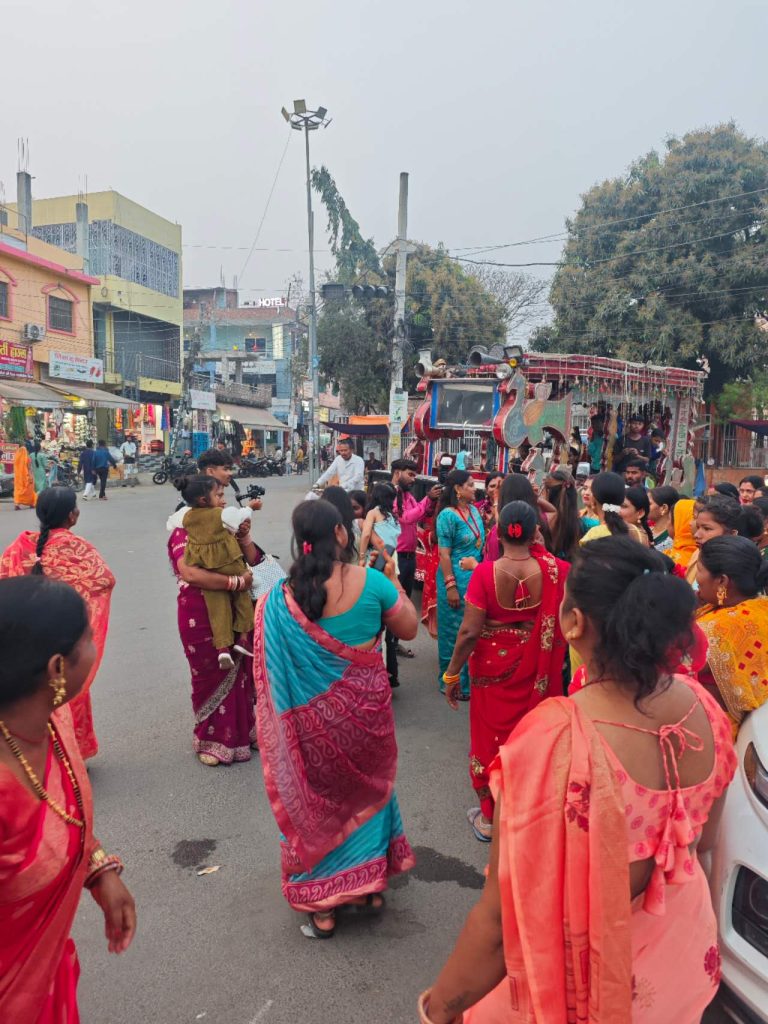
What they mean by DJ is the loud music played on the street or at functions using electronic devices. DJ is a rental service in the Tarai where two to three men, mostly youth standing on a moving vehicle, play music and songs, usually at heart-throbbing full volume that is inescapable even from a great distance. People often hire DJs for family functions, such as weddings, where participants dance behind the vehicle carrying the DJ setup.
Music and songs have always been an essential part of almost every religion and sect. Bhajans (devotional hymns) have great importance in the Hindu religion. Bhajans are ordinarily sung within a temple while sitting together. Occasional Hindu processions also include bhajans. But the trend of playing contemporary bhajans with political motives is becoming a reason for the frequent escalation of Hindu–Muslim conflicts in the Tarai.
Organisers of religious rallies use DJs to attract attention and propagate their activities. In particular, Hindus have begun using DJs as part of their religious activities in ways that are new and perhaps disturbing to those familiar with the practice. During Hindu festivals such as Saraswati Puja, Durga Puja, and Hanuman Jayanti, organisers hire DJs to play religious songs at loud volume coupled with provocative religious slogans associated with political Hinduism like ‘Jaya Siya Ram’, ‘Jaya Shree Ram’, ‘Jaya Shree Hanuman’, and ‘Durga Mata ki Jaya’.
A louder DJ equals conflict
In the third week of March 2026, violent tensions erupted between local Hindus and Muslims in Maharajgunj Municipality of Kapilvastu District, where one man died and at least 25 were injured. According to media reports, stone-pelting from both sides started on the eve of Eid, as local Hindu youths began playing bhajans more loudly during Muslim prayer time. Local police could take control of this volatile situation only after imposing a curfew. Among those arrested for violent activities, most are associated with local branches of Hindu nationalist organisations such as the Vishwa Hindu Parishad (VHP) and the Rastriya Swayamsevak Sangh (RSS) from the bordering Indian districts, and also the Hindu Swayamsevak Sangh (HSS), the subsidiary of the RSS for non-India locations such as Nepal. This is just the most recent communal incident to occur in the Tarai districts where the frequency of similar tensions is increasing.
In another example, a clash occurred between Hindus and Muslims at Shreepur in Birgunj Metropolitan area in April 2025, and again this had a DJ as its apparent cause. A Hanuman Jayanti rally had been organised by the local branch of the VHP. When it was passing by a local mosque, the rally turned into a violent clash mainly because the full-volume DJ in front of the rally provoked Muslim youths to begin pelting stones at the Hindu procession. The maulana of the Shreepur mosque told me that the ear-deafening DJ sound in front of the mosque irritated Muslim students, causing them to protest. A joint meeting of the two sides mediated by the local police following the curfew order ended the tense situation but only until another incident followed shortly thereafter.
Rampur Khap of Ishnath Municipality lies in Rautahat district and shares a border with India. Hindu–Muslim clashes have erupted there more than once, and again, one of the recurring reasons is the loud DJ sound. A local Muslim youth said that whenever Hindu wedding processions and religious rallies pass the local mosque, they not only raise the DJ volume but also play songs with vulgar meanings and do that for a prolonged time, mostly when Muslims are observing namaz, enraging Muslims and leading to fights. When I asked a group of Muslim youths gathered there to play on their mobile phones some of the songs usually played in Hindu functions and which they believe to have vulgar meanings, they laughed and also declined to play them in the presence of women who were also listening.
Gheuraa village, a couple of kilometres away from Rampur Khap, has experienced a similar conflict. During a group discussion with local Hindus, including some youth involved in the local branch of the Hindu Samrat Sena, they pointed at a small house on the main road of the village and spoke of it as the border separating the Hindu and Muslim areas. They called the Muslim side ‘the Chhota Pakistan (Small Pakistan)’. In Gheuraa village, conflicts between Muslims and Hindus have been occurring every two years on average and the use of loud DJ during Hindu social and religious functions being one of the main reasons. Local Hindus claim hiring a DJ and playing music is their right and assert that by challenging it, Muslims are trying to limit their right.
However, according to a local Muslim maulana, it is not the music and celebrations that the Muslim community has objected to but rather the loud noise and salacious lyrics. The aggressive response to requests to stop the noise has only further aggravated the situation.
As the number of religious tensions is soaring year after year, it has become one of the major concerns of the local state security agencies. Curfew orders are often issued. However, Hindu nationalist organisations see security forces as biased and think that instead of controlling Muslim ‘arrogance’, the police focus on suppressing only the Hindu side.
‘Why can’t we?’
Hindu nationalists in Nepal justify the use of DJ in their religious processions with statements such as ‘Why can’t we play music and dance during our religious celebrations whereas Muslims can do that every next hour?’, in reference to the azaan (the Muslim call to prayers).
Most of the people I interviewed from different places in the Tarai spoke in unison when asked about the DJ. They argued that a public road passing in front of a mosque is not sovereign territory belonging to the mosque and that anyone has the right to use it freely. They claim that Muslims are always ready to pelt stones at Hindu processions, and that they store rocks on the top floor of their homes.
Hindu nationalists described their activism as an initiative to defend sanatan (eternal) dharma and the Hindu-ness of Nepali society, which they believe has been under encroachment from Muslims. They said that the process of encroachment intensified after Nepal was declared a secular state in 2008. They present a myriad of issues, starting with the ‘illegal infiltration’ of Muslims to Islamic fundamentalism in madrasas and mosques, from so-called Love Jihad (alleged seduction of Hindu women and girls by Muslim males) to the growing number of mosques as evidence to justify their argument of Muslim aggression in Nepal.
In Birgunj, a local Hindutva activist showed a group of Muslim girls fully covered in niqab as evidence of expanding Islamic fundamentalism in Nepali streets. ‘The police never investigate mosques and madrasas—how Muslims are nurturing fundamentalists there and how those places have been used as secret and safe shelters for illegal infiltrators. Instead, they are asking us not to pass through and not to play DJ near the mosque area. Is that a separate country there? Is that Pakistan?’ said a leader of Bajrang Dal, one of the active Hindu nationalist groups.
Hindu nationalists think they need to control what they call Muslim ‘aggression’ and they use the DJ as a means to achieving their goal. By occasional religious processions with louder DJ music passing by the mosque, they think they can demonstrate to Muslims the presence and strength of Hindus. The leader of the HSS in Birgunj, Ranjit Sah, believes that Hindu activities can control Muslims’ supposedly defiant public expressions of power and DJ performance is one of many ways to keep the supposed Islamic threat under control.
Using DJs in religious processions works in two ways: first, the full-volume dance music, particularly in local Bhojpuri and Maithili, serves as an energiser to Hindu acolytes, and second, it causes backlash from the Muslims. In case tension erupts, the situation can be used to unite Hindus not only where it occurs but also in the surrounding areas with the slogan of ‘defending dharma’. Hence, when stone-pelting and violence occur, it is not confined to certain towns or villages. Rather, the news widely circulates through social media (particularly WhatsApp and Facebook), leading to the escalation of tensions in other places, and sometimes becoming more intense than where it first arose.
The DJ phenomenon in the Tarai is similar to what is happening in many Indian cities. For instance, in October 2025, in Kashi city of Uttar Pradesh, clashes erupted between Hindus and Muslims. According to an Indian news report, the conflict started when Hindus started amplifying Hanuman Chalisa, a Hindu religious script, using loudspeakers, countering the sound of the azaan. Using DJs during Hindu festivals has become a new normal in India, leading to violent conflicts between religious groups.
Hindutva growing behind the scenes
The HSS and its affiliates are active in urban areas of almost all districts. By and large, the influence of the Hindutva wave across the border is evident in these organisations’ activism in Nepal. Besides these, many small groups that carry Hindutva as their major agenda are mushrooming in the Tarai districts. Some are branches of major Hindu nationalist organisations, some are just part of the Hindutva network, and some are formed independently, influenced by Hindutva propaganda. Among them are service-intensive organisations whereas others are militant in character. The latter are mostly led by youth under 40. The constitutional provision of a secular state has been viewed as a source of identity threat for Nepali Hindus by these Hindu nationalists.
The local branches of Hindu nationalist organisations are found to exaggerate and twist local Hindu practices to create a binary opposition between locals on this religious basis. They celebrate various Hindu religious diwas and puja which were either observed with little fanfare or not at all earlier. Previously obscure local deities are being highlighted and used as a cause to unite local Hindus in celebration. Badri Narayan, an Indian researcher on Hindutva politics, has termed this process ‘appropriation’. In his book Republic of Hindutva: (How the Sangh Is Reshaping Indian Democracy), he has described how the RSS in India is working locally, strategically adopting ‘resistance and appropriation tactics’ by appropriating local deities and myths to unite local Hindus divided into different castes and varnas to unitedly resist Muslims.
In the context of the Tarai, the celebration of Saraswati Puja is a suitable example. Celebrated only within schools and campuses until some years ago, but now, even in small villages, big rallies are organised to mark the occasion. During such religious events, the DJ is played as an essential marker of identity.
Hindu nationalist organisations in Nepal are encouraged and influenced by the activism of their peers in India. The ways in which they are working ‘to defend Hindu Dharma as the identity of Nepal and the Nepali nation’ share similarities with the ways their Indian counterparts are acting to ‘defend Hindu-ness in India’.
A journalist based in Janakpur, Rohit Mahato, sees Indian electronic media, particularly TV channels, as major impact-creators among people in the Tarai in hardening religious sentiments. Indian TV channels, particularly the Hindi language ones, are watched widely in the Tarai, resulting in religious intolerance, hatred and bigotry. Consequently, the ideas of the religious hard-liners are gaining more prominence and sowing future conflict.
Conclusion
The cause of Hindu–Muslim tensions in Nepal is a broad area of study and analysing it through the lens of the use of DJs represents only a small part of the larger issue. Though loud DJ has become an oft-stated reason for escalation of tensions, it is only the tip of the iceberg. Underneath the tension lie multiple socio-political reasons, one of which is the proliferation of Hindutva or Hindu nationalist ideology and organisations working effectively to harden religious sentiment among people at the grassroots level.
