
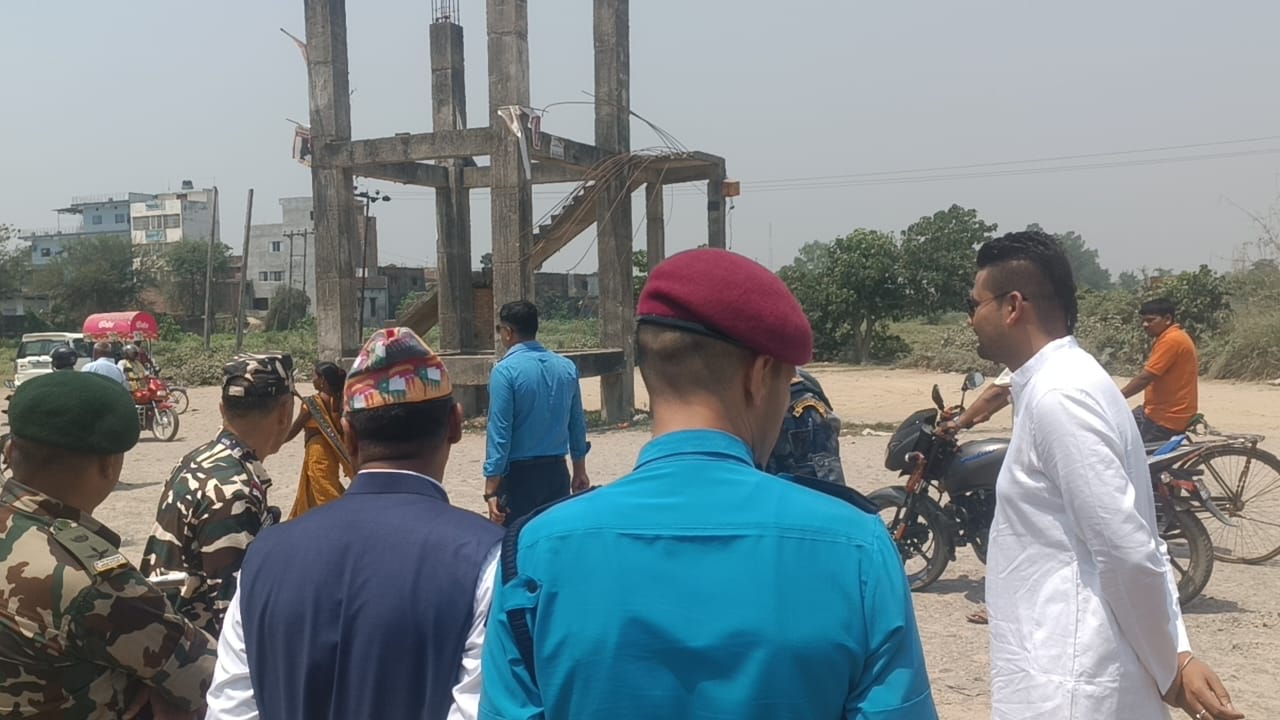
I grew up near the border, Gaur–Bairganiya. For me, the border was never a line of separation; that was where my maternal home is, a place with familiar faces, shared meals, and childhood memories. It was where my cousins lived. It is a place where we go for small things—shopping, visiting, occasional check-ups—without ever feeling that we are stepping into somewhere foreign. It feels close, known, and continuous with home.
Across this open border, people share far more than proximity. Language, religion, caste affiliations, festivals, and folklore circulate freely, creating a shared cultural world. Marriages across the border are not exceptions but a long-established practice, forming what people call roti-beti relationships—ties of sustenance and kinship. These relationships bind families across national boundaries, making the border not a point of separation but one of extension. Daily life reflects this entanglement. Movement across the border is routine: for work, trade, education, and family visits. In the Bairganiya market, we shop on credit, ensuring that payment will be made on the next visit. People from Bairganiya and other nearby areas in Bihar visit our bakery, often buying on credit when needed. This trust is not incidental; it is rooted in longstanding relationships that blur the distinction between ‘us’ and ‘them’. In all open border regions of Madhesh, economic life depends on cross-border trade.
During my ethnographic research in Birgunj–Raxaul for my MPhil thesis, which focused on the 2015 Madhesh movement, I had the opportunity to closely observe interdependence in the region. While taking an auto-rickshaw to Raxaul to meet with people there, I shared the ride with several individuals from Birgunj who commute to Raxaul daily for work. They often returned to Birgunj with vegetables and grocery items needed for their kitchens. Similarly, people from Raxual travelled to Birgunj and Parwanipur for work and took back green vegetables in the afternoon. People from both sides have operated businesses across the border, and they travel back and forth every day.
Border unbounded
During the 2015 crisis and blockade, kinsmen and locals of Raxaul supported protestors from Birgunj in ways that reflected the depth of cross-border ties. People organised food camps, cooking rice, lentils, and vegetables, and providing drinking water to protestors gathered in the no man’s land. Many protestors, when chased by police, crossed into Raxaul—not as outsiders seeking refuge, but as individuals returning to networks of relatives and friends. They stayed overnight, shared meals, and rejoined the protests the following day. These acts were not driven by formal political coordination but by kinship, empathy, and a shared sense of belonging grounded in long-standing social relations. Cross-border marriages, everyday mobility for work and trade, and sustained familial ties have produced an extended social world in which the distinction between ‘here’ and ‘there’ is often blurred. In this context, support during moments of crisis was not an exceptional gesture but part of an ongoing practice of mutual care and obligation.
Such practices point to a form of belonging not bounded by the territorial logic of the state but is instead constituted through kinship, reciprocity, and everyday interaction. The border, rather than functioning as a rigid line of separation, is lived as a relational space, where obligations and solidarities extend across it. As one interlocutor from Raxaul explained, helping was not about politics but about sukh-dukh—standing together in moments of hardship as kinsmen. The death of a young man from Raxaul who was killed during the protests in Birgunj underscores the depth of these connections. His presence in the movement was not unusual; he had come to visit his kin and lost his life while helping women protestors escape police repression. In that moment, he was not crossing into another country—he was acting within a network of relationships that made the border feel secondary. What matters instead are relationships that precede and exceed it. This is not an isolated moment but part of a longer historical pattern.
These relationships are also deeply entangled with political and administrative realities. One of the central concerns of the Madhesh movement—citizenship—resonates across the border precisely because of these kinship structures. While men marrying into Nepal may also encounter procedural challenges, cross-border marriages in the region are predominantly patrilocal, with women moving to their husband’s home after marriage. Women marrying from India into Nepal often face significant challenges in obtaining citizenship, leaving them without formal recognition by the state. This not only affects their everyday lives but also shapes the futures of their children, who may encounter barriers to accessing full citizenship rights and eligibility in accessing certain constitutional positions. In this sense, the movement’s demands were not confined within national boundaries; they spoke to a shared condition produced by cross-border marriages and intertwined lives.
The Nepal–India border has long functioned as a space of political and social interaction, across which people, ideas, and movements have circulated. During India’s anti-colonial struggle, this borderland played an important role. Freedom fighters associated with the Quit India Movement found refuge in the Tarai region of Nepal, particularly in Koiladi, Barshain, Sakhada, Govindpur, and Banarjhula in Saptari district. Madheshi communities supported these efforts, guided by the belief that India’s independence was closely tied to Nepal’s own struggle against the Rana regime, which drew support from the British.
These cross-border political entanglements continued into Nepal’s democratic struggles. In 1946, the Akhil Indian Nepali National Congress was formed in India, later evolving into the Nepali National Congress in Kolkata in January 1947. The Communist Party of Nepal was also established in Kolkata in 1949, and the Bairgania Conference held by the Nepali Congress in September 1950 approved the resolution to launch the revolution against the Rana regime. The cross-border dynamic continues to shape contemporary movements. During the 2015 Madhesh movement, for instance, acts of solidarity extended across the border, including the organisation of tanga julus (horse-cart rallies) in Birgunj, where tangawalas from both Raxaul and Birgunj participated. The struggles on one side of the border were understood as interconnected with those on the other, revealing a shared political horizon shaped through long-standing relationships.
Borderlands and the border
Yet, the history and lived realities stand in sharp contrast to how the state understands the border. Increasingly, policies frame it as a site of control—concerned with security, economic regulation, and national identity. Recent measures, including stricter customs enforcement and taxation on small goods, are presented in the language of preventing trafficking and strengthening the national economy. However, such framing merges fundamentally different forms of cross-border movement into a single category. Everyday practices—small-scale purchases for daily use, exchanges among kin, and the movement of goods embedded in social relationships—are treated no differently from commercial trade. This lack of differentiation reveals not only a policy gap but a deeper absence of understanding of borderland life, where economic, social, and cultural exchanges are inseparable.
What appears as regulation at the national level can have disproportionate effects in the borderlands. Consider an everyday scenario: my maternal uncle bringing a few sacks of wheat and sweets worth around Rs 500 for his married sister’s family on this side of the border. Such acts, rooted in care and obligation, now raise questions about the legality of customs duties. Similarly, when daughters marry across the border, the goods they bring—imbued with cultural and familial emotional value—become subject to taxation. These interventions transform intimate social exchanges into bureaucratic transactions.
Women, in particular, occupy a central role in sustaining cross-border life. Through marriage, they move between natal and marital homes, maintaining ties that span the border. As daughters, wives, and mothers, they embody the continuity of these relationships. Their mobility is not merely physical but deeply social, linking families and communities across national lines. When regulations tighten, it is often these gendered practices that are most affected.
The disjuncture between state narratives and borderland realities is stark—and persistent. During the 2015 Madhesh movement, then-Prime Minister Khadga Prasad Sharma Oli labelled cross-border supporters as paariko gunda (cross-border goons). With a single phrase, relationships built over generations—of kinship, solidarity, and shared struggle—were dismissed as criminal intrusion. For those of us living in the borderlands, this was not merely political rhetoric; it reflected a broader state tendency to view cross-border affiliations with suspicion. This logic has not disappeared; rather, it has been rearticulated in new policy languages.
Today, under the framing of anti-trafficking, national security, and economic protection, the same logic continues in more coercive forms. Everyday mobility is not merely viewed with suspicion but actively discouraged and constrained through stricter enforcement and punitive practices. Routine acts of visiting, caring, and exchange are increasingly subject to obstruction. When carrying sweets for relatives or clothes for family invites confiscation, public humiliation, or physical intimidation, it is not only movement that is being regulated—it is relationships that are being devalued and disrupted. This reveals a deeper issue: a state that seeks to govern the border without understanding the lives that make it meaningful.
Borders are not merely fixed lines; they are processes shaped by social relations, histories, and everyday practices. For borderland communities, the Nepal–India border is not a singular entity but a layered experience—at once administrative and deeply personal. It is lived through kinship, memory, and routine interaction. While this form of openness is distinctive within South Asia, it also resonates with Peggy Levitt, the American sociologist known for her work on transnationalism, particularly in her book The Transnational Villagers, who examines how people live their lives across borders, maintaining connections to more than one country at the same time. Her idea of transnationalism challenges the older view of the nation-state as a closed, self-contained unit. Instead, she shows that people often live ‘across’ borders—staying connected through family ties, religion, work, and everyday practices. In this sense, states are not sealed containers but become permeable, shaped by ongoing flows of people, ideas, and relationships.
In the Nepal–India context, such permeability is historically embedded in long-standing kinship networks and shared social worlds, giving it a particularly grounded and enduring character. However, the state’s understanding remains largely unilateral. Policies framed in the name of strengthening the economy prioritise control over cross-border exchange while overlooking its socio-cultural foundations. Measures such as imposing taxes on minuscule purchases above a certain threshold, or even gifts, fail to distinguish between everyday subsistence exchanges and commercial trade, revealing a fundamental misreading of borderland economies. In doing so, it marginalises the voices of those who inhabit these spaces.
This raises a critical question: whose understanding of the border is being privileged? For the state, the border is a marker of sovereignty. For borderland residents, it is a space of connection. These perspectives are not easily reconciled, but ignoring one in favour of the other has tangible consequences. The recent tightening of regulations, framed in the language of nationalism and economic protection, reflects a broader pattern. It suggests an attempt to redefine the border in ways that align with state priorities, while disregarding the lived realities of those who cross it daily. In this process, the border is transformed from a shared space into a controlled boundary—one that risks eroding the very relationships that have historically sustained it.
I know from my research and lived experience that the Nepal–India border cannot be fully understood through a state-centric lens. It is not only a geopolitical boundary but also a social world—one that is continuously made and remade through human interaction. To overlook this is to misunderstand the border itself.
The question, then, is not simply what the border is, but for whom it exists. If it disrupts the lives and relationships of those who live around it, if it fails to reflect their realities, then it becomes necessary to ask: Whose border is it anyway?
Kusumlata Tiwari’s research focuses on political anthropology, with a particular emphasis on marginalisation studies, including Madhesis, Dalits, indigenous communities, and women. ...
Kusumlata Tiwari’s research focuses on political anthropology, with a particular emphasis on marginalisation studies, including Madhesis, Dalits, indigenous communities, and women. She is currently working as a research associate for the Nepal Water Initiatives, a project led by the College of William and Mary, USA, where her work engages with indigenous knowledge, environmental change, and local resistance to hydropower and state-led development initiatives. She holds an MPhil in anthropology from Tribhuvan University.