
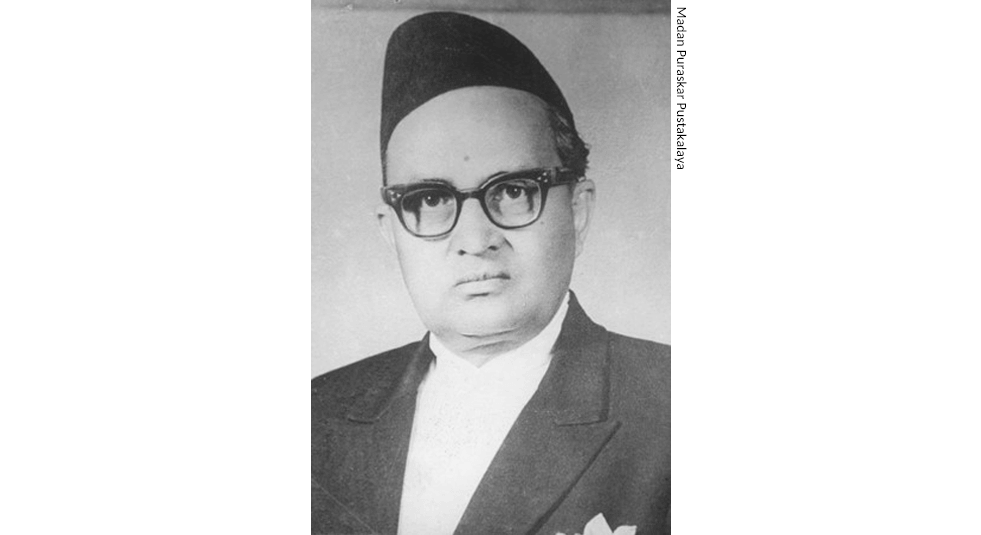
The beginning of Shree Bhim Nidhi Tiwari’s literary career clearly indicates that any kind of work undertaken by anyone is totally influenced by the environment of their past and their upbringing. He had witnessed his father Lal Nidhi Tiwari, who was General Tej Shumsher’s sycophant, writing various odes in order to please his boss. Having grown up in a literary, cultural atmosphere, Bhim Nidhi Tiwari’s life was carefree and leisurely and he began his literary career by first writing odes to himself! This was his first poem:
The trunk is long and the tummy big
The more one pulls, the longer it is
No one criticises this entity
I, who glorifies thee, am puny
This was an imitation, in Nepali, of an acrostic poem that spelt ‘Lalnidhi’. While writing the ode, the grammar might have been overlooked, but the child Bhim Nidhi’s psychology was already impacted by the era’s sycophantic tendencies. After contracting tuberculosis at seven, he stopped attending Durbar School after Grade Two, worried about his health, and grew up unrestricted and independent, even leading the Prabhat Pheri bhajan committee during the winter fair. As if anticipating internal transformations as a way to prepare for a literary career in the future, he even led the morning, afternoon and evening celebrations at Bhandarkhal, Thulo Gauchar, and Dillibazar’s Charkhal office, gradually embracing literature in the process. As a consequence of this Charkhal association, he was motivated to complete Grade Three at the age of 13, and began writing up lawsuits and court decisions, earning one mohar and three suka daily, which he invested in plants (a lover of nature) and pigeons (a free-spirited being).
At the age of 14 or 15, after being rejected from Bhim Shumsher’s palace—he had gone there looking for a job—he calmed down his fury by working as an apprentice in an office tasked with Madhesh management. But he still wasn’t at peace and so headed East and escaped to Calcutta for further studies. He was compelled to return promptly though, due to his father’s ill health, and that same year he got married for the first time, which resulted in a separation maintained to this day. Later, in 1935, he went to Benaras, graduated, and was enrolled in Intermediate of Arts (IA) but was unable to complete due to his father’s death that same year. ‘What’s the point in studying,’ he began philosophising, a contrarian, but this ‘philosophy’ might have dissolved in the year 1962 when he passed the IA exams along with his daughter and son-in-law!
On the other hand, enmeshed in family affairs after his father’s death, he took up a job in the cottage industries in 1939, and went to India for training related to textile technology. But he had already made an impression in the literary sector and so was able to transfer to the education department. He began with a salary of 900 rupees per year but today he is a chairman of that same office—Nepali Bhasa Prakashini Samiti.
After democracy, he was invited by the Indian government to tour North and South India. While travelling, he was lucky to be alive after a motor accident near Ambala, but according to him, he was destined to face a bigger and more serious accident in 1961. On his way to Putali Sadak for an x-ray appointment, his rickshaw was struck by a motor car and Bhim Nidhi-ji was bedridden for a whole month, unable to move.
* * *
So, one evening, we—Bhim Nidhi-ji, his two sons, two daughters and myself—were in the ground floor room of Tiwari ashram. Do not imagine a regular ashram when I say ‘Tiwari ashram’; this ashram was a ‘modern hut’, a concrete building. The room could probably hold up to ten people, but the six of us, sitting in chairs, were a bit congested because most of the space was filled with books. These books were for sale, and there wasn’t space for additional items. I introduced a topic, and Bhim Nidhi-ji, hoping for support from his eldest daughter, Benju, was saying, ‘Actually, I am a thoughtful person—without thoughtfulness, nothing is nice. If the intentions are solid, even a monarchy can be beneficial and if the rulers are thoughtless, communism can be terrible. And, by the way, I prefer socialism.’
We were sitting across from each other; there was a table between us. On my right was a chair occupied by Benju and Manju. The conversation was proceeding, ‘You know how we stick to a routine of eating lunch in the morning and snacks in the afternoon, but we still eat whenever we get hungry? I prefer writing in the mornings but I can write whenever I feel like it—morning, afternoon, evening, or night, doesn’t matter. Although these days I don’t write, I make my daughters write.’
He smiled and added, ‘That’s why Benju-Manju maintain that they are the writers, not me.’
‘Why not write yourself?’
‘I am unable to accomplish anything concrete these days due to ill health. Sometimes I get infused by random poems, which is when I call my daughters and dictate to them.’
He resumed in an animated tone, ‘Oho! All of my four children are getting more interested in literature every day. The daughters write poems and whenever I am on my way to recite a poem for a poetry conference, I am allowed to leave only after showing the poems to them and getting their feedback. They’ve become sharp,’ he said and readjusted his loose spectacles. When I glanced at his children, they were all smiling, some due to shyness and some due to pride.
When I expressed my intention to get acquainted with his perspective on modern literature, he began expressing his ideas, ‘To me, modern poems (and literature) are those that are able to examine social dynamics in an immersive way and make connections to the public’s trembling aspirations. We have now passed the era of describing rainbows, roses and butterflies. No need for prosody or grammar but space for sentient beings to scream—those are modern poems! The rose is not displaying beauty, it’s revealing its innermost aspect; but you are unable to discern this vulnerability. Whenever people pointed at a beautiful objects, I began noticing its sorrow, stress. and pain. What was considered ethical before has been transformed today. I can see the same tendency when it comes to admiring nature.
‘And the other thing,’ he continued, ‘I don’t bother with rhymes and prosody these days. Not because I’m unable to—because I prefer free verse and have been using that style. But I feel that this new surge in our literature isn’t suitable for society.’
‘What kind of surge?’
Perhaps because he didn’t want his daughters to hear, he whispered ‘sex’ and then, ‘This trend in writing vulgar literature in the name of Freud doesn’t suit our society. That’s why, other than sex, I’ve written 144 stories about every topic, and that’s not even considering the plays, poems, and ghazals…’
Bhim Nidhi Tiwari entered the public literary scene in the year 1935 with his purposeful poem ‘Kabita Harayo’ and that’s when his rivalry with [Bal Krishna] Sama-ji began. That same year, his popular poem ‘Suryaghat’ was published in Gorkhapatra, making him one of those few writers who began their literary career with the national newspaper. The poem ‘Suryaghat’, admired by the then Director General as ‘grave, simple and nice’ was later included in his first book, Baiyasi Ghazal. Although it was censored by the government for some time, the restrictions were later removed and the book ended up garnering popular interest. His second book, a lamentation titled Tarpan, and his third book, a social play, Sahanshila Sushila, were correspondingly published in 1958 and 1959. In this way, his words began dancing on blank paper and consequently, between 1935 and 1964, a period of approximately 30 years, he published 31 books, which includes plays, poems, novels, stories and ghazals, a mixture of diverse genres and topics.
When it comes to publications in Nepali literature, no one has been as prolific as him, and when it comes to veteran masters, he stands in the third place after the esteemed poet Lekh Nath [Poudyal] and Bal Krishna Sama. Grand introductions to Bhim Nidhi’s various books are also included in Tiwari ashram’s booklet. For example, regarding Sahanshila Sushila: ‘The fifth scene in the previous installation has infused women’s consciousness with revolutionary ideas…By using familiar folk tropes, it has sparked historical self-awareness.’ And about Putali: ‘Includes all the elements required for a theatrical play such as plot, dialogue, characterisation and psychology.’ In this way, each of his works is decorated with various adjectives. On top, his lamentation, Yashashwi Shabha, was awarded the National Prize by His Majesty in 1955 and his poetry collection Bishphot received the Madan Puraskar in 1960, the year the committee began considering poems.
Unfortunately for him, none of his works have managed to stir a critical discourse in the literary sector and he is generally ignored within intellectual circles. Most critics haven’t bestowed much significance to him. Most accuse him of ‘being involved in every issue and genre without due diligence and required skills’.
Perhaps that’s why he remarked, ‘When I consider Nepal’s critics and reviewers, sometimes I get amused and sometimes angry. It’s easy to become a writer but difficult to become a critic.’
Not yet ready to stop, he expressed his wish in this way, ‘Out of one crore Nepalis, I’m looking for only one person who would study and ponder all of my works. They can forget me, and without anger, jealousy and resentment, I wish they would provide a special criticism from which I can learn.’
Abruptly, Manju screamed, ‘A mouse, mouse’ and a mouse emerged between books and ran away.
‘Why are you screaming?’ Shree Bhim Nidhi scolded. Outside our room, a garden, perhaps well-tended at one point, now appeared like a jungle at this late evening hour, in the monsoon, perhaps influenced by the carefree atmosphere. Lots of mosquitoes! Because I was wearing a sleeveless shirt, the mosquitoes were attacking me relentlessly. It might be considered uncivilised if I complained, so I tolerated the bites nervously and continued my conversation with Bhim Nidhi-ji. Pointing at a souvenir which symbolised his Madan Puraskar win, he said, ‘Madan Puraskar has greatly benefitted writers and the future of the Academy is also quite bright.’
As soon as I heard the word Academy, I remembered something - ‘Did you write the poem “Ma Chin Hoon” because you couldn’t become an Academician?’
‘Yes, I wrote the poem because I was denied membership at the Academy. But these days my position is such that although the Academy has invited me to become a member for a few years, I’ve been rejecting it. If I wanted, I could formalise my membership any day but I won’t. Regarding “how” and “why not”, I don’t consider it appropriate to reveal palace secrets to the public. I am content with His Majesty’s views about me.’
For a moment, I was quite stunned by his response. To avoid the ensuing awkwardness, I asked, ‘Would you like to say something about your favourite writers and those who inspired you?’
‘I can’t name anyone really,’ he responded. ‘Society and nature are teachers. I learnt a lot from nature by spending time outdoors until the age of 14 or 15,’ he said, as if he was chatting with Benju, and once again began praising the same Charkhal office, Thulo Gauchar, Bhandarkhal, and Bagmati.
Bhim Nidhi Tiwari-ji, who had enough to make ends meet but not enough to publish his books, is quite tranquil when it comes to the future of Nepali literature. He says, ‘The future of Nepali literature is quite bright. Literature might not have penetrated the Tarai and the mountains due to lack of education, but its future is hopeful. Nepali literature is quite dynamic abroad. Half of my own books get sold abroad, the other half in Nepal.’
In 1938, Bhim Nidhi-ji had founded the Nepali Sahitya Press and in 1947 he was a coordinator of the newspaper, Gharelu Eelam Patrika. In this way, he has been invested in every aspect of literature, but for some reason, he has been unable to achieve exceptional acclaim in the literary sector. I had one final query, so I requested, ‘Out of your 31 books, which one do you consider to be the best?’
He fulfilled my wish: ‘When Dhir Shumsher was asked, out of his 17 sons, which one was his favourite, he couldn’t respond. I like all of my works, they are all good—no matter what, they are my creations.’
Saying ‘Thank you’, I rose and bid him farewell.
—19 August 1963
A recipient of the Madan Puraskar, Bhim Nidhi Tiwari (1911–1973) was a famous poet of the post-1950s era and a prolific writer, producing 38 books. He represented Nepal at the 1966 East Asia UNESCO seminar, which focused on copyright issues.
Uttam Kunwar (1938–1982) was the publisher and editor of the monthly periodical, Rooprekha ...
Uttam Kunwar (1938–1982) was the publisher and editor of the monthly periodical, Rooprekha, still remembered today as a milestone in the history of literary journals in Nepal. Readers interested to learn more about him and his work can click here.
Niranjan Kunwar is an educationist whose career includes teaching in primary schools and mentoring teachers in Nepal. ...
Niranjan Kunwar is an educationist whose career includes teaching in primary schools and mentoring teachers in Nepal. His memoir, Between Queens and the Cities, was published by FinePrint in 2020. A chapter book, Mijok’s Trip, was published by van Doesburg Creative Works in August, 2025 and his English translation of Seto Dharti, titled A White Life, was launched by FinePrint in December, 2025.

