
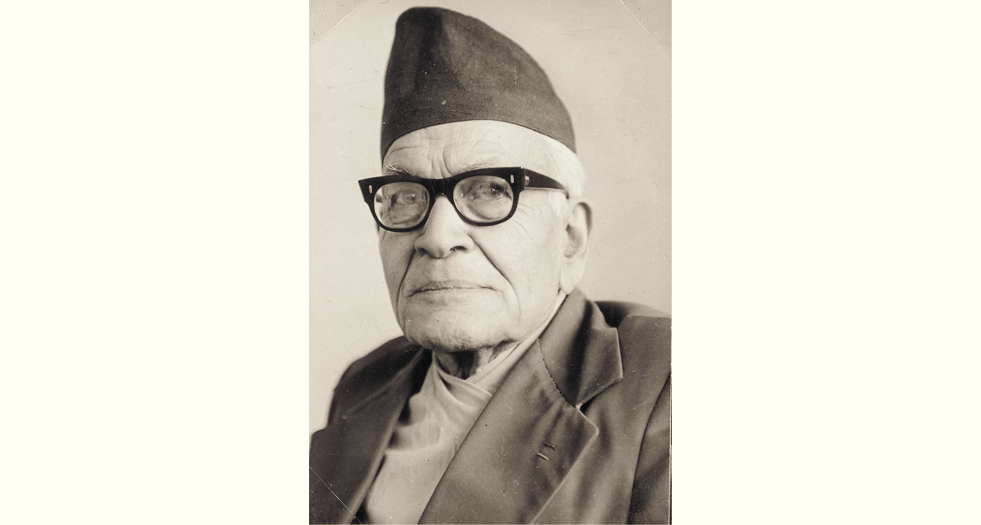
From a somatic standpoint, there’s nothing noteworthy about Shree Surya Bikram Gyawali: white hair according to age, a well-rounded, chunky body, moustache and spectacles. And he mostly spoke with gritted teeth—no point repeating all of that; an ordinary physicality resembling an average person. But when it comes to his work, it’s quite unique, and significant. In Benaras, he published a monthly called Janmabhumi and contributed articles regularly to newspapers and magazines.
In 1923, after quitting his co-editorial position at Allahabad Leader, he went to Darjeeling to work as a regular government-appointed high school teacher. A year after that, in collaboration with other linguaphiles, he formed a collective devoted to the Nepali language. Who can forget his contributions as a secretary, a chairperson, and an editor? Because of all the good deeds by aficionados like him, a scholar recently declared that it will take another two decades to raise the standard of Nepali language in Nepal compared to that in India. We all read that in Bharati, didn’t we?
I’ll speculate that he was probably involved in most of the books published in Darjeeling in 1956. There are hardly any writers who don’t seek his counsel. Not only that, he picked up where Motiram Bhatta left off, Motiram Bhatta who properly introduced Shree Paanch Bada Maharaj Prithvi Narayan Shah and Bhanubhakta Acharya to the Nepali public. And our language—what is it, really? Oh, right—Nepali! Before, there were other terms like Khas, Gorkhali, Parwatiya, and whatnot and its usage was limited to a small region, far from everyday realities and detached from general truths, similar to how some refer to our Bada Maharaj as an inhumane plotter. But Gyawali-ji liberated language from its limited periphery and renamed the Gorkha Bhasa Prakashini Committee as Nepali Bhasa Prakashini Committee. He was also involved in a campaign that successfully renamed the Parwatiya language as Nepali at Calcutta University.
So I’ve already met him, a meeting in which I resolved my curiosities and completed my queries. Although he has contributed to literature in myriad ways, his own subject was in fact history. As we all know, he was specifically focused on Nepal’s history. More than half of the dozen books he has edited and written have titles like Prithvi Narayan Shah and Bir Balbhadra. Prithvi Narayan Shah was popular with the public as well as critics. And when it comes to the content of these history books, what can I say—the idea that Nepal’s history is glorious will get imprinted in every reader’s psyche. I was a bit suspicious at first, knowing that history can be made up. Do you know what I asked him when we met? ‘Gyawali-ji, Is Nepal’s history truly glorious?’ I don’t know how he felt after a question like this; probably a bit uncomfortable.
Sitting cross-legged and in a determined tone, he had responded, ‘Isn’t it glorious? It definitely is comparable to India’s history. There was a tradition of hiding the truth and writing demeaning things when it came to Nepal’s history. I began uncovering facts based on rigorous research.’
Despite the nature of my question, the response was heart warming. He added, ‘You were probably hoping for an answer like that, right?’
‘Yes. I’m also curious as to how you ended up being a historian.’
He provided a mirthful and patriotic response: ‘During my student days, we had to read about India’s heroes and heroines. There wasn’t a single book dedicated to the peoples of Nepal. I began wondering, Why only Indians? I felt strongly that Nepalis should also be included. Later, this intention captivated me, and I began researching about Nepal.’
‘What was your research based on?’
Smiling gently, he replied, ‘As I mentioned before, I was intent on collecting historical facts that highlighted outstanding events.’
‘Gyawali-ji, you maintain that Nepal’s political history is illustrious. What about our literary history?’
Somebody served us tea.
‘Go ahead,’ he gestured and continued, ‘Literary history is also quite marvellous. And there has been progress. But due to a lack of equipment, there hasn’t been as much progress as it should have been.’
‘And how can there be?’ I offered, supporting his stance, ‘If an institution as powerful as Nepal Academy hasn’t shown much interest or fulfilled its core duties, forget about regular folks.’
But he didn’t offer the same kind of support—‘It’s not quite like that. It’s true that Nepal Academy hasn’t been able to meet the public’s expectations but it still has the power and knowledge to accomplish tasks.’
‘OK,’ I said meekly and remained silent. There was no point analysing this in detail since everyone knows what the truth is.
So I’ve been reporting our conversation but haven’t described the room properly. Let me do that since his environment might provide more insight. The room was also pretty simple. A mattress on the floor and a desk next to it; a pile of books on one side and on the other, a typewriter. A large curtain divided the room into two parts.
His admission—‘A well needs to be dug; something to call home’—had already acquainted me with Gyawali-ji’s condition. I regretted hearing that. And my regret sharpened when he said, ‘I’ve done so much work related to history but there’s no one who has followed my work and is eager to continue.’
Wouldn’t that make his work incomplete? I bet the readers and other scholars have similar concerns. In any case, I found out that Gyawali-ji devotes the morning hours to his historical writings and research; as for other random compositions, whenever he gets in the mood.
Several people have said that compared to his earlier body of work, his output has dried up in recent years. So I asked him about it. As soon as he heard my question, he began responding, disagreeing with the accusation, ‘It’s not that I’ve been distracted from my work. In fact, I’m putting finishing touches on Madhyamik Kaalko Itihaas. Then, I’m planning to focus on Nepal’s ancient history. I don’t agree that my work has suffered after moving to Nepal from Darjeeling. But my pace is indeed a bit slow.’
Almost three hours had passed. Not wanting to take up more of his time, I made a final request, indicating we were reaching the end, ‘In your opinion, what kind of future does Nepali literature have?’
He replied characteristically, gritting his teeth, ‘I have faith in the future when it comes to Nepali literature. It might take some time, but our literary future is beautiful. No need to worry about that. And I’m certain that nothing can stop the development of our powerful Nepali language.’
—April 15, 1962
Surya Bikram Gyawali was a Nepali historian, born in British India’s Benaras in 1898. He moved to Kathmandu after the 1951 revolution, eventually serving as the Chancellor of the Nepal Academy, among various other positions. He passed away on 1 December 1985 in Kathmandu.
Uttam Kunwar (1938–1982) was the publisher and editor of the monthly periodical, Rooprekha ...
Uttam Kunwar (1938–1982) was the publisher and editor of the monthly periodical, Rooprekha, still remembered today as a milestone in the history of literary journals in Nepal. Readers interested to learn more about him and his work can click here.
Niranjan Kunwar is an educationist whose career includes teaching in primary schools and mentoring teachers in Nepal. ...
Niranjan Kunwar is an educationist whose career includes teaching in primary schools and mentoring teachers in Nepal. His memoir, Between Queens and the Cities, was published by FinePrint in 2020. A chapter book, Mijok’s Trip, was published by van Doesburg Creative Works in August, 2025 and his English translation of Seto Dharti, titled A White Life, was launched by FinePrint in December, 2025.

