
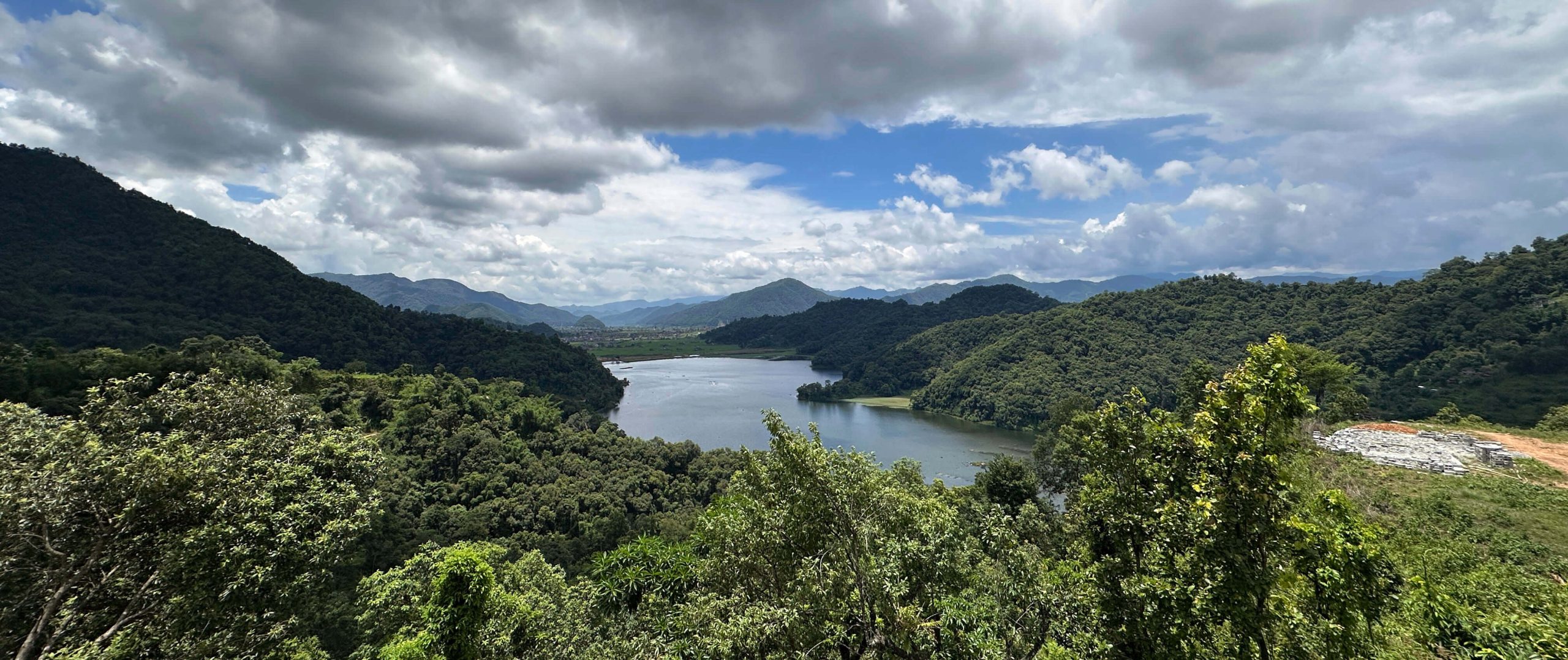
Nepal can boast of stunning snowcapped mountains and lush tropical forests. But like much of the Global South, it also grapples with urgent multi-facted environmental threats. Deforestation, although down in recent years, threatens soil erosion, hydrologic degradation, habitat destruction, and disrupted rural livelihoods. Pesticides, lead, and other hazardous substances undermine environmental and human health. Dams, roads, airports, and other new infrastructure chew up natural areas. Urban air, water, and soil pollution imperil nature and people. Climate change makes everything worse, as temperatures climb even faster in the Himalaya than elsewhere on the planet. Nepal as a country faces climate injustice, but climate change especially jeopardises marginalised and vulnerable groups.
At the same time, few countries are as unequal as Nepal. This inequality worsens environmental problems, just as environmental problems exacerbate social marginalisation. Dalits and Adibasi Janajati minorities—approximately 13 and 33 per cent of the population, respectively—face not just unfair resource allocation but also barriers in schools, worksites, and public places. Women of all groups face limited opportunities and inequality in all realms. The rural and urban poor—often made up of these marginalised groups—suffer from inadequate infrastructure, lack of educational facilities, and limited access to healthcare, perpetuating the cycle of poverty. Many people face intersecting forms of oppression.
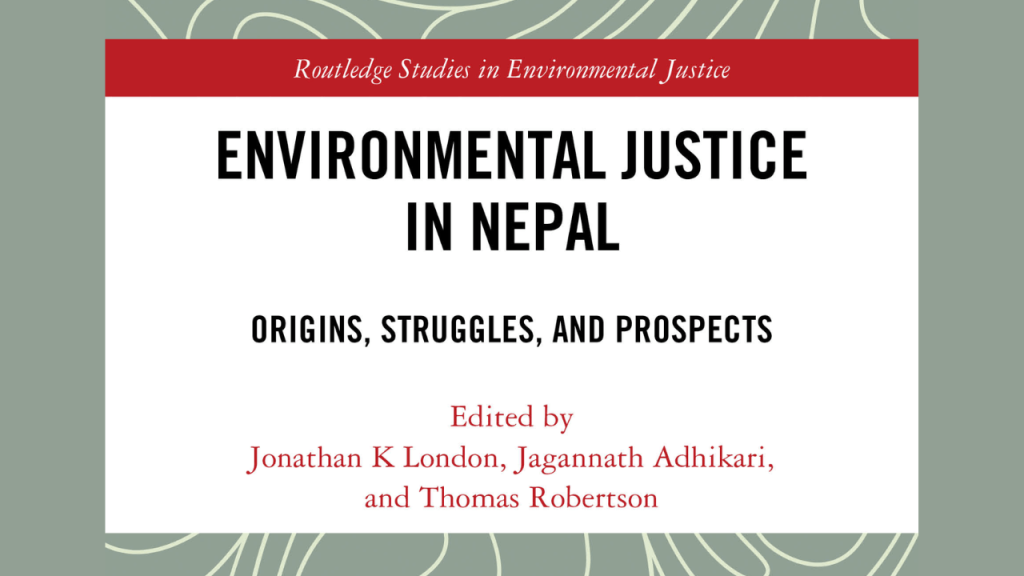
Our 2025 volume—Environmental Justice in Nepal: Origins, Struggles, Prospects—examines how Nepal’s environmental problems interweave with social, economic, and political marginalisation. How do environmental threats mesh with overlapping lines of caste, ethnicity, gender, and social class? How do Nepal’s poorest and most marginalised face disproportionately heavy burdens of air, water, and soil pollution and environmental degradation? Given that Nepal is globally renowned for both the severity of its environmental crises and the creativity and persistence of social movements to confront them, how do marginalised groups respond to environmental problems and push for greater equality? Unlike books that look at fields and forests and streams in isolation from poverty and caste/ethnicity and myopic bureaucrats, this book combines environmental concerns with equity-focused socio-economic analysis. That is, it views Nepal’s environmental and social landscapes through a holistic lens.
To do so, we adopt an ‘environmental justice’ framework. Broadly construed, environmental justice (EJ) looks at how environmental inequality and social inequality are bound together in complex and mutually constitutive ways. More specifically, as Jonathan London outlines in his chapter in our volume, environmental injustice can be understood to be ‘overburdening of vulnerable populations by environmental contaminants, exclusion from environmental resources, and marginalization in environmental policy and decision-making’. Often mixing local, national, and global influences, environment justice in Nepal includes struggles over customary access to land-based livelihoods as well as fights over environment quality in its growing cities.
Building on a tradition of critical scholarship
In combining environmental and social analysis, we are very aware we are standing on the shoulders of other scholars, both Nepali and foreign, who have analysed Nepal and its landscapes in previous years. We try to build on their excellent work.
Jagannath Adhikari’s seminal work in the early 2000s laid the foundation for our current EJ work. Adhikari highlighted both the natural resource-based and urban environmental struggles of Nepal’s environmental justice field and addressed water, air, forest, agriculture, and other related issues.
Further back, Mahesh Chandra Regmi’s works from the 1960s to 1980s on the economic history of Nepal, particularly his Landownership in Nepal (1976), blazed a path for class-based analysis of natural resource issues. Piers Blaikie’s ‘political ecology’ work (1985, 1987) on the politics of soil erosion and critiques of the Himalayan Degradation Theory was followed by several others who wedded social and environmental analysis.
Stan Stevens’s Claiming the High Ground (1993) and Ulrike Müller-Böker’s The Chitwan Tharu of Southern Nepal (1999) documented how Nepal’s most famous national parks, Sagarmatha in the Everest region and Royal Chitwan in the Tarai lowlands, infringed upon the traditional rights of indigenous groups. Ramachandra Guha had excoriated ‘authoritarian biologists’ in similar critiques of Indian national parks in two influential essays (1989, 1997) and advanced the framework of the ‘environmentalism of the poor’. Y.B. Malla (2001) examined how local elites had captured the lion’s share of Nepal’s famous community forestry programme. R. Pandey (2004) described the toils faced by waste scavengers and street sweepers in urban Kathmandu. In 2011, Anne Rademacher showed in Reigning the River (2011) how river restoration of Kathmandu’s Bagmati River overlapped with myopic visions of who had the right to speak for and claim river resources.
In our book, we try to build on this scholarship to cover more topics and add updated information. In particular, we adopt what London in Chapter 2 refers to as a ‘new paradigm’ for EJ studies in Nepal that integrates the historical livelihood struggles of the ‘environmentalism of the poor’ with those related to increasing globalisation and urbanisation. We view Nepal as providing a unique contribution to the global field of EJ studies through its unparalleled diversity of cultures and ecosystems, its deep histories of oppression coupled with vibrant social movements, and the growing breadth and quality of its national scholarship.
The book offers 24 richly detailed case studies from around Nepal, all researched and written by Nepali authors. Our authors take readers from climate change problems in the high mountain regions and middle hills to lead and air pollution in Kathmandu’s once pristine valley to problems of deforestation and ‘fortress conservation’ in Nepal’s lowland Tarai. Individual articles examine women’s access to land ownership, Dalits and climate justice, pesticides, parks and Indigenous rights, the earthquake and Tamangs, solid waste workers, transportation fairness in Kathmandu, climate justice in Khumbu, TB, urban water, and lead and children.
Key EJ Lessons and Themes
These case studies offer several insights and suggestions for better understanding both Nepal’s environmental problems and its social organisation:
i. An environmental justice approach can highlight critical dimensions of continuity and change in Nepal. An EJ approach can illuminate the country’s many intersecting social and environmental inequities, revealing the true complexity of these problems that hold the country back from sustainable and equitable development.
ii. Nepal offers many rich case studies for global EJ scholars. Nepal offers the global EJ studies field rich and distinctive case studies of cutting-edge EJ issues in a developing world context. These issues are not unique to the Himalaya but can illustrate larger global patterns in unexpected ways.
iii. In Nepal, environmental matters always have a social angle. Social inequality based on intersecting structures of class, caste, ethnicity, gender, region, disability, etc, is crucial in shaping people’s differential experience of environmental issues. Unfortunately, too much environmental analysis focuses narrowly on the technical aspects of a problem, ignoring socio-cultural factors to their peril.
iv. Conversely, social hierarchies also always have an environmental angle. Social inequality in Nepal has deep historical roots in the inequitable distribution and control of land and natural resources. These problems continue in the current day but often in new forms. Social hierarchies related to class, caste, ethnicity, and gender also structure exposures to environmental hazards, creating extra burdens for those in society least able to face them. Social inequities also limit people’s access to decision-making and democratic governance.
v. Interdisciplinarity is crucial. The intersectional quality of environmental justice issues in Nepal, as elsewhere, defies traditional disciplinary boundaries. Likewise, too much technical training fails to prepare practitioners and policymakers for multi-faceted problems, and too rarely are true transdisciplinary teams created to match the complexity of real-world problems.
vi. The State often looms large. Nepal is a young, challenged but also vibrant democracy; EJ movements must be placed within this historical context. The role of the state is contingent and often contested. To what extent can the state address environmental and social inequities and not exacerbate them? How can it live up to its lofty rhetoric and legal frameworks, for instance, the provision in the Constitution proclaiming that citizens are entitled ‘to live in a clean and healthy environment’?
vii. Those victimised are rarely just victims. Our book attempts to move away from deterministic narratives based on class, caste, ethnicity, gender, region, and disability disparities that overlook agency and instead highlight how marginalised groups, though often pushed aside, usually find a way to resist and otherwise shape the course of events, even if in small ways. We also try to not naturalise these inequities but instead show how they are historically produced and therefore can be changed.
viii. Nature, too, is rarely just a victim and often resists or shapes outcomes in unpredictable ways. Our stories often show how humans have damaged environments, but here, too, we try to avoid pure declension stories that suggest that nature has little agency or resistive capacity.
ix. Exotifying or stigmatising Nepal means missing the reality. Many depictions of Nepal fall into the trap of either idealising Nepal’s spiritual and natural beauty or deriding its poverty and degradation. We follow a middle course of depicting the everyday struggles of real people, not cartoon characters playing along someone else’s script, in this very real place of both peril and possibility.
x. To see what’s really going on, we need disaggregated data. Many of our cases reveal the problem of governmental data that is not sufficiently contextualised or disaggregated by social group. They also point to the need for more information and data broken down by group and subgroup to better illustrate social and environmental inequities. Disaggregated data helps us to better see social marginalisation at work and provides the empirical basis for claims of injustice.
xi. You can help amplify the voices of the socially marginalised if you know where to look. In these chapters, we try to highlight the perspectives of those with marginalised voices in society, although we are aware of the epistemological and methodological barriers to doing so. Where possible, we try to highlight the words and experiences of subaltern populations. Whether these are Indigenous people defending stewardship of their traditional homelands, Dalits and Janajati confronting the impacts of climate change, or women addressing legacies of patriarchal land tenure, we seek to depict this courageous agency.
Final thoughts
In this volume, we tried to cover a lot of ground, but much remains to be done. In this spirit, we look forward to new scholarship on crucial topics such as: sustainable agriculture and food justice, in both rural and urban settings; animal rights and the rights and agency of nature; youth activism on climate change and other pressing issues; state and corporate violence against environmental defenders; environmental justice and local governance in Nepal’s evolving federal system; and transboundary impacts and conflicts.
At a conference associated with the book, one speaker described EJ as a kind of jerti (glue) that can hold together multiple strands of social-ecological analysis and social movements. We hope that Environmental Justice in Nepal: Origins, Struggles, Prospects can provide this integrative function to support Nepali scholars and activists as they struggle to make the country live up to its democratic and social justice potential. In particular, we would be gratified to see the book used as a text in existing and new environmental justice courses and programmes, a resource to inform public policy, and inspiration for environmental justice social movements in and beyond Nepal.
Note: The contents of Environmental Justice in Nepal: Origins, Struggles, Prospects is available online. Click here to access the book.