
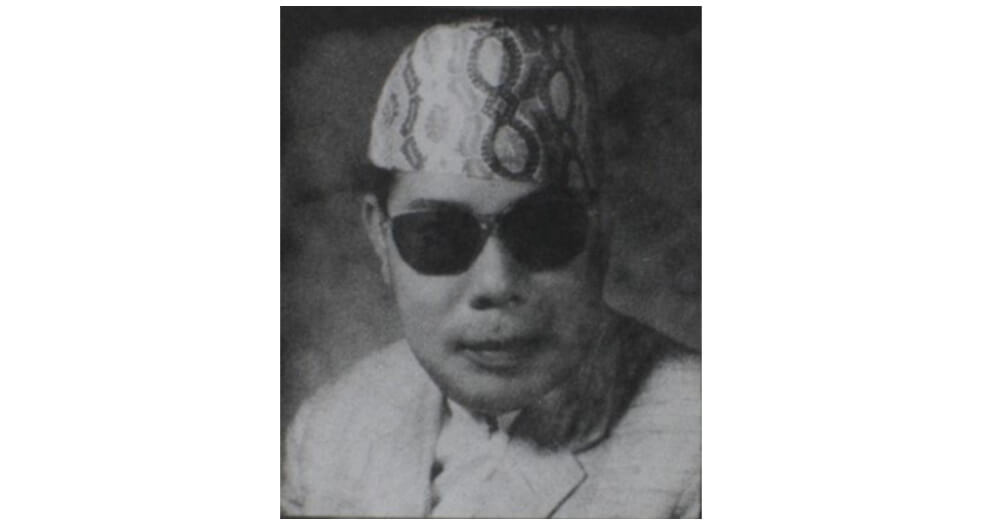
The intention is monumental, comparable to late Devkota-ji’s teachings. To not seek influence or entertainment, or anyone’s praise in this seventh decade of the twentieth century! Instead, to lead a very simple life in order to serve literature! That, undoubtedly, takes enormous willpower and refined moral consideration. But is this practical? Trustworthy? In other words, is it possible to implement this intention?
These sorts of blazing questions make our heads hurt; questions that easily provide negative answers. Rest assured, there’s no need in Nepali literature for literary folks who simply hold on to big ideals. What’s needed is experienced and practical individuals. These days, most are destabilised by their circumstances as opposed to personal whims. Still, hopefully these writers will prosper in the future. Most of us wish them well but are nervous that our hopes might get dashed.
Born in a feudal household, instead of learning to identify letters from the comfort of his father’s lap, he was taught to play with cowrie shells. But it’s admirable that this idle person, clueless about making ends meet, was now working hard to maintain his self-esteem. At first, mythological stories relayed by pandits to his father piqued his interest. He enrolled at Durbar School of his own volition and from a young age, began writing poems, participated in plays, became involved in various legal issues, got caught up in revolutions and faced all kinds of rumours. So, it is surprising, as well as admirable, to witness someone who had eventually managed to lead a life of integrity, his reputation somewhat secure.
Having faced societal taunts, psychological pain, and bitter life experiences—some of which were due to circumstances and some due to his own faults—the writer gradually detached from worldly affairs and became motivated to serve literature. And it won’t be surprising if this same writer produces work in the future inspired by his experiences. Because humanity, after all, is a sort of a laboratory, full of novel experiments as well as consequences each day. To that end, anyone sincere to their principles will certainly achieve success; and that person’s life will also be exceptional. And our literary sector will also benefit from their selfless service. Leeladhwaj Thapa, a winner of the Madan Puraskar prize for his novel, symbolises our collective wish.
* * *
It was getting hot in Kathmandu and the monsoon was approaching. I went to meet Thapa-ji in Hadigaun on one of those drizzly mornings. It was only after getting directions from more than one person that I was able to locate his residence. A concrete stairway jutted out of a window, rather unusual, perhaps constructed as a result of the recent plague to facilitate a speedy exit. Using this stairway, I went up to his small room; the space was further constrained by a bed covered with mosquito netting, tables and chairs, a radio and a closet, as well as a glass bottle filled with colourful fish. Thapa-ji’s prominent forehead on a long, angular face was accentuated by his bright eyes and fair complexion. Often clad in a well-ironed mayalposh-suruwal and coat with a slightly tilted dhaka cap, he wore modern eyeglasses, well-polished shoes, rode a shiny bicycle, and sometimes indulged in self-mockery, aware of his own sense of style and the care he took to dress up. But there was a stark difference between this external appearance and how he looked inside his shabby room. Perhaps due to his shaky financial situation. In any case, he seemed to make ends meet and for that, he was grateful to God.
After making some small talk, I expressed my curiosity, ‘Thapa-ji, I don’t understand why you focus on personal flaws in your literary projects?’
‘When Ram speaks, Ravan appears flawed; and when Ravan speaks, Ram is the flawed character. That’s the nature of defects—one can’t extricate oneself from this blame game.’ His response was agreeable but I was still processing some statements he had uttered earlier. What he had said was this: ‘One shouldn’t attack someone personally if one doesn’t agree with them on principle—but a few famous personalities in Nepal have demonstrated this tendency.’ Unpalatable, yet true—whether we choose to agree or disagree with this stance is a personal matter.
For some reason, I abruptly changed the topic, ‘So what sort of topics do you like to write about?’
He replied in his usual self-satisfied tone, ‘When it comes to prose, I prefer tackling contemporary social issues; and in poetry, I prefer exploring satire, using karun rasa [the sentiment of pathos]. Because I have faith in the public sphere, I sometimes insert progressive ideals in my literary works.’
‘Oh. So, you believe that literature ought to be progressive?’
‘You could say that. Because literature should not limit itself with aesthetic concerns. Literature should serve the country, depending on context, wanting to improve things.’
‘In that case, you must be involved in something these days, in order to fulfil your goals?’
‘I’m working on a novel, along with a few poems and stories.’
‘Depending on your mood—?’
‘That’s how it is. That’s the nature of “mood”—its arrival doesn’t depend on the right time or place.’
‘And I wanted to confirm something. In terms of your own work, do you consider Mann to be the best?’
‘Actually, no. When it comes to novels, Purwasmriti; and in terms of poems, I think Varun is the best.’
‘What about writers?’
‘Lekhnath and Devkota. Devkota was my teacher.’
In this chain of questioning related to his opinions and private wishes, I posed this question, prompted by a woman who had just left after serving tea to us, ‘Thapa-ji, you married when you were quite young, right?’
Taking this opportunity, he spoke at length about his relations with Bal Krishna Sama’s family and related events and consequences. Finally, he said, ‘I got married in 1942; she died in 1951. Two years later, I remarried which resulted in two sons. And then last year, I made another attempt as per the Gandharva tradition [a consensual union between two people without formal rituals].’
His amusing response made me giggle, and as if anticipating a challenge, he resumed, ‘According to the census, there are more women than men in Nepal. Rather than sending them abroad or reserving them for the future or conducting affairs in secrecy, it’s more honourable if powerful men get married a few times.’ His face flustered as he made this defiant expression.
‘I guess this can also be considered progressive,’ I thought, and then articulated another query, ‘What’s your take on purity when it comes to Nepali prose?’
‘I’m not fond of current tendencies. Language has its own tradition. Just because someone like Taranath-ji and Sapkota-ji inserted a couple of words from their regions, the writing doesn’t automatically become pure. Because language can’t be pure.’
‘What about modern poems?’
‘I don’t like those either. Poems written in prosody are comparable to statues inside temples, which means prose poems are like statues tossed in a field. But contemporary writers are rejecting prosody without actually understanding what it is. There’s nothing as bad as judging things without truly comprehending their true nature.’ Thapa-ji’s prose is generally well-liked by his readers and when it comes to rhythmic poems, he is an expert.
I had another question. ‘Thapa-ji, did you receive any encouragement when it came to your writing journey?’
‘I have. And I have to say I continually get inspired by Madan Puraskar despite their mistakes and charitable work, most of which is conducted almost as an apology to mask its inception. And the Royal government also prods us in a positive direction now and then.’
‘And what are your views regarding the Nepal Academy?’
‘Listen, I’m affiliated with the government. If I speak in practical terms, I can only tell lies. And if I actually point out the flaws, I’ll be risking my employment.’
‘Thapa-ji, have there been any special moments this past year during your leadership of the Nepali Bhasa Prakashini Samiti?’
‘Nothing special, other than the fact that being involved in this business of publishing has hampered my creativity, which is diminishing daily. It would have been better if I were directing plays at the Department of Archaeology or was a newsreader for Radio Nepal. Because a Nepali like me can survive in specially diverse Nepali ways; I can sing or act.’
I requested him to demonstrate his acting skills. He agreed, selecting a melancholic segment from Amar Maya, the first time he published in book-length format (The poem, ‘Aansu’, was his first creation to appear in print, published by Sharada in 1960). We were both in a joyful mood but as I watched him act, a sudden sorrow infused my being. I was, in fact, stunned by his impactful showmanship. He had begun his career as a child actor and was a cast member of Sama-ji’s Pralhad when he was just thirteen.
Time indeed flies; four hours had passed since my arrival. Since it was time for Thapa-ji to get to his office, I bid farewell and returned to my rented flat.
—April 15, 1962
Leeladhwaj Thapa (1921–1984), a Nepali novelist, was awarded the Madan Puraskar for Mann in 1957.
Uttam Kunwar (1938–1982) was the publisher and editor of the monthly periodical, Rooprekha ...
Uttam Kunwar (1938–1982) was the publisher and editor of the monthly periodical, Rooprekha, still remembered today as a milestone in the history of literary journals in Nepal. Readers interested to learn more about him and his work can click here.
Niranjan Kunwar is an educationist whose career includes teaching in primary schools and mentoring teachers in Nepal. ...
Niranjan Kunwar is an educationist whose career includes teaching in primary schools and mentoring teachers in Nepal. His memoir, Between Queens and the Cities, was published by FinePrint in 2020. A chapter book, Mijok’s Trip, was published by van Doesburg Creative Works in August, 2025 and his English translation of Seto Dharti, titled A White Life, was launched by FinePrint in December, 2025.

