
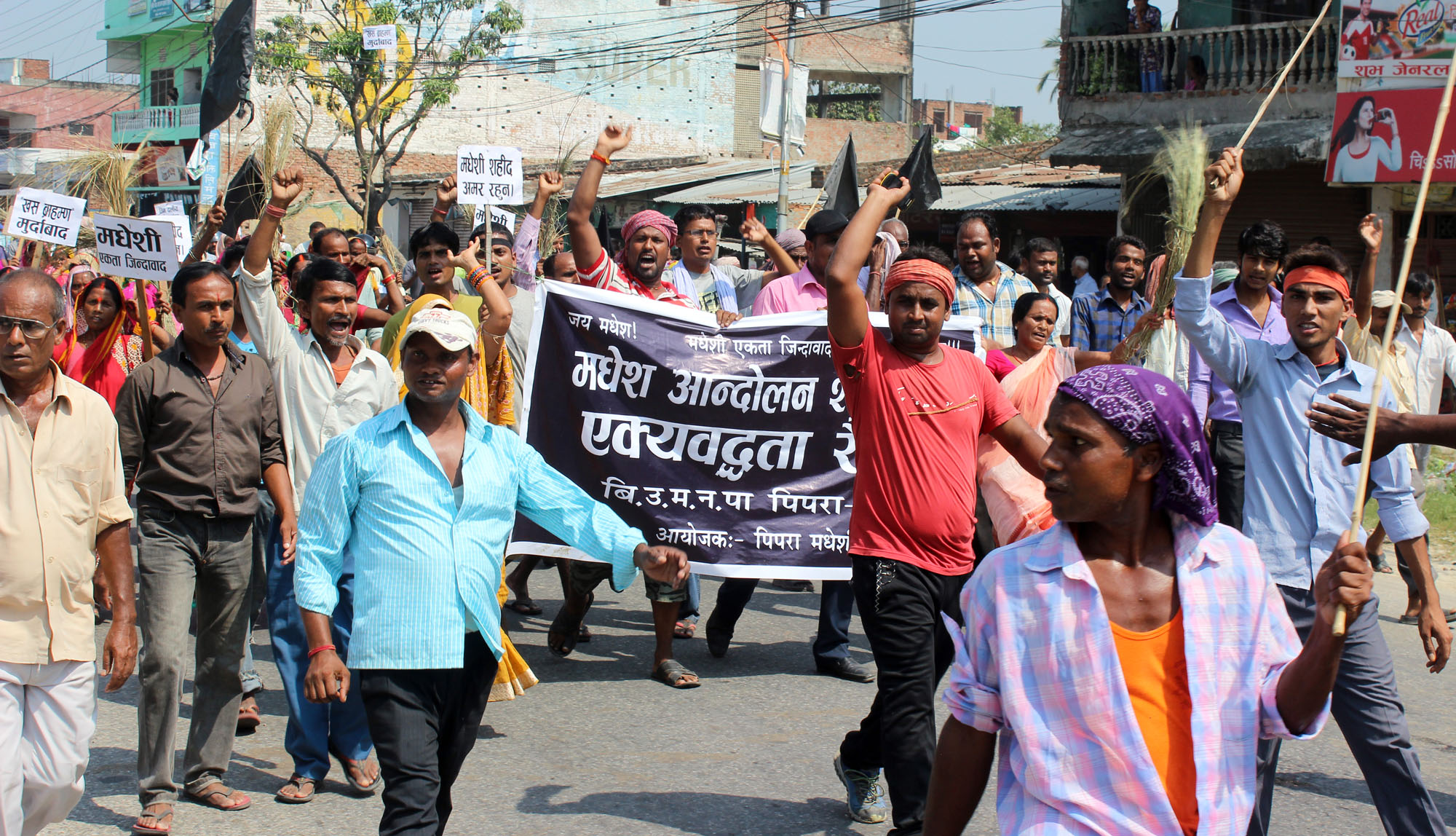
What makes a movement successful? Is it the brilliance of its core leaders or the collective pulse of ordinary people? And if we call them ‘ordinary’, do we risk overlooking the extraordinary in them that sustains a movement? These questions take me back to the Madhesi women I met during my fieldwork in 2023—women whose stories continue to unsettle the neat boundaries of political history.
As I walked through the villages of Parsa district, I was trying to trace the roles Madhesi women had played during the 2015 Madhesh Movement—a mass uprising demanding rightful representation and recognition in Nepal’s new constitution.
Finding them wasn’t difficult. Every household, every lane, every courtyard carried echoes of that time. When I asked locals who I should speak to, they smiled and said, ‘Pura Birgunj andolanne me rahe—apne kekaro se puchle’ [‘All of Birgunj participated in the movement — just ask anyone you meet’].
That sentence stayed with me. It revealed how collective memory turns entire communities into living archives. It hinted at a collective ownership of struggle, where participation was not a matter of choice but of being. In those words, the boundary between the personal and the political dissolved. Everyone, it seemed, had lived the movement, even if not everyone had led it.
Among the many conversations that unfolded, one remains etched in my mind—the story of Rita, a woman who, until the 2015 Madhesh Movement, had never imagined herself as political.
I used to listen to FM and watch the live broadcast on Birgunj TV. I saw the brutal killings of our Madhesi daju-bhai. My husband was from the UML party—the one against the movement. He didn’t participate actively, but as a Madhesi, he silently supported it. I kept questioning him — how could he stay away when our people were dying? I kept insisting that we join the protest. Finally, after many discussions, he called a meeting in the village. Those who owned tractors agreed to take people to the Birgunj–Raxaul border. We had one, too. The next day, many of us—men and women—went together in solidarity.
Rita had never seen herself as political. She had never marched in a rally or spoken in a public forum. Her world had revolved around her home, her children, and her fields. Yet, witnessing violence on the screen—and the silence of those around her—transformed something deep within.
Her story questions the notion of ‘common people’ as passive observers. What emerged in Rita was not simply outrage, but a moral awakening—an inner compulsion to act, to make her presence felt in history. She exercised her agency not through grand gestures, but through persuasion—convincing her husband, her neighbours, and finally leading a group on her own tractor to the protest site.
* * *
AT THE OUTSET of my fieldwork, I consistently received suggestions to interview the women involved in politics and activism and directly engaged in the movement. That is to say, those considered to be well-informed (padhelekheko–bujhne). That perhaps explains why there is hardly any research on or general discussion about women’s involvement and support from within the household in the wider field of movement studies in Nepal. Such women are rarely recognised as political actors. Confined within their households, their contributions are often categorised as moral support rather than political engagement. But what if the household itself was one of the movement’s most crucial frontlines?
Aalok, whose recollection of his mother captured this subtle-yet-profound transformation. ‘During the demonstrations, my mother would watch from the balcony and on live television. My father, a journalist, and I were both active in the protests. One day, while watching the coverage, she asked me why people were protesting. When I explained the issue of citizenship—that Madheshi women who came from India through marriage couldn’t pass full citizenship rights to their children—she was stunned. She said, “Oh! This movement is relevant to me as well. It’s for my rights.”’
That moment of realisation turned observation into participation. Once merely a spectator, she began offering refuge to protestors fleeing police violence, allowing them to hide inside their home. When demonstrators outside prepared to burn tyres, she brought them kerosene and matches. Her empathy had evolved into action—a transformation that mirrored that of countless Madheshi women who discovered, often suddenly, that the movement was not distant but deeply personal.
Nitesh shared a similar story. ‘My mother, like many Madheshi women, was shocked to learn that she couldn’t transfer full citizenship to her children despite years of marriage in Nepal. She said to me, “If this is the law, then where do women like us belong? If the movement opposes such discriminatory attitudes, then we must support it.” She supported us quietly—cooking early, packing food, and reminding us to wear shoes instead of slippers so we could run faster if the police chased us.’
Hefurther reflected on the invaluable support women extended during those volatile days. ‘During the protest, I fractured my leg while running from the police. I fell, and in the chaos, several protestors trampled over me. A woman I didn’t even know pulled me into her home. She boiled water to clean my wound, applied ointment, tore a strip of cloth to bandage it, and offered me food. I rested there until evening when the protest subsided, and later used her phone to call my father to pick me up.’
Several political leaders I talked to credited these unnamed housewives with saving their lives. In the chaotic streets of Birgunj, they found sanctuary in open courtyards and unlocked doors. The quiet hospitality of these women blurred the lines between compassion and rebellion. The women who stayed home did not abstain from politics; they practised it differently—relationally, affectively, and morally. Their support was not passive but performative: it materialised through acts of feeding, sheltering, healing, and insisting that the safety of others mattered. In these moments, the domestic sphere became a site of resistance—not because it was invaded by politics, but because it always contained the potential for it.
The stories of Alok’s and Nitesh’s mothers, like Rita’s, compel us to rethink what political agency looks like in Nepal’s protest movements. They remind us that the Madhesh Movement was fought not only in the streets or at the border but also in living rooms—where ordinary women, watching from balconies, began to see their own lives reflected in the smoke rising from the burning tyres.
During the movement, the homes lining the protest routes became unexpected extensions of the street, and the women inside them emerged as indispensable actors. From rooftops and balconies—spaces usually associated with domestic routines—they watched the demonstrations with a mixture of concern, vigilance, and solidarity. Many protestors said that they moved through the crowds with a sense of reassurance, knowing that if the heat overwhelmed them or if the police attacked, the women watching from above would intervene. Their presence and watchfulness formed a powerful support network that held the movement together from within the household.
As the protests intensified, these women’s balconies became sites of moral witnessing. When the police chased and beat protestors, the women shouted down from above, their voices cutting through the chaos: ‘Leave them! Aren’t they someone’s children?’
These cries articulated something larger than empathy—they asserted a moral claim against state violence, grounding the movement in an ethic of care. Through their words, they reframed the protestors not as threats or agitators, but as vulnerable bodies deserving protection, dignity, and recognition.
Their participation extended beyond vocal protest. Many women defied the risk of being identified by authorities and recorded photos and videos of both the demonstrations and police brutality—creating a grassroots archive of the movement from the vantage point of their homes. At the same time, they offered immediate, embodied care. Standing on rooftops with buckets of water, they poured relief onto the protestors below, easing the burning heat and washing away the sting of tear gas. From their refrigerators, they handed out cold water to those fleeing or exhausted, transforming household resources into political tools of sustenance.
Protestor Pradeep Yadav told me that on scorching days, he was ‘relieved countless times’ by these women’s efforts. After he won a parliamentary seat in the aftermath of the movement, he publicly acknowledged them, expressing gratitude for their acts of support and solidarity.
Muni Shriwastav—a widely recognised figure of the 2015 movement in Birgunj—said that her activism made her a frequent target of police surveillance and harassment. On one occasion, while she was on her way to join a protest at Maisthan, the police ambushed her. With the help of the temple priest, she slipped out through a back exit and sought refuge in a nearby home. The woman of the household immediately understood and offered her a change of clothes. She advised her to veil her face like a newlywed bride so she could move through the neighbourhood without drawing attention. She remained in that house for the entire day—resting, eating, watching the protest on the street from the balcony, and gathering her strength—before quietly returning to her own home late at night.
* * *
TAKEN TOGETHER, THESE moments reveal a distinct form of participation—quiet, domestic, yet undeniably political. The balconies from which women observed the protest were not passive viewing points but active platforms of care, resistance, and documentation. From within the household, women became part of the movement, shaping its moral tone and sustaining the protestors in ways that were both practical and deeply affective.
One woman I met described how profoundly the movement shaped her daily life. Although she never stepped onto the street, she was, in her words, ‘in the movement every day’. Her days were filled with anxiety as she waited for her sons and husband to return safely, listening for sounds of violence, scanning the streets from her rooftop, and watching the ebb and flow of protest from her balcony. She recounted how she shouted continuously from above—calling out in support of the protestors and condemning police brutality whenever she witnessed it. Other women described similar forms of participation: opening their homes so protestors could use the toilet; offering slippers when someone’s broke during the march; tending to the injured; and providing respite to those overwhelmed by the heat or the chaos.
These acts, though rooted in domestic practices of care, became political interventions that enabled the movement to persist. Through their labour, their voices, and their presence, these women transformed the household into an extension of the protest ground. The balcony became a place of vigilance, care, and resistance. Their contributions reveal how the movement was not only fought in the streets but also nurtured, protected, and propelled from the balconies and thresholds of their homes, where acts of care became acts of protest in their own right.
Kusumlata Tiwari’s research focuses on political anthropology, with a particular emphasis on marginalisation studies, including Madhesis, Dalits, indigenous communities, and women. ...
Kusumlata Tiwari’s research focuses on political anthropology, with a particular emphasis on marginalisation studies, including Madhesis, Dalits, indigenous communities, and women. She is currently working as a research associate for the Nepal Water Initiatives, a project led by the College of William and Mary, USA, where her work engages with indigenous knowledge, environmental change, and local resistance to hydropower and state-led development initiatives. She holds an MPhil in anthropology from Tribhuvan University.