

Deep inside the forests of the Himalayan foothills, the pangolin, an animal with scales, wanders slowly and keeps busy digging burrows for shelter. It is a shy, nocturnal animal with a body covered in keratin scales. It feeds on termites and ants. Such behaviour has attracted researchers and conservationists for decades. Despite its ecological importance, the pangolin is one of the most highly trafficked mammals in the world. Hidden behind this tragic reputation is its extraordinary evolutionary story—one that begins nearly 200 years ago in Nepal. Today, our team of researchers are reshaping our understanding of its taxonomy and biodiversity.
Pangolins and their global diversity
Pangolins are a species included in the EDGE (Evolutionarily Distinct and Globally Endangered) list. Its scaly body evokes an image of a reptile, but it is a mammal with deep evolutionary roots going back tens of millions of years. There are eight surviving species that inhabit Africa and Asia. The Asian group includes the Chinese pangolin (Manis pentadactyla), the Sunda or Malayan pangolin (Manis javanica), the Philippine pangolin (Manis culionensis), and the Indian pangolin (Manis crassicaudata) along with the reconfirmed Himalayan pangolin, Manis aurita. Each species occupies a different ecological niche, from island forests in Southeast Asia to the dry plains and high-altitude forests in the foothills of the Himalaya. This diversity in habitat reflects a long evolutionary history shaped by ancient climate shifts, geographic isolation, and adaptation to specialised diets.
Asian pangolins have particularly remarkable features. Their long, sticky tongues allow them to reach deep into termite tunnels. The strong claws help them break open hard mounds. They have the ability to roll into a tight ball, which protects them from natural predators. These characteristics point to the specialised role of pangolins in ecosystems. It also explains the story of their survival for millions of years in habitats ranging from tropical forests to the uneven Himalayan foothills.
Ecological importance of pangolins
Pangolins have a crucial role in ecological functions. They have a big appetite for ants and termites. This helps maintain ecological balance, which prevents insect outbreaks in crops and forests, making them important natural friends of farmers. Digging burrows is the main characteristic of pangolins. This naturally exposes the soil, recovers nutrient cycling, and improves the movement of water percolation. These burrows also serve as important asylums for a variety of other small mammals, reptiles, amphibians, insects, and even some ground-dwelling birds. These burrows also provide shelter from extreme weather and the growing impacts of climate change. They contribute to overall biodiversity and ecological stability. Forests with healthy pangolin populations often show stronger soil structure and greater ecosystem resilience.
Despite these contributions, pangolins are one of the least understood mammals. Public attention to pangolins increased dramatically during the COVID 19 pandemic when early studies suggested that the corona virus may have passed from bats to humans through an intermediate host—pangolins. Scientists isolated coronaviruses from Malayan pangolins that share significant genetic similarities with SARS-CoV-2. Although later genomic analyses did not suggest pangolins were the direct intermediary host, this association briefly brought global attention to a species that has long remained overlooked.
A species lost in time
The pangolin’s evolutionary history is exciting. Fossils from prehistoric epochs reveal that the pangolin’s ancestors once showed a wider variety of forms. Over time, environmental pressures and dietary specialisation shaped the lineage into the scaled insectivores we see today. Pangolins are distributed across mountain ranges, river valleys, and islands. These regions function as ‘sky islands’—isolated habitats separated by geographic barriers. Higher elevations and deep valleys gradually diverged pangolins into distinct species. Species confined to such environments often diverge rapidly, developing unique adaptations over thousands or millions of years.

In 1836, British naturalist Brian Houghton Hodgson collected a pangolin specimen in central Nepal that stood out from those already known. It was larger, had smaller ears, and had more scales than other species. Believing it was a new species, Hodgson named it Manis auritus. In 1938, another naturalist, G.R. Waterhouse, corrected the name to Manis aurita, because the genus name ‘manis’ is feminine in Latin, and the species name must match that gender. The name Manis aurita was approved, and the specimen was carefully preserved in the Natural History Museum in London as ‘BNHM: 43.1.12.85’.
As years passed with few additional specimens, the scientific community began to doubt the species’ distinctiveness. Pangolins from across Asia were often lumped together under broad classifications, and Manis aurita was eventually considered a variant of the Chinese pangolin, Manis pentadactyla, and addressed as its subspecies Manis pentadactyla aurita. For more than a century, the Himalayan pangolin lacked scientific recognition.
The reasons were simple. Pangolins are rare in field observations, and their cryptic nature has increased their vulnerability. As poaching pressures worsened, pangolin populations have declined drastically over the past three decades—before scientists could fully document their ecology. The Himalayan region is even more difficult to access, and few researchers had the opportunity to document Himalayan pangolins in the field. Meanwhile, natural history museums around the world held scattered specimens with incomplete locality data and resolving the taxonomy is not possible without sufficient comparative material and genetic tools. As a result, Hodgson’s Himalayan pangolin was forgotten for nearly two centuries.
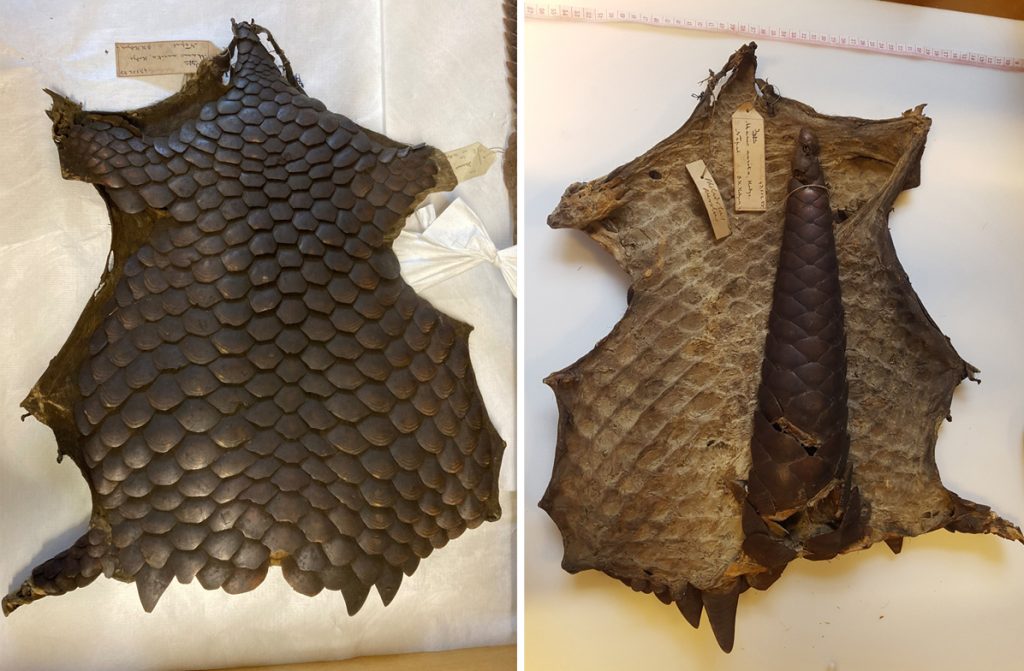
A modern scientific mystery resurfaces
In this context, our rediscovery in 2018 of a historically overlooked pangolin species in the Himalaya marks a significant moment. This is important not only for evolutionary biology but also for the conservation of one of the world’s most threatened and ecologically valuable species.
Our study on pangolins, which focused on the Kathmandu Valley, was motivated by the lack of genetic data of pangolins from Nepal. Using faecal samples, we extracted DNA and amplified a short gene fragment. When these sequences were analysed, we found that they did not match those of Manis pentadactyla. Phylogenetic analysis (to show the relationship between ancestors and evolution) showed that Nepali samples did not cluster within the same clade (biological cluster); instead, it appears to be a sister lineage, indicating a clear divergence. This unexpected result prompted us to revisit Hodgson’s 1836 description, which suddenly seemed highly relevant. Together, these findings raised a compelling question: could Nepal’s pangolins belong to a forgotten species. This initial evidence led us to expand our research, incorporating additional samples and undertaking more detailed morphological and genetic analyses across a wider range of pangolin species.
This question raised a wide range of scientific research. We put together one of the most complete datasets ever used to study pangolins. It included genomic data from museum specimens, confiscated samples and recent field samples. We sequenced the whole genomes of 34 samples, including the lectotype (representative specimen) collected by Hodgson from central Nepal. Samples came from more than nine natural history museums and institutes in China, the United States, and the UK. In addition, we used morphometric data of 44 intact skulls and 26 complete skins, and 3D CT scans of nearly 75 skulls. The results indicated that the specimens from Nepal, South Tibet, and northeast India are associated in an integrative framework. This brought a clear and compelling picture of the taxonomic position of the pangolin from Nepal.
The revalidation of Manis aurita and its special features
Our recent study based on genomic and morphological data revealed that the Himalayan pangolin split approximately 1.8 million years ago from the Chinese pangolins, and the two have very poor gene introgression (gradual movement) between them. Himalayan pangolins have a longer body length, a broader skull, a shorter palatine bone, and a more elongated snout. They have smaller and more rounded ears and longer bodies and tails compared to the Chinese pangolin. Their limb size, strength, and sharp claws support adaptation to the steep, rugged terrain of the Himalayan foothills and help in burrowing and navigating uneven slopes for survival.
The skull of the Himalayan pangolin shows modifications related to sensory perception and feeding specialisation, including broadened nasal structures and characteristics associated with boosted olfactory ability. Genomic analyses revealed genetic enrichment in genes linked to smell, suggesting this species has evolved sharp sensory capabilities to locate prey hidden deep in Himalayan soils and decaying logs. Ecologically, Manis aurita occupies forested foothills and lower mountain regions in Nepal, South Tibet, and northeastern India. These habitats, characterised by mixed evergreen and deciduous forests, provide abundant ant and termite communities.
The rediscovery of Manis aurita further concluded that the species named Manis indoburmanica, from northern India, is genetically indistinguishable from the Himalayan pangolin. Therefore, according to the rules of zoological nomenclature, Hodgson’s older name, Manis aurita, takes precedence. A species lost for nearly two centuries returned to the scientific stage, deeply restructuring our understanding of pangolin diversity.

Conservation challenges
Despite its rediscovery, Manis aurita faces severe and immediate threats. The illegal wildlife trafficking, especially of pangolins, however, remains the most persistent challenge in Nepal and South and Southeast Asia. Pangolins are hunted for their scales and meat, which are trafficked through underground markets and transnational routes. Due to its strategic geographic position, Nepal serves as a key transit corridor in trafficking networks. Frequent confiscations of pangolins and their scales along trafficking routes in Nepal underscores the scale of the illegal trade. Numerous seizures reported in Nepal highlight the ongoing pressure on pangolin populations. In our study, based on mitochondrial analysis of pangolin scales used by pharmaceutical companies, we revealed they are already being imported into China illegally.
Habitat degradation adds another layer of risk. The Himalayan foothill forests are increasingly affected by land-use change, infrastructure development, forest fires, landslides, and agricultural expansion. These compressions fragment pangolin habitats, isolating populations, and increasing the likelihood of genetic bottlenecks. Our genomic analyses already indicate concerning levels of inbreeding in some populations, particularly those around the Kathmandu Valley. Without immediate intervention, small and isolated populations could decline swiftly.
Climate change presents an additional challenge. Changes in temperature, forest fires, and rainfall patterns will alter termite and ant populations. These disrupt the availability of prey and increase the vulnerability of pangolin habitats to landslides, forest fires, and erosion. For a species so exceptionally adapted to the specific ecology of the Himalayan foothills, these climatic shifts could be disastrous.
The path forward: Protecting a rediscovered lineage
The scientific recognition of Manis aurita offers an opportunity for conservation. The species’ distinct evolutionary history and narrow geographic distribution make it a high priority for conservation. Conservation strategies must now be tailored specifically to its ecological needs, distribution patterns, and threats. Legal recognition under frameworks such as the Convention on International Trade in Endangered Species of Wild Fauna and Flora (CITES), Appendix I and the IUCN Red List category Critically Endangered are essential to ensure that Manis aurita receives the same level of protection as other pangolin species.
Community-based conservation holds significant potential. In Nepal, many communities live close to pangolin habitats and can play a vital role in reporting poaching, protecting habitats, and raising awareness. Education programmes highlighting the ecological importance and evolutionary uniqueness of Himalayan pangolins can develop ownership at the local level. At the national level, strengthening wildlife forensic capabilities through genomic data can help trace trafficking routes and dismantle illegal networks.
The broader significance of conserving Manis aurita extends beyond pangolins. Protecting this species means conservation of Himalayan ecosystems, preserving evolutionary processes, and honouring Hodgson’s early contributions to science. The rediscovery of Manis aurita is a rare and uplifting example of how modern science can correct historical oversights and illuminate hidden dimensions of biodiversity.
Conclusion: A species reborn, a responsibility renewed
The story of Manis aurita, from Hodgson’s early observations to modern genomic confirmation, spans nearly two centuries. It is a story of scientific curiosity, rediscovery, and the powerful relationship between natural history and modern genetics. The Himalayan pangolin is more than just another endangered mammal. It is a symbol of the Himalaya’s remarkable capacity to generate and conserve unique forms of life. Its rediscovery challenges us to rethink what we know about Nepal’s biodiversity and reminds us of the many species whose stories remain untold.
As we challenge the accelerating biodiversity crisis in the Himalaya and beyond, Manis aurita stands as a beacon of hope, a testament to nature’s resilience, and a call to conservation action. Whether this newly recognised species flourishes or disappears into extinction will depend on the choices made in the coming years. For now, the Himalayan pangolin has reclaimed its name, its history, and its place in the world. It is our responsibility to safeguard its future.

