
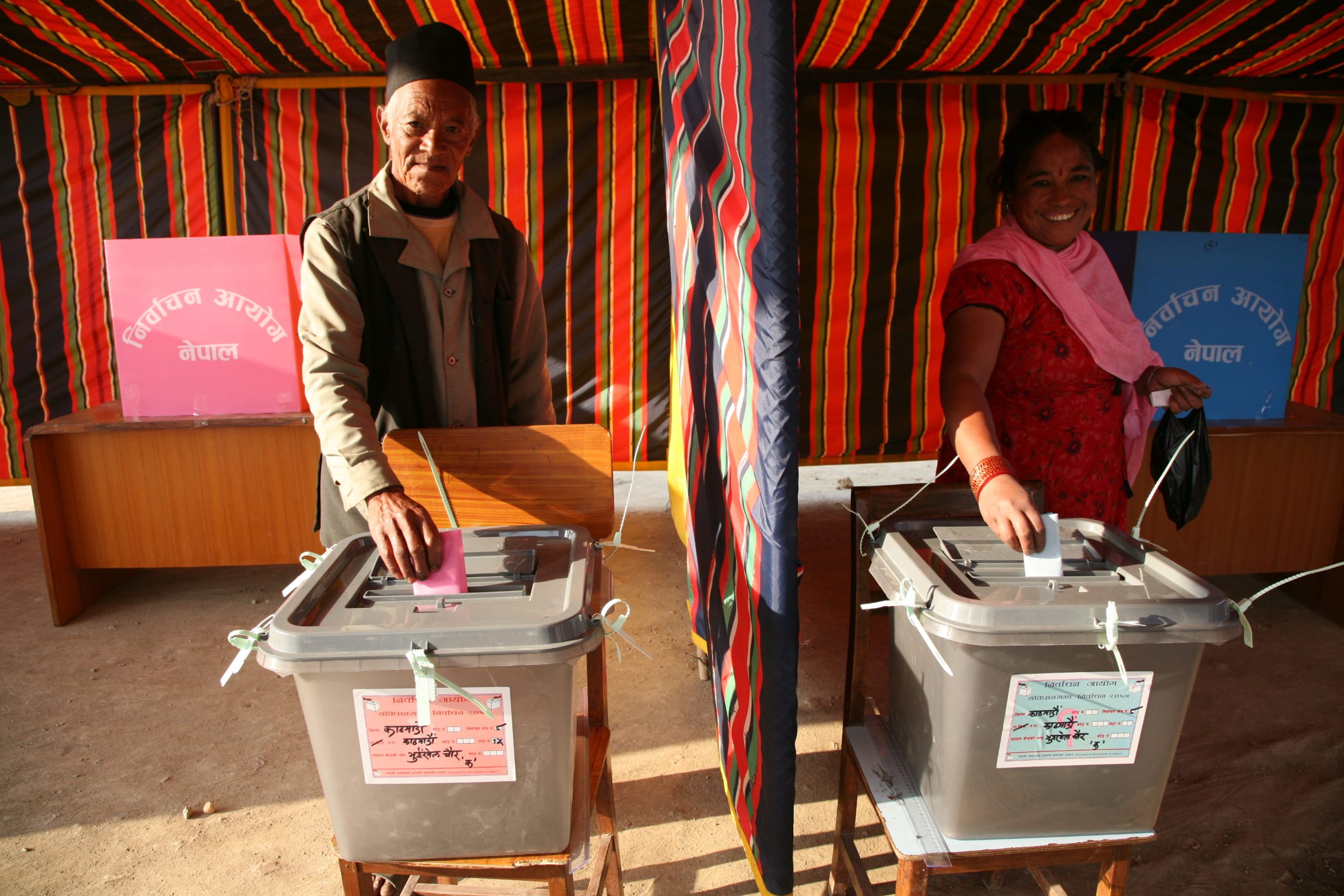
Following the GenZ protests, fundamental questions have been raised on a number of issues, one being the system of representation. Since the first Constituent Assembly (CA), elections for the House of Representatives (HoR) and the provincial assemblies have been under a mixed system, with elements of both first past the post (FPTP) and list proportional representation (PR). The municipal councils have been elected by FPTP and, since the first round, the same has been true for the National Assembly (NA).
Choosing electoral systems
There are a large number of representation systems in use internationally. Since each has advantages and disadvantages, determining what qualities are most important when choosing a system is crucial. Among the important ones are fair representation of the competing parties, representation of different groups and gender, stability of government, accountability, and voters’ direct influence on who governs them. Unfortunately, parties have a tendency to consider only the system that would benefit them in the next election. Those that have just won an election believing that the system that brought them to power will do it for them again. The better question for them to ask would be: What is the system we would like to have if we lose the election?
Generally, the PR system produces the most representative parliament, not only along the political dimension but also in terms of different social groups and gender. Plurality systems (such as FPTP) applied to single-member constituencies (SMCs), where the party with the most votes wins the seat even with less than 50 per cent of the cast ballots, normally give a big advantage to the largest party while smaller parties struggle to be represented at all. Hence, forming a government may be easier, and the government may be more stable with FPTP. One may also argue that accountability is stronger under FPTP since the constituencies are smaller and one votes for a person, not a party.
With single-member FPTP, a voter may not feel the same connection if the local members of parliament (MP) come from a party she has not voted for. On the other hand, even under PR if one divides the country into multi-member constituencies (MMCs), local connections can be established, and there is also a chance that at least one of the local MPs is from the party of one’s choice.
Accountability may also be strengthened by introducing open lists in List PR, where the voter gives preferential votes to the candidates listed. However, this may prove impractical in Nepal, where the ballots show party or candidates’ symbols only.
Other systems are available, such as FPTP in multimember constituencies. In this case, the biggest party has an even larger advantage, and it will often end up with a winner-takes-all result. The system is not common in national elections, but it is being used for local elections in Nepal.
Single transferable vote (STV) is a proportional system where voters choose individual candidates by ranking them from 1 to as many as are running. This system was used for the first election to the National Assembly in 2018, but is impractical, and the count is very complicated.
If one wants to combine the characteristics of different systems, mixed systems are often introduced. These are of two types: i) the parallel system, which is the one used in Nepal, and ii) a mixed-member proportional system (MMP) used in, for example, New Zealand and Germany. MMP is a fully proportional system where the PR side is used to compensate for any disproportionality in the FPTP part, whereas the parallel system is only half proportional. MMP combines the advantage of electing someone in a small constituency with a representative result. The parallel system is more of a compromise between those wanting a representative result and those emphasising stable governments and strong accountability.
Except for open lists and MMP, all the other systems have been used in Nepal.
When deciding on the electoral systems, one should keep in mind the role of the elected body and how it fits into the overall structure of the state. We discuss some systems in more detail below and suggest reforms in order to make all the elected bodies representative, strengthen accountability, promote dialogue and compromise, and strengthen the political culture.
Federal Nepal has a bicameral parliament at the central level, a government that is required to have the confidence of the parliament, and a president as the ceremonial head of state. The principal chamber of parliament is the HoR, which also elects the federal government. The secondary chamber is the NA, the house of the provinces. The NA also passes laws, although the HoR has a more decisive voice if there are disagreements between the two houses. While the HoR is directly elected, the NA is indirectly elected by an electoral college consisting of members of provincial assemblies and the heads and deputy heads of the local bodies in the concerned province. The president is elected by an electoral college, consisting of the two houses of parliament and the province assemblies.
Following the GenZ movement, fundamental questions have been raised about both the federal state and this type of parliamentarism. The main concerns have been the fight against corruption and the need for stable governments. We will not discuss those issues here but only warn against a directly elected prime minister or president. If the chief executive does not command a majority in the HoR, it may be very difficult to pass laws and budgets.
House of Representatives
As the HoR is the more powerful house of parliament, its decisions need to reflect the will of the people. That would point towards an electoral system which reflects voters in the best possible way. On the other hand, since there have been frequent changes of government (15 since 2006), there may be a longing for a system where the largest party wins a majority of the house more easily.
In a post-conflict situation, representation of all major currents in society is crucial. It is important that the main sectors are represented and have their voices heard when key decisions are taken. While FPTP strengthens the accountability of those elected, it is the PR system that makes the HoR a more inclusive body. However, in Nepal, the central leadership of the parties nominates the candidates. Changing to a local party democracy would improve accountability, even if political parties were to still play the main role. This is how it should be in a democracy for only with parties will voters know what policies to expect if a party wins.
With a closed List PR, the voters will know who will fill the seats won by a party. In the Nepali context, so far, the lists have been national, and people may not really know the candidates. This could be improved by introducing constituencies for PR as well. One could also introduce open lists where the voters have a direct say in the choice of MPs, but this may be too complicated as long as the ballot papers consist only of symbols.
Both CAs and the HoR have been elected by a parallel mixed system. In the CA elections, the share of PR seats was higher than FPTP (58 per cent compared to the current 40 per cent) and the discussions on changing the proportions have, to a large extent, been directed by what system any one party may gain from rather than what is desirable in an electoral system. The parallel system has been retained as a compromise between FPTP and PR, rather than for the quality of the system as such.
If one chooses a representative system, one needs to address the issue of stable governments. Even in the 1990s, when the election was purely FPTP, there were frequent changes of government. This appears to be more of a political culture issue, where personal position and power games seem more important than the political platforms of a government. A better political culture would be one where negotiating a political platform of a coalition government would be a constructive process, and once agreed upon, a government should survive till the next election.
The dimension of representation which has been important in Nepal is the representation of different ethnic groups and castes. That is done by quotas in the PR election. It is possible to combine representation of excluded groups with FPTP, like in India, where certain constituencies are reserved for excluded groups, and therefore present serious restrictions on the right to stand for elections. And in India, groups benefitting from the rule are all defined as one group, in addition to women.
In order to have a representative HoR and also strong accountability, there are several options, as laid out below.
Adjustments to the mixed system
The current quota system is complicated, and it also has the uncommon feature of defining quotas even for the elites, although they already win seats in the FPTP far beyond their share of the population. One implication is that in the PR race, Dalits will have 13 per cent of the seats but no more since all groups have quotas. A solution better suited to ensure inclusion would be to adopt minimum quotas only for highly excluded groups such as Dalits.
A further consideration can be changing to the MMP, which would produce fully proportional results in terms of parties, and still keep the accountability and local representation of FPTP. In order to avoid very small parties from being represented, which can complicate the process of creating stable majorities in parliament, one can raise the threshold from 3 per cent to 4 or 5 per cent. In any case, the mixture of FPTP and PR could be more even with 50 per cent from each race instead of the current 60 per cent FPTP.
PR in multi-member constituencies
Another option would be to move towards a PR system only, but introducing MMCs. These could be provinces or parts of provinces. In each constituency, the parties would register candidate lists. Since the candidates would be local, the chances for voters to know their merits would increase, while geographical representation would also be guaranteed. The quota system could be retained, guaranteeing female representation and a minimum representation of Dalits and other excluded groups.
When adding up the results from all the constituencies, the result may not be proportional nationwide even if the results in each constituency are. In particular, small parties may not be able to win seats locally. One option is to keep, for example, 20 per cent of the seats for nationwide lists to be used to top up the results in order to compensate for any disproportionality.
Figure 1. Compensatory Seats May Top up the Results to Achieve Proportionality

For both the above alternatives, one may consider implementing open lists. In such arrangements, the voters may give a vote to one or more candidates within the list of choice. With nationwide lists, this may be more complicated to implement than for MMCs because the lists would be too long. However, with the current practice of relying on symbols on ballot papers, it may be too complicated even for shorter lists.
One further way to improve accountability is for parties to engage their local organisation when nominating candidates, instead of the top leadership choosing candidates in both the PR list and the FPTP.
National Assembly
Each province, regardless of size, sends eight members to the NA. International practice vis-à-vis secondary chambers varies. In Germany, the power of the Bundesrat is restricted to certain laws which have to do with boundaries and powers of the provinces, and the delegates are bound by the position of the state governments. In other countries, such houses are for ethnic or linguistic minorities. In Nepal, both laws and budgets are to be passed in both chambers. Therefore, it would be logical that this chamber is also a representative house. The 1990 constitution and the first law after 2015 prescribed STV as the electoral system for the NA. STV is a proportional system without being dependent on political parties. However, after having staggered the terms in office for the members of the NA, FPTP has been used, most likely without a thorough discussion of the alternatives.
All eight representatives from a province are not elected at the same time and are elected in separate races for women, Dalits and ‘other’. They could instead be elected in a PR election with quotas. Since political parties play a major role in these elections, the benefit of the STV would be limited. List PR with quotas could just as well be used.
A more drastic change could be to elect all representatives from a province at the same time and stagger the provinces instead. That means that the province would vote every six years, not every two years as they do now. That would enable a more diverse representation from each province.
Provincial assemblies
Province assemblies are elected in the same way as the HoR. It would be reasonable to keep the same system in the provinces as for the HoR.
Local councils
Local assemblies are elected under a FPTP system in what are akin to multi-member constituencies. This is close to a winner-takes-all system. Unlike for the NA, this system is written into the constitution. Studies of election results show that, at least at the ward level, all members tend to come from the same party; voters just mark the same symbol for all positions. It would seem more reasonable that local bodies represent a variety of political views, and that the representatives have dialogue and negotiate solutions across party lines. One may consider a PR system even here.
NOTA
The idea of ‘None of the above’ (NOTA) has been discussed in Nepal, allowing a voter to choose that option if they do not like any of the candidates. If implemented, there needs to be a rule for what happens if that option wins the most votes. However, democracy is about participation, not demonstrative non-participation. Ideally, if all candidates lack support, people should use the opportunity to stand for elections. A protest vote may feel good but it will not take the country forward.
Role of political parties
There has never been a government that has been in office for the whole term of the HoR. The main reasons have been fragile coalitions and factionalism within the parties. Political parties should not only be platforms for competition for power, but rather vehicles to develop the country. Parties should have a clear agenda and voters should be able to choose among alternative development strategies.
This requires a shift in political mentality or culture concerning the role of political parties. In addition, more internal democracy within the parties may help. The top leaders should have the support of the local and provincial branches of the parties. A bottom-up process of designing the political programme could change the attention from personal gain to what is best for the country.
Party reform may come, both in old parties and in new alternatives. A comparative perspective suggests that only then may we hope for more stable governments.

