
Amid the recent political upheavals, are we in danger of missing or ignoring longer term ‘tidal’ changes in Nepali society? While party politics in Nepal may be the realm where ‘nothing ever changes’ even when the personnel change, a slow trend away from secularism and multi-faith tolerance and towards some version of Hindutva may be more significant for Nepal in the medium to long-term.
This short essay looks at this issue critically, asking whether reports of a ‘Saffron Nepal’ are exaggerated and tries to pinpoint exactly what ‘signs’ we should be looking for when we talk about Hindutva in Nepal. Hopefully, it might shift the perspective of some readers away from an undue focus on rhetoric and elite discourse to one focused on actually existing or potential social movements.
On the face of it, there is evidence of a significant ‘vibe shift’ in Nepali politics: we see leaders of all parties (including purportedly secularist ones) charting a saffron path. Nepali observers have ably described the evidence for this rhetorical shift citing the various pilgrimages Nepali leaders have made to sacred and politically contentious sites in India, and the many personal connections between Nepali political parties (especially the Nepali Congress) and Hindutva organisations in India. In this article, I won’t waste time on rehearsing these symptoms, since others have done so in great detail. I will focus instead on Hindutva as a social movement, rather than as a set of discourses and provocative anti-secular gestures.
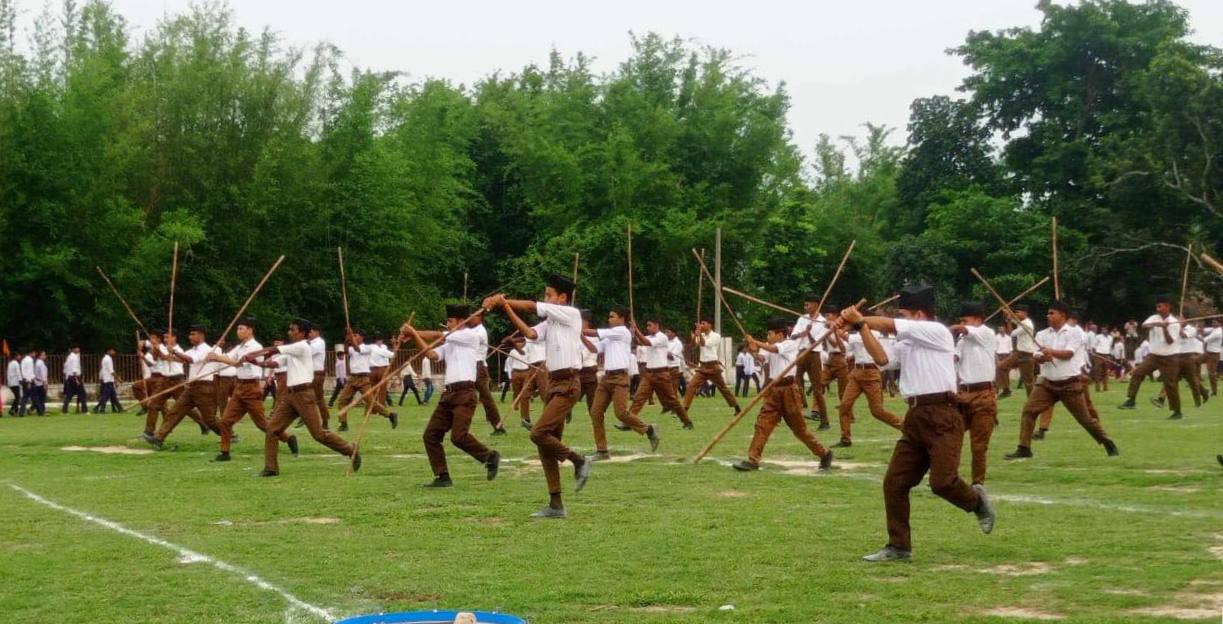
Antonio Gramsci talked about a ‘war of position’ and 1960s socialist activist Rudi Dutschke of a ‘long march through the institutions’ of a society. These notions are familiar today as strategies for the Left, to take power ‘behind the backs’ of the ruling elite, through a slow penetration of the complex institutions governing everyday life in modern societies. A ‘counter hegemony’ is built up generating a new ‘historical bloc’ that eventually seizes state power. Hindutva in India is arguably the most impressive example of such a war of position in modern history, having begun its long march in the 1930s and achieved something like hegemony at the state level in the last 10 years. Tanika Sarkar, an important scholar of India Hindutva as a social movement, has described this vividly as the ‘slow and cellular expansion’ of Hindutva; a young potential adherent can now move smoothly between shakhas (branches), vidya bharatis (Sanskritic schools), mandirs (temples), and sangsthas (organisations), each coordinated with the others to create an actionable package of education, spirituality, physical fitness, sense of communal obligation, and political preferences.
Can we assess Nepal’s Hindutva through this same lens? Is there a Hindutva social movement in Nepal corresponding to the Sangh Parivar in India? And are there special obstacles—historical or ideological—likely to hamper any Nepali Hindutva’s ‘march through the institutions’ here?
On the face of it, there seems to be much less to write home about in Nepal. By the admission of senior Hindutva veterans based in Kathmandu with whom I spoke in 2025, Nepal has only around 250 active shakhas (branches where youth undertake their physical and spiritual exercises). India has 83,000 by a recent estimate. That is 1 per 120,000 in Nepal and 1 per 17,000 in India, suggesting that Nepal is off by about a factor of 10. The ratio of Sanskrit schools is a little less behind in Nepal (though their pool of students is mostly limited to Brahmins, unlike in India), but the other elements of the ‘actionable package’ of Indian Hindutva are very much behind the curve in Nepal.
For one thing, Nepal’s heterogeneous religious landscape, ethnically particular structure of guthis (religious trusts)and recurring allegations of money-orientation at large religious institutions, makes the hope of emulating Indian Hindutva’s homogenisation of religion rather tough. As an illustrative anecdote, a couple of years ago I spoke to the chairperson of Nepal’s jyotish (astrologer) organisation—a conservative group favourable to the general anti-secular agenda in Nepal and associated with a network of gurus such as Pushpa Raj Purush and Chintamani Yogi who want to see Nepal as a Hindu country again. However, the jyotish was clearly concerned that there was a tragic trade-off in adopting the discourse and praxis of Indian Hindutva. For him, Nepali Hinduism was rare and beautiful precisely for its traditionalism, its complex, time-consuming and sometimes expensive rituals, its deviations from Hindutva’s ‘narrowing down’ of the Gods, and of religious practice. While certainly, when push comes to shove, he would side with a politicised Hinduism as opposed to secularism, there was none of the zealotry one would associate with his Indian ideological cousins, and thus none of the passion for grassroots organising that would be needed to replicate India’s social movement model in Nepal.
The same lack of zealotry affects the political leadership of any potential Hindutva movement in Nepal. As most readers will recognise, the leadership of the Rastrya Prajatantra Party (RPP) is patrician, Anglophilic, and distinctly lacking in the ‘popular touch’ that the likes of Modi have acquired from rising up the ranks of the Sangh Parivar organisations. One senior RPP leader, whom I interviewed, even referred to the Indian Bajrang Dal as ‘those louts’. At the local level in the Tarai (Janakpur), a Hindi-speaking RPP cadre whom I spoke to was keen to get a ‘Love Jihad’ campaign going, based on rumours of the seduction of some female Hindu students by Muslims, but the central RPP leadership showed no interest in taking up the case, much to the disappointment of the aforesaid cadre.
* * *
OVERALL, THAT ACTIONABLE package of shakha-mandir-sangstha-school-party that we see in India as the vehicle for Hindutva’s long march through the institutions does not yet exist in Nepal.
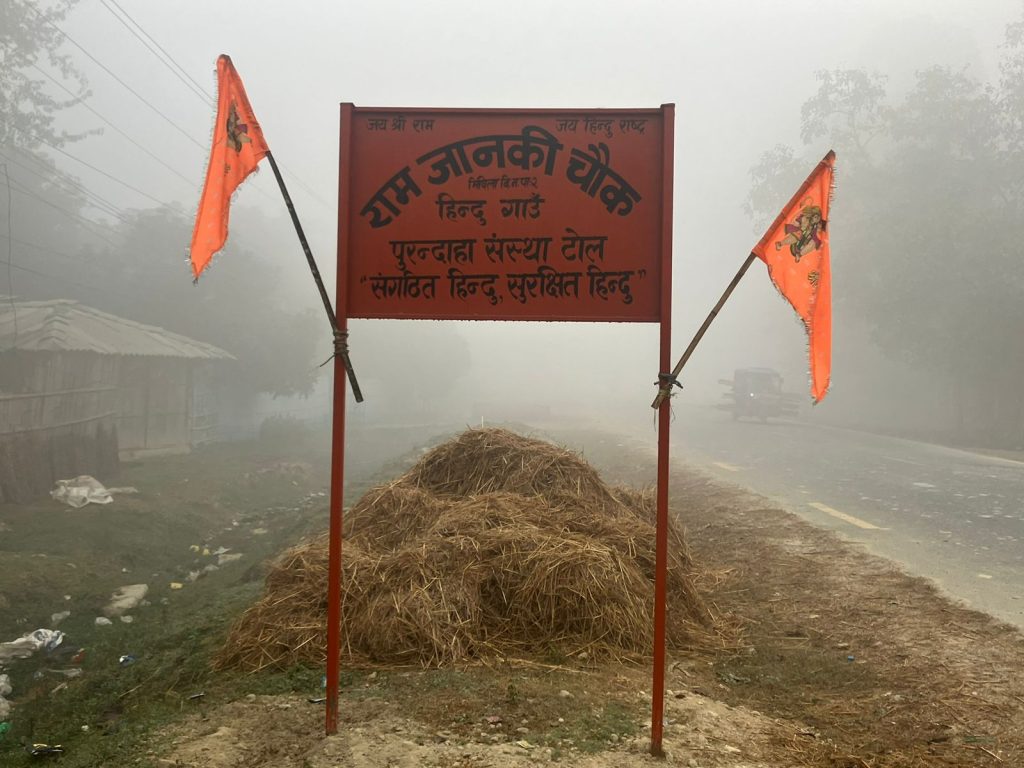
So, do active Hindutva networks even exist at all in Nepal? They surely do. We have seen multiple incidents, protests, riots, provocative processions of idols through Muslim neighbourhoods, social media provocations, and I have seen and read a lot of Hindutva-affiliated propaganda distributed in Nepal’s border towns and cities and heard testimonies from Muslims who argue that this activism has begun to create caste-like boundaries between Muslims and Hindus, at least inside the big border cities. On the inauguration of Ayodhya in the Spring of 2024, there was even a saffron tide of flags from West to East along the border region, celebrating the highly politicised event, although significantly this tide ebbed and faded as one got further from the border; overwhelming in Nepalgunj but almost invisible in Kohalpur.
One problem (from the point of view of generating a true Gramscian movement), is that the network is split. There is an elitist, traditionalist network of anti-secularist gurus and intellectuals, based largely in Kathmandu and then there are the Rastriya Swayamsevak Sangh (RSS) affiliates (the Hindu Swayamsevak Sangh [HSS] and other ‘Omkar family’ groups) trying to seed new shakhas and reach a mass audience. These two networks may indeed both be supported by the Indian Sangh Parivar and the Indian security state, in various ways, but they only work very loosely with each other, and their aims are rather different; the traditionalists being ‘vertically’ oriented toward a hierarchical conception of Hindu traditional society, and the RSS/HSS being horizontally oriented toward mobilising the middle classes in shakhas.
The traditionalists are pro-monarchy and show signs of being rather caste-ist. To be monarchists is not necessarily a barrier to popularity in the Tarai, where the former king seems as popular as anywhere else, but the monarchical tendencies of the traditionalists—forged though 200 plus years of a Hinduism-monarchy alliance in Nepal—also reflect an elitism, class-ism, and anti-reformism that make this wing of Hindutva (we can call it the ‘RoyalHindutva’) unappealing to some ethnic minorities and to some Madhesis. For example, a Janajati acquaintance of mine, with Hindutva inclinations, was disappointed when he heard one of Kathmandu’s famous traditionalist gurus arguing that to be a Brahmin was a matter of birth. This is the kind of overtly caste-based language that Indian Hindutva has been manoeuvring away from for decades.
The other network—we could call it the ‘Popular Hindutva’ network—is not at the same level of mobilisational capacity as its Indian cousin, despite being somewhat less elitist than Royal Hindutva. Its actions also reflect local caste power and petty politics as much as genuine popular outreach. For example, in 2023 a mobilisation of Hindu youth wielding sticks and performing martial arts in Saptari, seems to have been about intimidating a local non-upper caste political candidate. These kinds of stories of upper-caste party elites calling on Hindutva ‘mobs’ from across the country at election time to intimidate opponents are common. Many Hindutva activists I spoke to in the Tarai regretted this shallow ‘electoralism’, calling it ‘shout Hinduism’. Of course, it is not as if Indian Hindutva doesn’t engage in violence and intimidation, but it does so on the solid ground of organisations built up over decades. In India, the friend-enemy distinction is also more clearly focused on Muslims rather than caste rivals (at least since the populist shift in Indian Hindutva associated with figures like the third RSS supremo, M.D. Deoras, in the 1980s).
This question of defining an enemy and establishing a clear boundary also divides the two networks. The Royal Hindutva groups are more focused on Christian conversion in the hills and in Kathmandu compared to the popular Hindutva groups’ focus on Muslims in the Tarai. Muslims make up about 5 per cent of Nepal’s population, but with concentrations of up to 20 per cent in some Tarai districts. Christian numbers are hard to pin down but can’t be more than about 3 per cent. These numbers, except in certain cities in the border region may not be enough to sustain an ‘enemy threat’ narrative and there would need to be concerted action between the two networks to decide which religion is the true threat and which tactics to use against each.
So, would a saffron Gramsci despair of the prospects of building an Indian style, social movement-Hindutva in Nepal? He would note that the organisational synergies generated by Indian Hindutva over 70 years of trial and error do not really exist yet in Nepal. But there are, as I have noted, organisations and actors that wish to imitate that path. The ingredients for a multi-ethnic, multi-caste saffronisation are there, even in unexpected places. For example, I interviewed Dalit entrepreneurs in the Tarai who have entered Omkar politics, seeing it as a ladder toward building a caste-free society, and to personal career advancement in a society with borders defined horizontally, versus non-Hindus, rather than vertically by caste. This process, which in India, includes the somewhat bizarre placing pictures of the Dalit leader, B.R. Ambedkar, next to those of the Hindutva ideologue, V.D. Savarkar, in RSS offices, could be developed further by religious entrepreneurs, but would encounter entrenched caste-ism in Nepali Hindutva circles.
There is even surprising evidence on various Facebook pages of Janajati groups (especially Magars) employing Hindu-indigeneity versus caste power, with one activist writing: ‘Stop telling Magars that Hindu religion is imposed by Bahuns, try to understand the [Hindu]history and heritage of your ancestors.’ This suggests that even ethno-nationalism might be harnessed by Hindutva activists, if they have the imagination to forge the alliances required, perhaps feeding off anxieties about rapid Christian conversion in the hills.
Social scientists are notoriously bad at making predictions and there are too many unknowns at work in Nepal’s religious politics to pontificate about the future. Many wild cards are at play, not least the future career of Yogi Adityanath, currently the chief minister of the Indian state of Uttar Pradesh bordering Nepal and a possible successor to Narendra Modi as prime minister of India. Although, in India he counts among the Hindutva populists, in terms of his cultural ties to the former Nepali monarchy, he counts as a supporter of the traditionalist strand of anti-secularism in Nepal. This would potentially complicate things for the development of a ‘monarchy-free’, anti-elitist Hindutva in Nepal.
Then there are the various possible outcomes of the Gen Z movement, the ramifications of which for Hindutva are impossible to account for at present. Nepal’s ‘partyocratic’ system is, in a sense, a barrier to popular movements because those movements constantly get co-opted by party elites. Could breaking this system open lead to opportunities for new non-secular movements?