
The first time I watched a stolen deity come home, nothing could have prepared me for what I felt, and more importantly, for what the community around me did. It was not one but many emotions at once, layered and contradictory and impossible to reduce to the narrative of triumph that the occasion seemed to demand.
Of the many repatriations that had occurred before, the return of Lakshmi-Narayan to Patko Tole in Patan was different. It deeply moved not only the community whose temple had been hollowed out by its absence, but also the world watching from afar. This was a case that had involved diplomatic cables across continents, FBI offices, and customs agencies before the statue could finally make its way back home after almost four decades. And it was this case, messy, historic, and deeply human, that forced me to confront something that no legal framework had yet managed to articulate: repatriation does not end the moment an artefact is returned; it is an ongoing process of healing, re-consecration, and living memory.
The global discourse on heritage repatriation is largely conducted in the language of law, diplomacy, and art history. These frameworks are necessary, but insufficient. They can tell us where an object came from, who holds the legal title, and how it might be returned. What they cannot tell us is what it costs a community in ways that are not as tangible but no less real to get it back. Also, they cannot tell us what happens when the government that fought for the return shows up for a photo-op and then promptly disappears, leaving the community to figure out the rest on its own.
The pain of theft and the labour of waiting
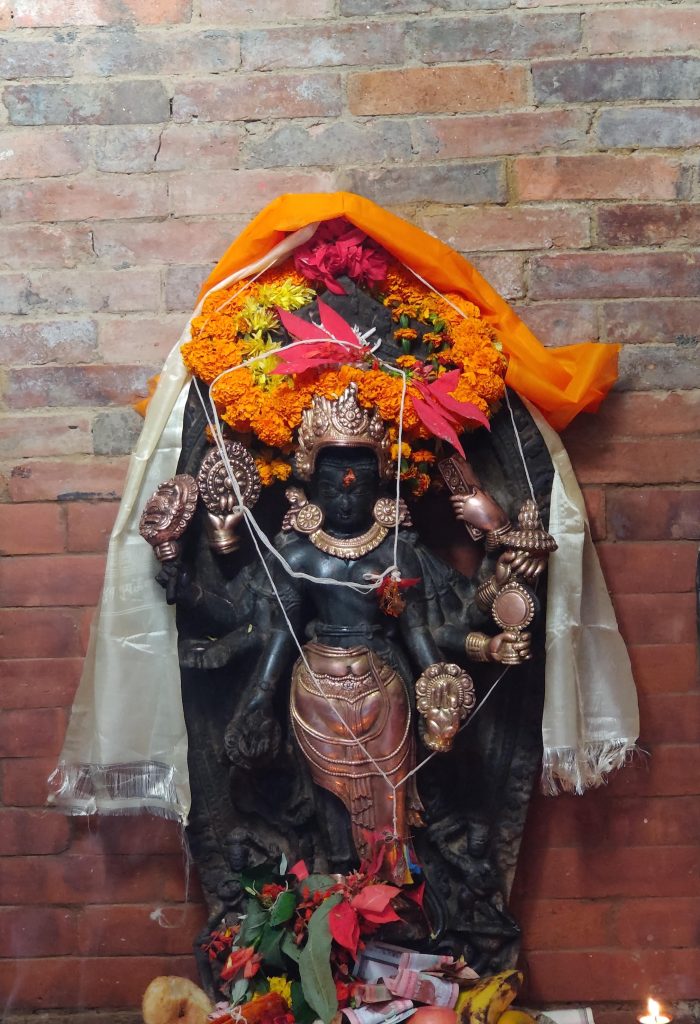
The story of Lakshmi-Narayan begins, as do many stories of stolen heritage, with an ordinary morning interrupted. In July 1984, devotees arrived at the two-tiered temple at Patko Tole for their daily prayers and found only bricks strewn on the ground where the androgynous Devi-Devta—neither fully god nor goddess but both at once—had stood for eight centuries. The statue, a composite figure of Lakshmi and Vishnu, had been wrenched from its shrine overnight. A community that had organised its festivals and daily rituals around this figure was left with an empty plinth and, eventually, in 1993, a replica established as the main deity.
The physical journey of the stolen statue followed a well-worn path of illicit antiquities trafficking that devastated Nepal’s cultural landscape in the late 20th century. In the 1970s and 1980s, the Kathmandu Valley was systematically targeted by international art thieves and local collaborators who realised that unguarded neighbourhood shrines held priceless masterpieces of ancient ‘art’. The statues were stolen, smuggled across the open border into India, fitted with false provenance papers in cities like New Delhi or Mumbai, and then shipped out to the major art markets of Europe and North America.
Bhai Raja Shrestha was among those who remembered that morning in 1984. He was 79 when we talked, and he carried the memory of the theft the way people carry old injuries—not with fresh pain, but with a permanent awareness of the absence. ‘People still came to do puja every day,’ he told me, ‘but it was not the same thing.’
And then, with a plainness that contained an entire psychology of loss: ‘We had no hope of finding the lost god, and with the disappearance of our patron deity, the community also started falling apart.’ That sentence does not appear in any legal filing or provenance report. It lives on the margins of the official record, where the emotional reality of source communities has always been forced to reside.
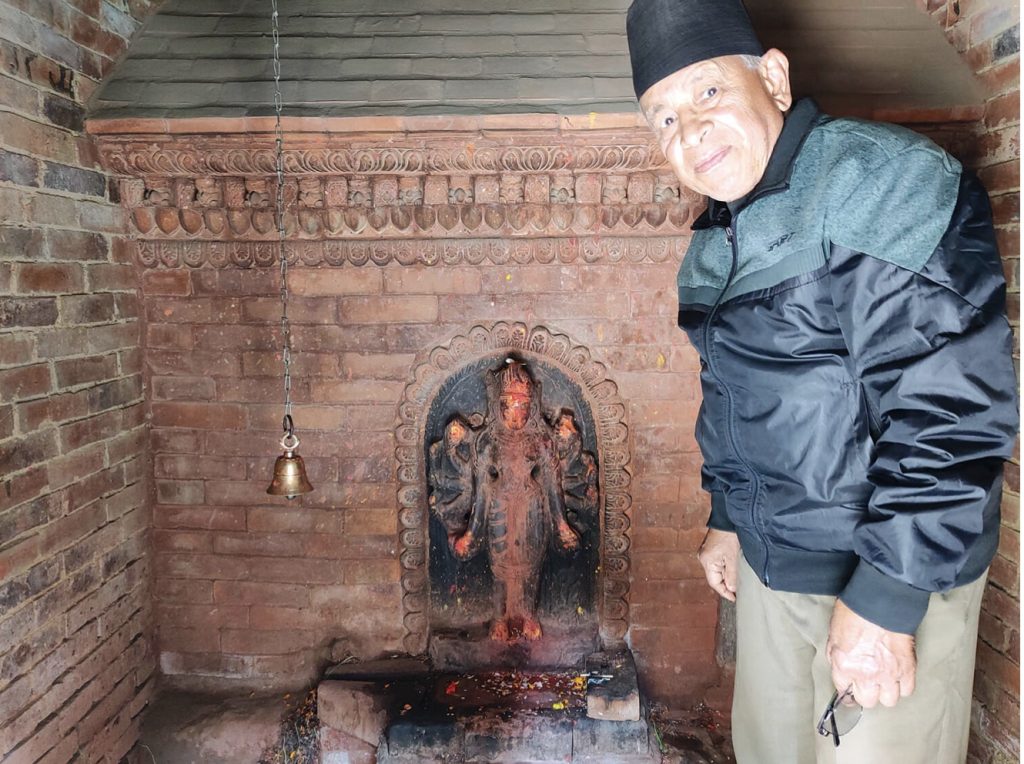
The statue was first documented by Indian archaeologist Krishna Deva in his 1984 book, Images of Nepal, with his photograph later featuring in Lain Singh Bangdel’s seminal The Stolen Images of Nepal. Published in 1989, Bangdel’s book utilised a stark juxtaposition of ‘before’ and ‘after’ photography to illustrate the theft. The statue surfaced briefly in 1990 at a Sotheby’s auction in New York, then disappeared again, until American artist Joy Lynn Davis located it through a Google Image search at the Dallas Museum of Art, where it had been on display since 2007 under the name Vasudeva-Kamala. Attributed to Nepal, stripped of its living context, exhibited as an object of aesthetic interest rather than active devotion. Art Crime Professor Erin L. Thompson’s tweets in 2020 broke the story publicly, and what followed was a cascade of media coverage, FBI investigation, and diplomatic pressure that eventually compelled the museum to relinquish the statue.
Keeping up with this case meant navigating a maze of correspondence between the Nepali embassy in Washington DC, the Department of Archaeology, the Ministry of Culture, and the Ministry of Foreign Affairs, all the while staying close to the Patko Tole community. What I observed during those years of waiting was a profound form of emotional labour—a constant oscillation between hope and exhaustion for a people long told that the burden of proof lay entirely with them. Their initial disbelief wasn’t cynicism; it was the scar tissue of 40 years of disappointment, where hope itself had become a risk. This waiting was never passive. It was a sustained emotional effort that left visible marks on everyone who endured it.
The chaos of return
Before Lakshmi-Narayan could return, the entire process devolved into chaos over something far more prosaic: the shipping bill. The ensuing bureaucratic mess laid bare the chasm between institutional rhetoric and actual responsibility.
When the Dallas Museum of Art agreed to give up the statue, its transport costs triggered a standoff between government bodies, each expecting the other to pay. The Department of Archaeology claimed it did not have an allocated budget for international shipping logistics. The Ministry of Foreign Affairs suggested that the embassy in Washington handle the costs from its internal funds, while the embassy argued that heritage recovery fell under the jurisdiction of the culture ministry back home.
Amidst this impasse, a news report prematurely claimed the government lacked the funds. In reality, it wasn’t a financial deficit, but an administrative tangle: nobody knew how to handle the shipping mechanics, creating an institutional paralysis while the statue waited.
Seeing the national gridlock, the Lalitpur Metropolitan City stepped up to fund the return. However, amidst the noise, it was the US Embassy in Kathmandu that ultimately facilitated the physical logistics via courier.
The arrival and the vacuum
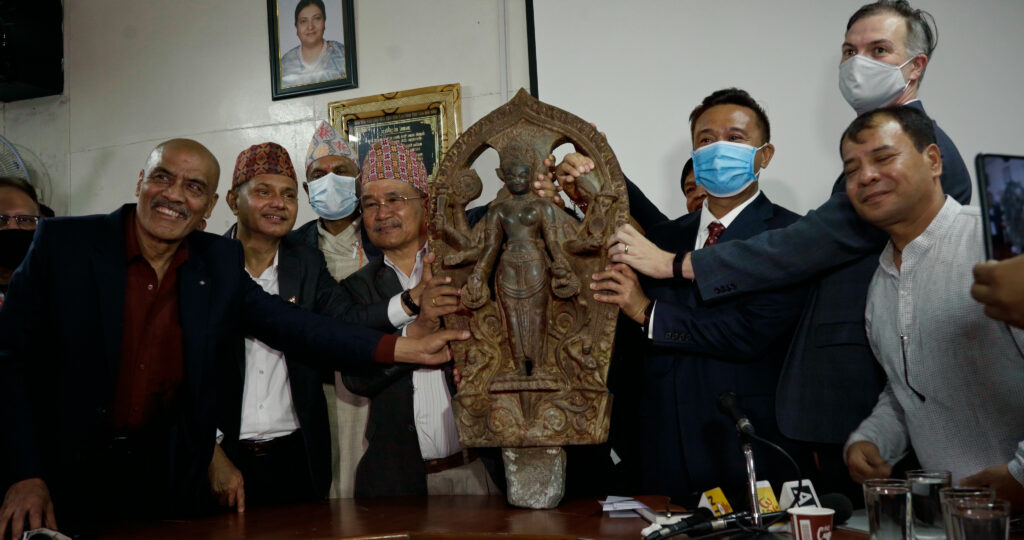
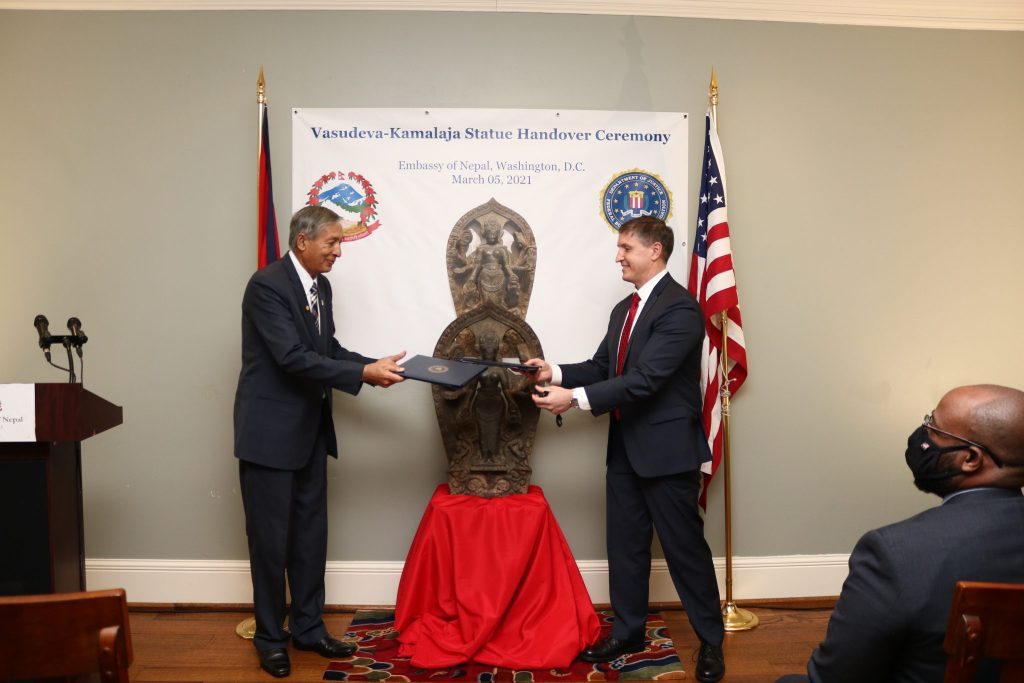
On 5 March 2021, Lakshmi-Narayan was formally handed over to the Nepali Embassy in Washington, DC. Word was out on 10 April that the statue had landed on Nepali soil but immediately held up in customs. It was not released until 12 April, when the Department of Archaeology called a press conference.
What unfolded exposed the gap between the symbolic weight of repatriation and the institutional capacity to honour it. In the chaotic crush of bodies, a clutch of male officials gathered around the statue, squaring their shoulders for the cameras to claim credit. Meanwhile, the researchers, advocates, and community members who had spent years making this moment possible were pushed to the edges of the frame or excluded entirely. As one of the few Nepali women in the room, I felt a distinct exhaustion watching a public institution take credit for a homecoming it had done very little to prepare for, and even less to understand.
Photographs taken by documentary filmmaker Amitabha Joshi during the official handover in Washington told a sharply different story. In his images, the FBI handled Lakshmi-Narayan with gloves and deliberate care. In Kathmandu, the statue was yanked out for the cameras with no ceremony and even less grace.
This chaos was a direct policy failure. Until Lakshmi-Narayan’s return, Nepal had no official repatriation framework to govern reception, documentation, handling, or reinstatement. The statue crossed the border into an institutional vacuum. The day after the press conference, Patan Museum took custody, placing the plastic-wrapped figure into a store. The god that had crossed the oceans simply sat in a new waiting room.
The emotional lifecycle of restitution
Robert Plutchik’s Wheel of Emotions offers a more honest map of what repatriation actually involves. His model proposes that human emotional experience is not a sequence of discrete states but a layered cycle, and the Patko Tole community travelled nearly its full circumference—completing the circle of repatriation.
There was the prolonged grief of the original loss, compounded over decades into something closer to resignation. The sudden reactivation of hope when the statue was located was followed by the anticipatory anxiety of watching the diplomatic process drag on. Then the complicated, undercut joy of the press conference, and the quiet deliberative tension of confronting a god that had come back damaged—one of Lakshmi-Narayan’s eight arms had broken somewhere across its long journey through theft, auction houses, and museum display cases. According to tradition, a damaged deity cannot be reinstated as the central god of a temple. Religious scholars and priests weighed in, some advising against full reinstatement. The community deliberated on its own terms. And then, on 4 December 2021, nearly 40 years after that morning when devotees found their temple emptied, Lakshmi-Narayan came home properly.
The Patan Museum courtyard was packed. When the statue was brought out of the gallery, people surged forward to offer their devotion, hands reaching, faces open, before it was placed inside a palanquin with a gilded roof and carried through Darbar Square to the sounds of jhyali-jhyamta, the crowd chanting ‘Laxmi-Narayan ki jay (Hail Laxmi-Narayan)’ with a collective joy that felt almost physical. When the procession reached Patko Tole, it made three ceremonial rounds of the temple. A kshyama puja, a ritual seeking forgiveness, was performed for any transgression committed in the deity’s absence. And then the god was interred inside, standing between the replica, which had moved to the left to make space for the returned god, and an ancient stone inscription on the right.
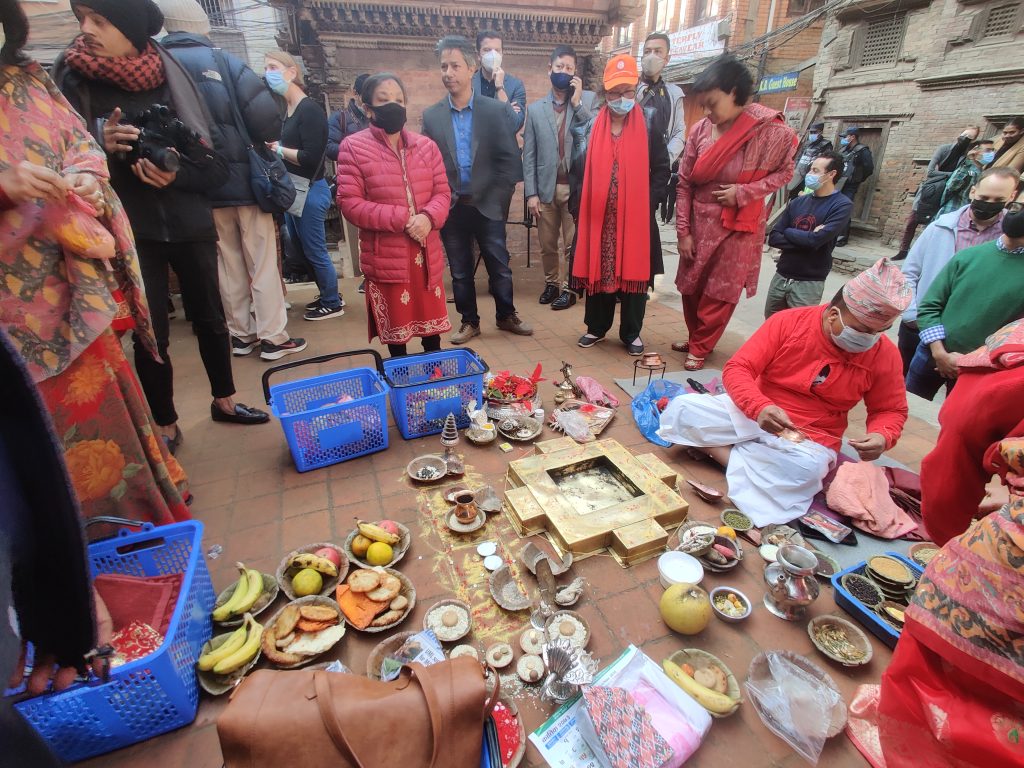
Bimal Lal Shrestha, whose ancestors had built the temple centuries ago, placed on the returned statue a special garment and ornaments of copper traced with gold and silver, heirlooms that had sat in his family for nearly four decades because they had never fit the replica. ‘We had been unable to use them all these years,’ he said quietly.
It was, in its way, one of the most precise articulations of loss I have ever heard. Not the absence of the god itself, but the accumulation of all the small ceremonies that could not be performed without it—the rituals deferred, the garments folded away, the traditions maintained in diminished form because the original was gone.
And yet, even inside that moment of fullness, something more complicated lived at its edges.
I spoke to younger members of the community, people in their twenties and thirties who had grown up with the copy as their god, who had no living memory of the original, no personal experience of the morning the theft was discovered. Their relationship to the return was different. Not hostile, not joyful, simply distant, the way you might feel about the arrival of someone whose importance everyone insists on but whom you have never actually met. The older generation had waited, and grieved, and fought, and celebrated. The younger one had grown up inside the gap. When something has been absent your entire life, its return does not always feel like restoration. Sometimes it feels like the arrival of a stranger, and the emotional response is a kind of shrug, not from apathy, but from a loss that was not as acutely felt.
This generational flatness is the affective state that current repatriation frameworks are least equipped to address, because it does not fit the narrative that diplomatic victories require.
Limits of repatriation and problem of optics
It has now been nearly six years since the movement began in earnest. Over 300 Nepali Devi-Devtas have been identified in museums and private collections across the globe. More than 100 have been repatriated, with over 26 returned to the precise communities and sacred spaces from which they were taken. Local governments have stepped in with a seriousness that the federal machinery has often lacked.
But the majority of returned objects sit in the ‘Waiting Room’, the temporary exhibition gallery in the National Museum of Nepal, where gods in transit accumulate, patient and uninstalled, while genuine restoration waits for institutional will that has not yet arrived. Some communities are not ready. Some returned objects remain unidentified.
The Nepali government’s engagement with repatriation has too often been oriented around the photographs and identity rather than the process. Officials appear for the press conference and the ceremonial handover, for the moment that generates coverage, the image that can be shared, the occasion that allows heritage to be invoked in the language of national pride. What they are consistently absent for is everything that comes before and after—the community consultation, the ritual preparation, the careful handling, and the long-term planning for reinstatement. The shortcoming is not only bureaucratic but lack of genuine interest, a pattern in which heritage is treated as an opportunity for photo-ops rather than an ongoing responsibility.
Towards a framework that holds the full arc
Nepal’s Ancient Monuments Preservation Act, enacted in 1956, remains a legal instrument designed for a different era, one that could not have anticipated global identification campaigns, community reinstatement ceremonies, or waiting rooms full of gods in transit. Six years into a movement that has fundamentally altered the landscape of cultural heritage recovery in South Asia, the absence of a revised policy framework is no longer a gap that can be attributed to novelty.
What it must do is acknowledge that repatriation is an extended process with distinct phases. The moment of identification requires community consultation, cultural verification, and documentation of living practice. The diplomatic phase requires clear protocols for reception, handling, and custody. The moment of return requires ritual readiness and community agency. And the long period after return, the unglamorous and unphotographable work of genuine reinstatement, requires sustained institutional support, not a single ceremony and then silence.
Such a framework must create space for the ambivalence that physical return inevitably produces—for the broken arm, for the replica that has accumulated decades of its own devotion, for the younger generation that receives a return with the studied indifference towards a loss they inherited rather than experienced. These are not failures of repatriation but rather its honest human texture. A policy that cannot account for them is a policy built for optics, not for people.
Nepal’s lawmakers need to understand that heritage is not a seasonal interest, something to be championed when a high-profile case generates international attention and quietly deprioritised when the cameras move on. The theft of sacred objects from the Kathmandu Valley was not a single event. It was a sustained assault on a living culture conducted over decades, and the work of repair will be correspondingly long.
Repatriation, at its best, is an act of return. But return is not the same thing as restoration, and the distance between those two worlds is where the real work lives. The gods are coming home. It is past time for the people responsible to show up for something more than the photograph.