
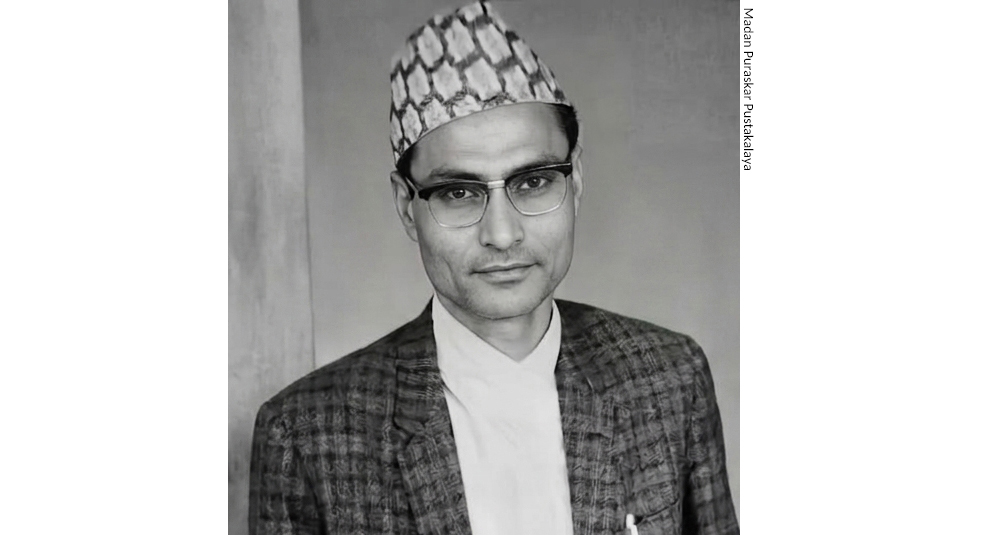
‘Are you returning from the bank?’
‘Yes. I just arrived. Please sit.’
The two of us were in a tiny room inside his small, cute home close to noon. Two more friends were with us, witnesses to our conversation. After settling in, I asked him, ‘So, Lohani-ji, I just can’t understand this thing…’
Interrupting me with a chuckle, he said, ‘What is it? Please go ahead.’
‘What else—I’m quite perplexed by the responses of some of our critics and writers to such progressive, Marxist literature. For example, a few reviewers, about five or six who consider themselves progressive Marxists...but their opinions are constantly clashing; and not only me but perhaps, I imagine, other readers as well, are perplexed—unable to determine who the true progressive Marxists are. One Marxist considers a work to be progressive but the same work is labelled as reactionary by another Marxist critic. What is the criteria for distinguishing between progressive and reactionary? Is progressive literature only that which represents the voices of women and people advocating for farmers, road builders, and the poor oppressed by the wealthy? Or literature that genuinely represents the true aesthetics of daily lives, that can reimagine the future based on the past and the present considered progressive? Another thing—what exactly do we mean by progressive? I feel like I vented a bit.’
‘That’s all right. In short, literature that attacks materialistic perspectives is Marxist and that’s what being progressive is. The other aspect of advancement is that which destroys bad things. When benefic forces claim victory, that’s a symbol of progression or forward momentum; for example, the Ramayana and the Mahabharat are also examples of progressive literature and progressive ideas are not limited only to materialism, but are intrinsically connected to spirituality, psychology, and the pleasure of life.’
‘But Nepal’s Marxist critics maintain that only feminist literature and those that align with the times are progressive and as far as I know, in other socialist nations too, only that kind of literature gets acclaimed. As a result—let’s take Russia for example—the esteemed collection Bitter Harvest was smuggled out of Russia for it to get published. From a Marxist perspective, is this the only way for literature to gain recognition, Lohani-ji?’
‘Definitely not. Lenin himself said one can get transcendental pleasure from so-called bourgeois art and literature and these end up becoming immortal too. But one can’t advance with these; that’s why these might be suitable for upper class intellectuals. For the ordinary public, the construction of so-called contemporary, progressive literature was necessary in a practical sense only in order to get them interested in development work. Lowbrow literature like these will dissipate once the project is complete but highbrow literature will remain immortal. These days, development projects in Russia are mostly complete and because the public is mostly prospering, there is no need for propaganda-based literature. That’s why writers there are working to create and advance intellectual concepts in literature. If they succeed, the intellectualism that stopped with Gorky’s work might resume again.’
‘That means you consider the writings of Ilya Ehrenberg and Sokolov to be propaganda too?’
‘Definitely,’ he responded concretely. ‘Propagandists like them and their books are necessary for every developing nation. But since their shelf-lives tend to be short and these don’t appeal to scholars, it’s quite important to invest in conceptual literary works. So-called Marxist critics from a developing nation like Nepal labelling their propaganda—produced as per their capacity, in order to fulfil their own selfish needs—as highbrow, all the while dismissing scholarly literary work is not so surprising.
‘But then what can I say about Nepal’s critics? They rely on their study of pamphlets to become interpreters of Marxism. And I wonder what their selfish incentive is—they seem to latch on to specific writers and misuse their pens by writing imbalanced reviews. In fact, Nepal’s literary sector is in great need of a proper critic who can provide a basic evaluation of Nepali literature as well as evaluate Marxist perspectives on Nepali literature.’ Lohani-ji’s response was as long and grave as his essays.
‘What is your own opinion about literature, aside from these Marxist angles?’ Leaning against a closet behind me, I asked.
‘I have my own special take; literature is not merely a vehicle for entertainment. Literature deeply impacts society. Humans contemplate other humans; a person’s curiosity is stoked by other people only. And in this way, a society gets analysed. Literature can be a potent tool to advance a society’s material and intellectual aspects.’
‘And Lohani-ji, what do you think of the pace of modern influences in Nepali literature?’ I made a delicate request.
He began by lighting a cigarette, ‘There are three aspects to the modern influences that’s been apparent in Nepali literature. Those are: Marxist, psychological, and experimental. I don’t have any more comments regarding Marxism. But I do want to say something about the psychological and experimental trends. Psychological literature leans heavily towards sexuality in an unhealthy way. As if the purpose of psychological literature is simply arousal. Psychology is not limited to sex. But the writers exploring psychology in literature, without studying and comprehending properly, have limited psychology to sex, in the name of Freud. Even Freud didn’t equate psychology only with sex. But experimental literature has been making a lot of progress. We can find regular usage of novel metaphors, topics, and style; novel analysis, et cetera, when it comes to experimental literature. Shankar Lamichhane successfully advanced these trends.’
‘And what do you consider to be modern literature?’
‘Standards for scientific and general knowledge gradually increase over time. The rate of changes also increases; it’s been quickening lately, compared to the rate about a hundred years ago. Even then, compared to developed Western nations, we are about 200 to 300 years behind. Our writers study the material and intellectual advancements made by developed nations and using that background, compose contemporary novels about their nation and that is what modern literature is.’
‘Lohani-ji, you made a reference to sex just now in the context of psychological novels. Is it a bad thing to include sexuality in literature?’
‘No. I didn’t say that one should not refer to sex at all in literature. Actually, literature is not considered vulgar just based on its reference to sexual issues. But if the intention is limited to simply stoke pleasure or entertainment, then it’s definitely vulgar. For example, some of Kalidas’ work is full of vulgarity. If there’s a tendency to portray someone’s life by bringing up their sexuality, then it’s vulgar. The intention ought to be decent. Because sexual and economic conditions are inseparable from life, it’s not right to claim that literature should not include sex at all. Whenever a reference is made to anything, it should be based on strong philosophical concepts…Ok, Have some cucumber.’
And we began to eat cucumbers.
* * *
Shree Govinda Prasad Lohani! The middle child of poet Dip Keshwar Lohani. He was born on 13 November 1928. When he was a couple of years old, he got separated from his parents and taken to Benaras to live with his maternal family. Lohani-ji returned to Kathmandu at the age of thirteen or so, unable to speak in Nepali. He got enrolled at J.P. High School, and because of his fluency in Hindi, became famous as a marsya.
During this period, he began participating in Buddhi Prakash Pandey’s intellectual gatherings and began listening intently to the discussions, whether he could follow along or not. And then a day arrived when he made this dedication in one of his books, ‘To Buddhi Prakash Pandey, from whom I received introductions to Marxism, literature, global politics, modern psychology, et cetera.’
After completing his schooling, due to a lack of government scholarships, he had to rely once again on his maternal family’s aid and returned to Benaras for higher education. He completed a bachelors in commerce and a few years later, in 1952, he passed the MA in economics.
He had also been getting involved in Nepali politics since 1945. He represented Kathmandu Valley at the general convention of the Nepali Congress in Benaras in 1948. When the Congress split in two, he sided with [Dilli Raman] Regmi-ji for a while but since Lohani-ji was a Marxist, he signed up with the socialist party and remained with them until 1954. By that point, he was facing the reality of running a household, and so he began looking for jobs. But although he had an MA in economics, he wasn’t eligible for a government job because he had supported socialism at one point. He excelled in every written examination conducted by the government but always ‘failed’ the interview.
In the end, compelled to take care of his wife and children, he began teaching at Sitaram High School, with a salary of Rs. 67 per month (due to the school’s fluctuating income, he usually received an amount between 60 and 65). But he didn’t lose hope. He might have lost his right to get a job but he hadn’t lost the right to sit for the Lok Sewa exams. On one hand, he kept preparing for the exams and on the other hand, he began networking.
In the end, with the help of the late Nar Pratap Thapa, he was employed by Nepal Bank as a regular clerk. Soon after that, he scored the highest marks in a Lok Sewa exam related to the post of a Section Officer. He wrote a formal letter to the palace, claiming that just because he had supported socialism at one point, being denied proper employment for the rest of one’s life is unjust. As a result, he passed the interview and became a Section Officer aligned with the Rastra Bank. And so, his job search, which had lasted nearly three years, came to an end.
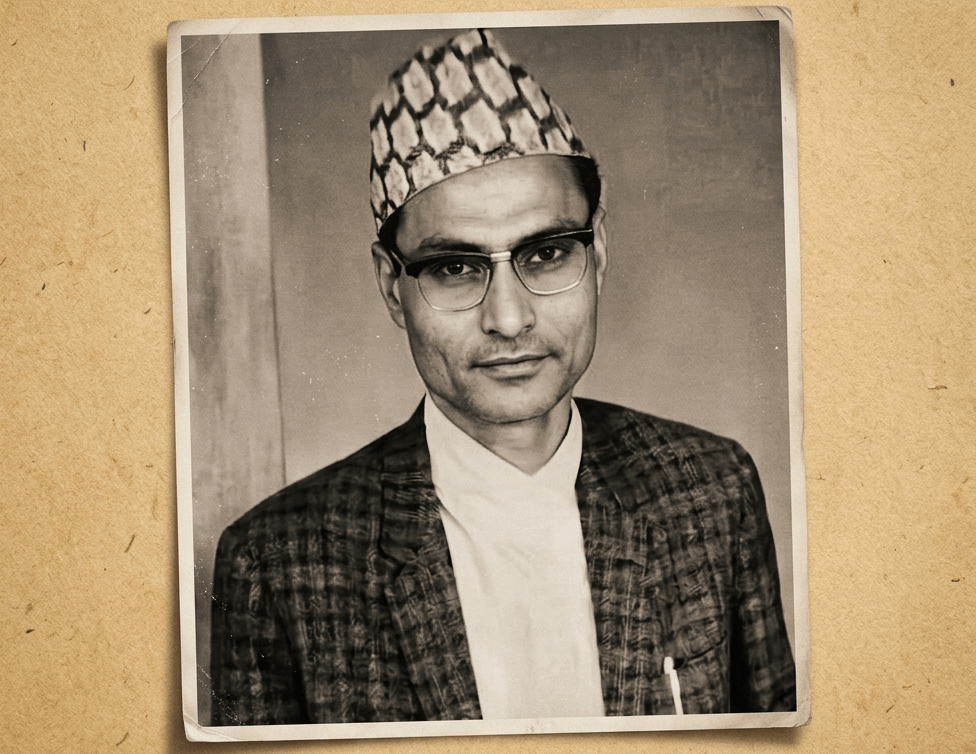
Although everyone faces some kind of struggle in life, it felt that Lohani-ji’s struggle was categorically different. Did he get into literature to fulfil some kind of void because of the financial and social difficulties he faced while pursuing an intellectual life? His neck was bony, fleshless, and his thick nose, large forehead, and eyes that were once bright were spread out across his similarly fleshless face. Govinda Lohani-ji, whose body was thin and singular, had written an article titled ‘Proteinko Samasya’ and then ‘Chikitsako Naya Siddhanta’, published in Gorkhapatra in 1947. After Yugbani began circulating in Banaras, his literary articles as well as those related to economics began getting published. Why did he get into Nepali literature, I asked him. Was it merely to ‘introduce progressive ideas and put an end to traditional mindsets’? Or was there any other reason?
He responded, ‘Literature is always meant for society; that’s why writers get involved in social development. In that vein, writers begin writing hoping that their ideas become influential and they get some recognition. These sentiments are applicable to me as well. Another thing—to say ‘art for art’s sake’ is somewhat pointless. Writers want people to read and appreciate their creations. To say ‘for art’s sake’, or ‘this is pure service only’ in a completely selfless way—what can be more ridiculous than this?’ He then began laughing and we joined him.
He does have a grievance: ‘But then, I’m not really a litterateur; I’m an economist. Even though the government hasn’t accepted me as an economist.’
Despite his complaint, Lohani-ji is well-recognised in the literary field for his essays. His topics range from philosophy, literature, and art to profiles, and general and scientific knowledge; and we have found exceptional instances of concrete ideas, high standards, sharp criticism, and intellectual rigour. He had also written short stories around 1952 but wasn’t able to succeed, which he himself maintains: ‘Apart from “Jiwit Laash”, other stories aren’t good. Because I’ve already concluded that I’m not a short story writer, I only write essays. Alongside, I’m also writing a travelogue about Europe and South-East Asia (He had travelled to Australia, Vienna and South-East Asia as a representative of Rastra Bank for training and conferences.) I have already written about 135 essays and will continue writing.’
‘Oho! Out of all these essays, which ones are your best?’
‘I like the ones related to literature, philosophy, realism and those based on cultural traditions. Along with those, I like some new essays too.’
Shree Govinda Lohani-ji’s research is not limited to one discipline. HIs studies have extended from entertainment efforts to Italian nationalism; from Russel’s philosophy to progressive literature. He is an independent thinker inspired by Marxist ideas.
Speaking of research and studies, ‘In the context of your expansive interests, you must have some favourite writers as well. Can we have some insights regarding that?’ I asked him.
Saying ‘Sure, I will’, Lohani-ji began, ‘Yashpal, Rahul Sankrityayan, works by Rangeya Raghav; Bertrand Russell’s essays; Aldous Huxley and his takes on the current state of the world, as well as the future; Sartre’s extraordinary philosophy, which I still haven’t managed to fully comprehend; Lenin and Mao’s analytical writings; Gorky and Dostoevsky; and novels by Turgenev, et cetera. As for national writers and their creations, Balkrishna Sama’s philosophical elements, his plays filled with deep introspections and other works; poems by Devkota and Gopal Prasad Rimal; and Bisheshwar Prasad Koirala’s stories. As for contemporary ones, Shankar Koirala, the Malla brothers (Gobinda and Bijay), Ramesh Bikal, stories by Poshan Prasad and Madan Mani; based on subject matter, Hriday Chandra Singh’s Swasnimaanchhe and Mohan Koirala; poems by Shashi, Bhupi, Kali Prasad Rijal, Dwarika Shrestha, and Krishnabhakta might not have achieved maturity but I like their experimental styles. That was a rather long response…’
‘I came to listen,’ I smiled.
He had also founded a secret group during his schooldays. Later, around 1950, he established a network of progressive publishers. He was also involved in the management and operations of Jana Sahitya and Jana Bikas; and these days, as part of the Academy, he is the point person for Kathmandu related to a network of Nepali writers.
‘What are your thoughts regarding the Academy, Lohani-ji?’
‘As a friend recently said, the Academy functions as an authoritarian animal shelter where old cows are put on leash. There is an appreciation for writers but the Academy’s function should not be limited to that; besides, the respect should be mutual. The current Academicians have been appointed; as for their function, it would be more impactful if the youth could be mobilised instead of just providing membership to them.’
‘What about the Madan Puraskar prize?’
‘Madan Puraskar has done excellent work and encouraged a lot of writers. It would’ve been so good if other Rana-jis had acted in a similar manner.’
‘So Lohani-ji, despite this long conversation, I almost forgot to ask about your writing habits.’
‘That’s all right. I write in a few different ways. If I get an order from the radio or Gorkhapatra, I forcefully get the job done at any hour. I’m more careful about writing down my own thoughts. Regarding time, mostly in the morning. If I write late in the evening, I can’t sleep all night.’
‘Aren’t you planning to publish your essays in an anthology?’
‘Yes. Some anthologies with my essays are coming out and the Academy also said they’d publish some. And I’m planning to publish separate anthologies of my economic essays (about thirty), literary essays (about thirty) and philosophical essays (about ten).’
Hanging on a wall of that small room were posters of Marx, Engels, Gandhi, and the royal couple. Against a wall was a bed and next to it was a mattress on the floor; a pile of books on a low table next to the pillow. We were sitting on cushions on the opposite side. There was a closet behind me and in a corner were two chairs occupied by our observers. We were offered another round of milky bread and tea. We began eating as the conversation progressed, ‘What’s your take on our future and the future of Nepali literature, Lohani-ji?’
‘Literature’s reach has been expanding due to the expansion of education. The future looks rather bright because of the new styles and output of new writers. If a couple more writers like Shankar Lamichhane appear in the literary sector, we might get international recognition within a few years. Our literary future looks bright also because of the partial support from the government, sympathy, and support from the poet King and due to general public awareness. But the publication process is still laborious. It would be wonderful if the Nepal Bhasa Prakashini received a capital worth a few lakh rupees. Printing remains an obstacle. But the quality of writing has greatly improved. For the sake of a comparative study—Kashmir became free two or three years before Nepal; literary awareness also started then. But compared to Kashmiri literature, Nepali literature has made more progress within a shorter time.’
Lohani-ji, who is intellectually gifted, has also become a victim of oppression. Superiors associated with him at work have been taking credit for ideas that belong to him. His suggestions to the Agricultural Development Bank regarding the control of the Indian rupee were implemented but his contributions were not recognised. He has become inured to being dominated and excluded. In this way, scholars rely on Govinda Prasad Lohani-ji’s essays sparked by his introspective studies while high profile officers rely on his personality and his bureaucratic work.
—7 September 1963
Govinda Prasad Lohani (1927–2020) was an economist and an author of more than 20 books. He also served as Nepal’s ambassador to Pakistan, Iran, and Turkey during the Panchayat era.

