
Nepal is experiencing a peculiar kind of intellectual boom. Buddhijibi or public intellectuals are spread all over—across television channels, YouTube podcasts, radio shows, and news portals—offering commentary across subjects ranging from federalism to foreign policy. As such, on the surface, Nepal's academic ecosystem appears vibrant and alive. Yet, beneath the noise of expert panels and invited lectures lies a world of falsified scholarship, manufactured credentials, intellectual capture by political patronage, and a systemic corruption of the very institutions mandated to produce knowledge for the public good.
A paper trail of misconduct
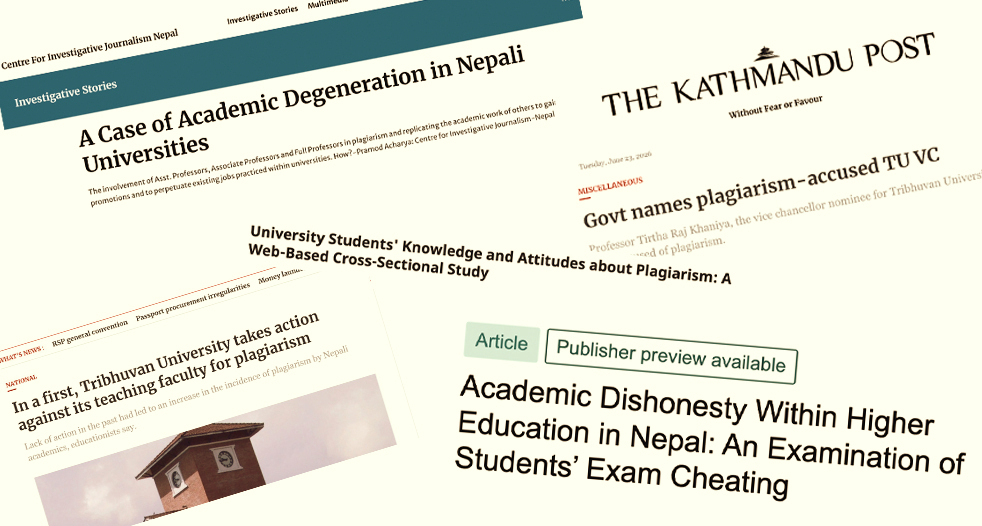
The Centre for Investigative Journalism Nepal (CIJ) findings reveal how assistant professors, associate professors, and full professors have engaged in plagiarism specifically to gain academic promotions and to perpetuate existing jobs within universities. The University Grants Commission (UGC) charged a department head with a serious allegation of plagiarism, blacklisting him from applying for UGC funds. At the same university, another professor was found to have copied entire paragraphs from a Nobel Prize press release without any citation in a 2011 bulletin. Another documented case involves a professor’s book on human resource management that reproduces large sections of other works with minimal or no citations.
Perhaps the most symbolically damaging case is that of TU's Vice Chancellor himself. Professor Tirtha Raj Khaniya, while heading the English Education Department at TU in 2006, had lifted a section of an article and copied it into his own work published in the Nepal English Language Teachers' Association (NELTA) journal. Khaniya was subsequently appointed Vice Chancellor regardless. Nepali educators including researchers, professors, and doctoral students were penalised for detected plagiarism, as documented in a 2026 Oxford Academic study on drivers of research misconduct in Nepal. Another study found that while most university students in Nepal had heard of plagiarism, more than half lacked a full understanding of its consequences or institutional responses.
Publish to be promoted: predatory journals and citation fraud
To understand why plagiarism persists, one must understand the incentive structure that drives it. In Nepal's public university system, promotion from lecturer to assistant professor, to associate professor, to full professor is tied substantially to the number of publications one can claim. This creates an almost rational case for shortcuts. Predatory publishing remains prevalent, particularly in places where academic success is measured by the quantity rather than the quality of publication output.
Compounding this is a malpractice of hiding academic ethical violations by secretly adding others' articles to one's own Google Scholar account to inflate scores; getting name-matched authors to cite each other's articles; having journals or articles one edits cite one's own work unnecessarily; dumping unnecessary citations in reference lists and grey literature; and artificially inflating citation numbers, h-index, and i10-index. Researchers have documented at the country level how geographic clustering of retractions and fraudulent behaviour suggests that localised academic pressures and incentive structures amplify susceptibility to misconduct. Furthermore, wilfully submitting to predatory journals where rapid publication requires little or no peer review has itself been identified as a covert form of research misconduct, one that floods the scientific literature with unsound research and can mislead policymakers and the public alike.
The Tribhuvan University Service Commission, the body responsible for academic promotions operates in an environment where political party affiliations among faculty, administrators, and students often compromise academic standards through partisan favouritism. In such a context, a faculty member with political proximity and accumulated publications, regardless of their merit, is far better positioned for promotion than one who produces rigorous, original, but institutionally ‘unrewarded’ research.
The political economy of the intellectual
Academic credentials in Nepal are not merely a pathway to promotion within universities. Beyond that, they are a currency traded in the political marketplace for ambassadorial posts, senior advisory roles, National Planning Commission posts, and membership of Eminent Persons Groups. Nepal's ambassador appointment system has long formalised the conversion of academic and political capital into diplomatic positions. The tradition of splitting ambassadorial appointments between career diplomats and political nominees has meant that those with ‘excellent academic record and capability to represent the country’ can be appointed as ambassadors, a criterion that, in practice, provides a formal pathway for academics with political connections to secure lucrative postings abroad. Political appointments tend to sideline career officials, and ambassadors appointed through political affiliation automatically become insecure the moment their political masters go out of power. They are either recalled or they resign, reflecting domestic political shifts.
This political embedding of the academic class is not incidental but structural. As Prof. Alok K. Bohara argues, Nepal's civil society failed to help guide the country into a stable democratic middle corridor. Many academics became shareholders in the expanding NGO industry, aligning their energies and loyalties with politicians and donor networks. Government funds began flowing through political channels into NGOs, bypassing universities and research centres, and professors had to join political tribes just to stay connected.
The National Planning Commission represents the apex of this dynamic. Political influences in appointments have been noted, with members often retaining positions across government transitions, potentially affecting continuity but also introducing partisan elements in planning processes. Appointments to the NPC rotate with governments, with TU professors cycling in and out alongside cabinet reshuffles: the Cabinet appointed the head of the Central Department of Economics of Tribhuvan University as NPC vice-chairman in one such rotation, and subsequent appointments have continued the pattern of drawing academics into senior advisory roles through political selection rather than open competition.
Going back in time
In 1970, scholar and linguist Kamal P. Malla argued that Nepali scholarship had always been derivative in nature. More pointedly, he identified the economic dependence of Nepal's intelligentsia on the state as the source of their intellectual submission, invoking Julian Benda's La Trahison des Clercs, the betrayal of the intellectuals, to describe a class that had abandoned its primary social function as critic and evaluator in exchange for the security of establishment patronage. The ultimate ambition of the Nepali elite, Malla observed, was the short-cut recognition through ‘ambassadorship, Ministership, Secretaryship’. The intellectual credibility deployed in the service of power, and the critical independence traded for institutional reward, remain intact even five decades later, and in some ways, have rather deepened.
In a similar vein, Dipak Gyawali discusses Nepali buddhijibi as largely a performative figure whose authority rests on visibility and rhetoric rather than sustained, rigorous intellectual work. Shyam Prasad Mainali reiterates that Nepal’s intellectual class has failed to meaningfully shape public discourse or policy because it remains fragmented, reactive, and insufficiently grounded in critical, independent thinking.
At present, the buddhijibi in Nepal's public sphere has come to mean someone with a university title and media presence, not necessarily someone producing rigorous original knowledge. The current landscape that many Nepali intellectuals occupy appears increasingly critical but less analytical, and public discourse is beginning to resemble political performance rather than civic clarification. Prof. Bohara describes the resulting vacuum as the ‘discourse enterprise’—not think tanks themselves, but a wider community of intellectuals and commentators who have replaced deep research and reflective analysis with popular outrage.
The student whose work disappears
Amid the career manoeuvrings of the academicians, it is students who bear the heaviest costs. Nepal's graduate thesis defense culture is symptomatic of the larger dysfunction. The process is heavily focused on formatting compliance, citation style, and procedural adherence rather than on intellectual engagement with the substance of the research. Critical feedback, where it exists, tends to address form rather than thought. Students graduate having learned to satisfy a compliance checklist, not to think rigorously.
Another major concern is the appropriation of student research by senior academics claiming authorship credit disproportionate to their actual intellectual contribution. Studies on honorary and ghost authorship in high-impact research journals have found systematic instances of senior researchers claiming authorship with minimal contribution, and questionable authorship practices have been flagged repeatedly by researchers examining the country's publication ethics.
The result is a generation of graduate students who relate to their supervisors not as intellectual mentors but as bureaucratic gatekeepers, people to be managed and appeased, not engaged with. In addition, academic conferences, as and when organised, fail to provide adequate space for intellectual engagement particularly for students and young researchers. Conferences now have become a carefully choreographed display of hierarchy with lamp-lighting (commonly the ‘panas ma batti baalne’ ritual), elongated introductions, and a procession of dignitaries delivering generic remarks that rarely engage with the subject itself. This performative ceremonialism leads to compressed presentation sessions and rushed Q&A, the very core of scholarly debate.
Time for reform
Academic professionals face pressures to publish, secure promotions, manage heavy teaching loads, and navigate politically influenced administrative systems, all without adequate professional development or institutional support. Acknowledging these structural pressures is not the same as excusing the misconduct they generate.
Promotion criteria must be restructured to reward quality over quantity, with mandatory peer review requirements that distinguish genuine journals from pay-to-publish operations. The UGC can develop enforcement mechanisms for academic integrity violations that withstand legal challenge and operate on reasonable timelines. Authorship contribution statements must become compulsory on all co-authored work, with building capacity for research ethics treated as an institutional priority rather than an afterthought.
The political revolving door between academia and appointments to the NPC, to ambassadorial postings, and to senior advisory roles must be subject to greater transparency. The recent move by Nepal's foreign ministry to open ambassadorial positions to open competition, with academic publications and research work in areas relevant to Nepal's foreign policy listed as an added advantage, is a step in the right direction but only if the process is genuinely meritocratic and insulated from the party machine that has historically determined these appointments. Thesis supervision also must be reformed. Students deserve supervisors who are mentors, not gatekeepers, people accountable for the intellectual development of those in their charge, not those who just extract publishable outputs from them.
Amidst this gloom, there are green shoots worth acknowledging. A new generation of academic programmes is beginning to challenge the orthodoxy of Nepal's traditional university curriculum. The Master's in Social Innovation & Entrepreneurship, MBA in Nonprofit, MBA in Agribusiness, and Master of Public Policy and Management are courses that blend economics, sociology, environment, international relations, and development management into a single interdisciplinary degree explicitly aimed at producing development practitioners, policy analysts, and researchers. The stance of the current political leadership not to entertain aspirant buddhijibis canvassing for political and diplomatic positions also indicates merit-based appointments, which is a welcome move.
Nepal's knowledge institutions have the potential to anchor democratic accountability, inform evidence-based policy, and cultivate a generation of original thinkers. That potential is untapped at the moment, not through lack of talent, but through a system that has made shortcuts rational, co-option rewarding, and integrity costly. It is, therefore, high time that the sector goes through a process of review and introspection for systemic reform.
Sudeep Uprety is a Kathmandu-based researcher and development practitioner. He is currently pursuing his PhD in Sustainable Energy Management from Prince of Songkla University, Thailand. ...
Sudeep Uprety is a Kathmandu-based researcher and development practitioner. He is currently pursuing his PhD in Sustainable Energy Management from Prince of Songkla University, Thailand. He has academic publications on climate change and sustainable development, international relations, public health, media, urban governance, among others, to his credit.